 SkyFlux
JPL at 90: From a Riverbed Rocket Test to Voyager and Mars
Published · Updated
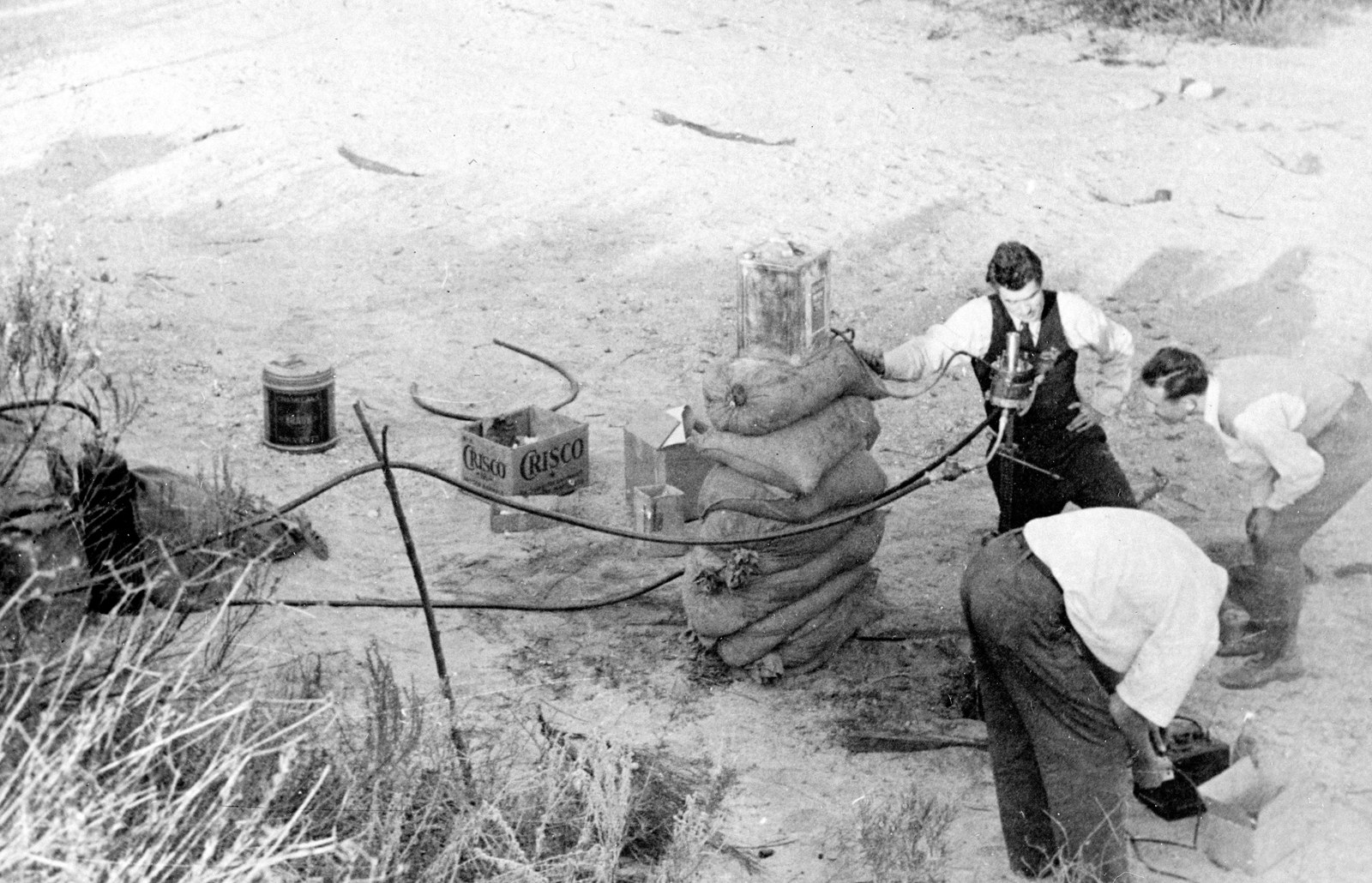
On Oct. 31, 1936, a group of Caltech students and two Pasadena rocket enthusiasts lit a small rocket motor in the Arroyo Seco, a dry riverbed north of the Rose Bowl. NASA's Jet Propulsion Laboratory (JPL) dates its founding to that day.
Four tries on Halloween
The group grew up around Frank Malina, a graduate student at GALCIT, the Caltech aeronautics laboratory that Theodore von Kármán directed. Jack Parsons, a self-taught explosives expert, and Ed Forman, a skilled mechanic, built rockets of their own; the three were the core of what Caltech would later nickname the Suicide Squad. Von Kármán insisted that they measure how a motor performed instead of just launching rockets, so they built an instrumented test motor, much of it from junkyard parts, that burned methyl alcohol with oxygen.
They went to the Arroyo Seco because Caltech did not want fires and explosions on campus. Three times the powder fuse blew out before it could light the motor. On the fourth try the motor ignited, and so did the oxygen hose, which whipped across the ground in flames as the team ran. Sandbags shielded the team; no one was hurt. JPL's account says the motor ran about three seconds; no thrust was recorded. With a spark plug in place of the fuse, the team got its first thrust measurements on Nov. 15.
From Army rockets to a NASA lab
In 1939 the work found a customer: at the request of the chief of the Army Air Corps, a National Academy of Sciences committee funded work on rockets to help planes take off from short runways. In 1943, in a proposal to the Army for a U.S. answer to Germany's V-2 missile, the team first called itself the Jet Propulsion Laboratory.
So when did JPL begin? In 1936 there was no laboratory and no name, only a student project. The name first appeared in 1943 and became official in June 1944, when the Army's Ordnance Department took over the funding. JPL dates itself from the first test.
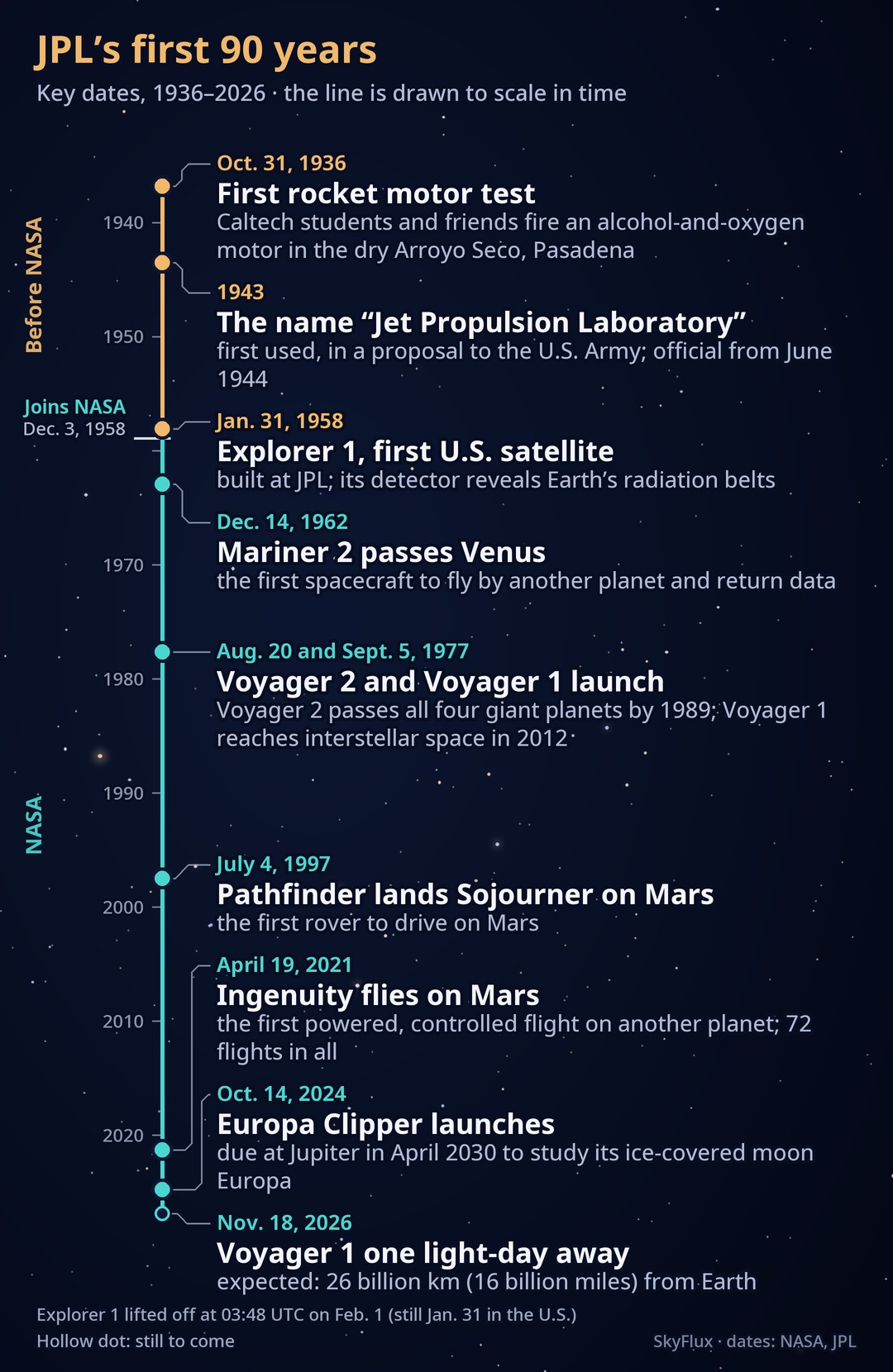
On Jan. 31, 1958 (already Feb. 1 in UTC), an Army Jupiter-C rocket launched Explorer 1, the first U.S. satellite, which JPL designed, built and operated. Its cosmic-ray detector, from James Van Allen, counted fewer particles than expected. Van Allen read that as a sign the instrument was swamped by trapped radiation; a satellite launched two months later confirmed the belts now named after him. On Dec. 3, 1958, JPL moved from the Army to the new civilian agency NASA. Caltech still runs it for NASA.
A lab that goes first
Mariner 2 flew past Venus on Dec. 14, 1962, the first spacecraft to fly by another planet and send back data. Voyager 2, launched in August 1977, became the first probe to visit all four giant planets; its planetary tour ended at Neptune in 1989. On Aug. 25, 2012, its twin Voyager 1 became the first spacecraft to leave the heliosphere, the bubble the solar wind inflates around the Sun and its planets.
Mars Pathfinder touched down July 4, 1997, and released Sojourner, the first rover to drive on Mars. In 2021 the Ingenuity helicopter made the first powered, controlled flight on another planet and flew 72 times in all. Europa Clipper, launched Oct. 14, 2024, is due at Jupiter in April 2030 to study Europa, a moon thought to hide a salty ocean under its ice.
What comes next
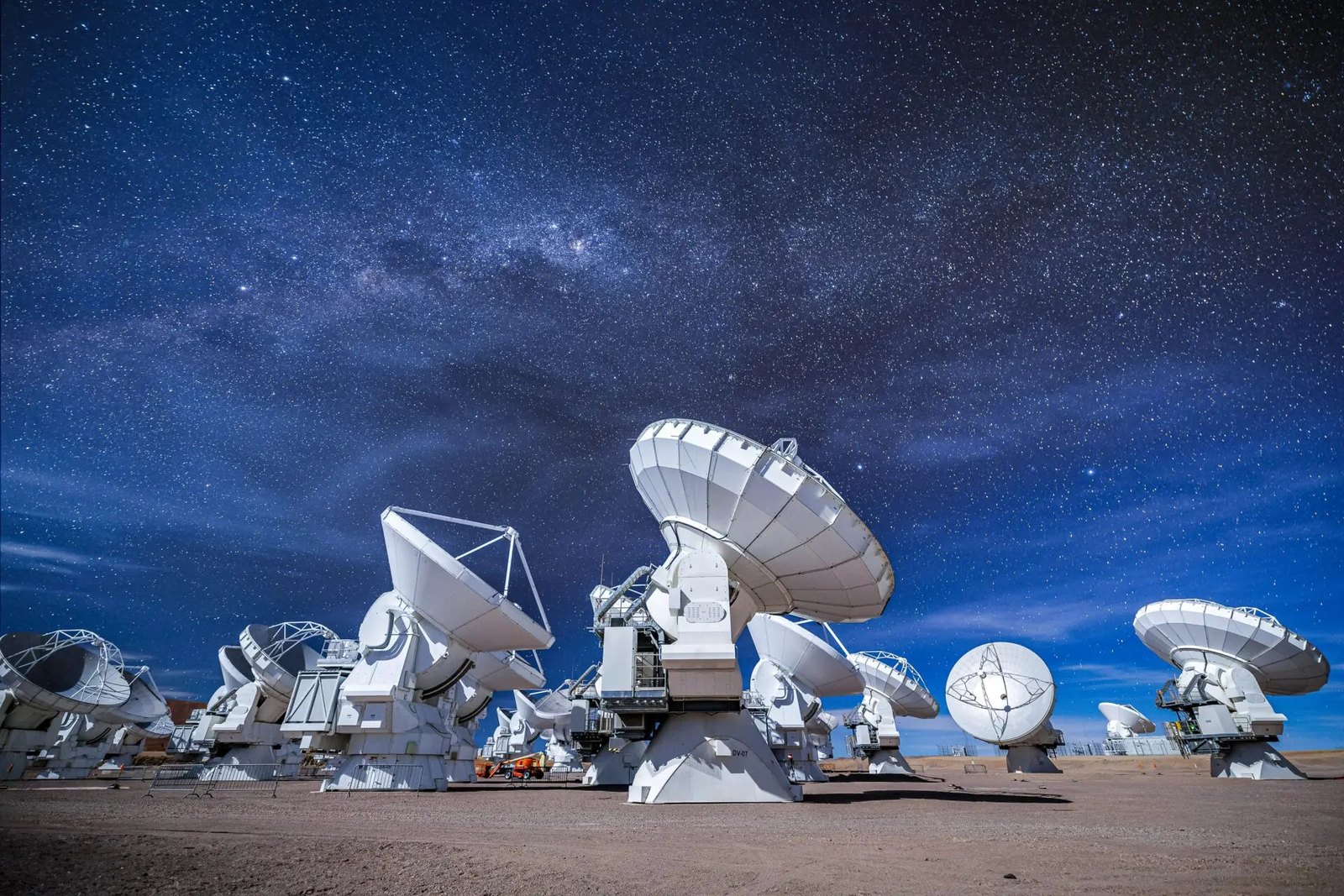
On Nov. 18, 2026, Voyager 1 is expected to reach one light-day from Earth, about 16 billion miles (26 billion kilometers): a command sent that day takes 24 hours to arrive. No optical telescope can see the spacecraft; the only link is through the large antennas of NASA's Deep Space Network, which JPL began building in 1958 and formally set up in 1963.
Next for JPL: SkyFall, aiming to launch in 2028 and drop three helicopters during descent to Mars to map buried ice; MoonFall, rocket-powered drones to land near the Moon's south pole; SunRISE, six small satellites set to launch in 2027 and fly in formation as one radio antenna to study the Sun; and NEO Surveyor, an asteroid-hunting space telescope.
The anniversary comes at a hard time: after two rounds of layoffs in 2024, JPL cut about 550 more jobs in October 2025, citing budget pressures.
Sources and licences
- NASA, NASA JPL Looks to Next 90 Years of Innovation, Exploration (Oct. 21, 2026) — Used for the Oct. 31, 1936 start in the Arroyo Seco, Caltech managing JPL for NASA, Explorer 1 in 1958 and joining NASA the same year, the first visits to all four giant planets, the first rovers to roll on Mars, Voyager 1 reaching a light-day on Nov. 18 (16 billion miles, 26 billion km), and SkyFall, MoonFall, SunRISE and NEO Surveyor. https://www.nasa.gov/centers-and-facilities/jpl/nasa-jpl-looks-to-next-90-years-of-innovation-exploration/
- JPL, History — Used for the founding group, the 1943 proposal in which the name first appears, the Army Ordnance Department funding, Explorer 1 with the Army Ballistic Missile Agency, the move to NASA on Dec. 3, 1958, and Mariner 2 as the first spacecraft to fly by another planet and return data. https://www.jpl.nasa.gov/who-we-are/history/
- Erik M. Conway (JPL historian), From Rockets to Spacecraft, Caltech Engineering & Science no. 4, 2007 — Used for the Suicide Squad nickname, Parsons and Forman, von Kármán's insistence on measurements, the junkyard rig, why the tests left campus, the three failed fuses and the burning oxygen hose, no thrust data on the first day, the spark plug and first thrust data on Nov. 15, the 1939 take-off rocket funding requested by the Army Air Corps chief through the National Academy of Sciences, and the name becoming official in June 1944. https://calteches.library.caltech.edu/702/2/Spacecraft.pdf
- JPL, The Spark of a New Era (updated 2017 from a 2011 story) — Used for the first test in the Arroyo Seco, the alcohol and oxygen propellants fed from pressurized bottles, and the motor running about three seconds. https://www.jpl.nasa.gov/news/the-spark-of-a-new-era/
- JPL, Slice of History: The First Rocket Motor Firing (Jan. 30, 2026) — Used for the hero photograph and its description of the test site. Credit NASA/JPL-Caltech. https://www.jpl.nasa.gov/images/slice-of-history-the-first-rocket-motor-firing/
- NASA and JPL mission pages: Explorer 1, Mariner 2, Voyager 1, Voyager 2, Mars Pathfinder, Ingenuity, Europa Clipper — Used for the launch, flyby, landing and flight dates, the Explorer 1 launch time and how its detector found the radiation belts, Voyager 1 leaving the heliosphere on Aug. 25, 2012, Ingenuity's 72 flights, and that radio telescopes (not optical ones) have detected Voyager 1's signal (PIA17047). https://www.jpl.nasa.gov/missions/explorer-1/ https://www.jpl.nasa.gov/images/pia17047-voyager-signal-spotted-by-earth-radio-telescopes/ https://science.nasa.gov/mission/explorer-1/ https://science.nasa.gov/mission/mariner-2/ https://science.nasa.gov/mission/voyager/voyager-1/ https://science.nasa.gov/mission/voyager/voyager-2/ https://science.nasa.gov/mission/mars-pathfinder/ https://science.nasa.gov/mission/mars-2020-perseverance/ingenuity-mars-helicopter/ https://science.nasa.gov/mission/europa-clipper/
- Caltech, campus announcement on JPL layoffs (Oct. 14, 2025); NBC Los Angeles (Feb. 6, 2024); ABC7 (Nov. 13, 2024) — Used for the roughly 550 layoffs in October 2025 and the budget reason (Caltech), and for the two 2024 rounds: 530 employees in February (NBC LA) and about 325 in November, from Director Laurie Leshin's memo (ABC7). https://hr.caltech.edu/campus-announcements/78146 https://www.nbclosangeles.com/news/local/jpl-plans-to-lay-off-hundreds-of-employees-due-to-lack-of-funding/3332447/ https://abc7.com/post/jpl-pasadena-lay-off-325-employees-5-workforce-amid-budget-cuts/15542972/
- Physics Today, The Deep Space Network at 50 (December 2014) — Used for the Deep Space Network's start: a JPL antenna at Goldstone handed to NASA in 1958, and the network formally established by JPL director William Pickering on Dec. 24, 1963. https://physicstoday.aip.org/features/the-deep-space-network-at-50