 SkyFlux
MACS J0454.1-0300: Webb Image of the Golden Galaxy Cluster and Its Lensed Arcs
Published · Updated
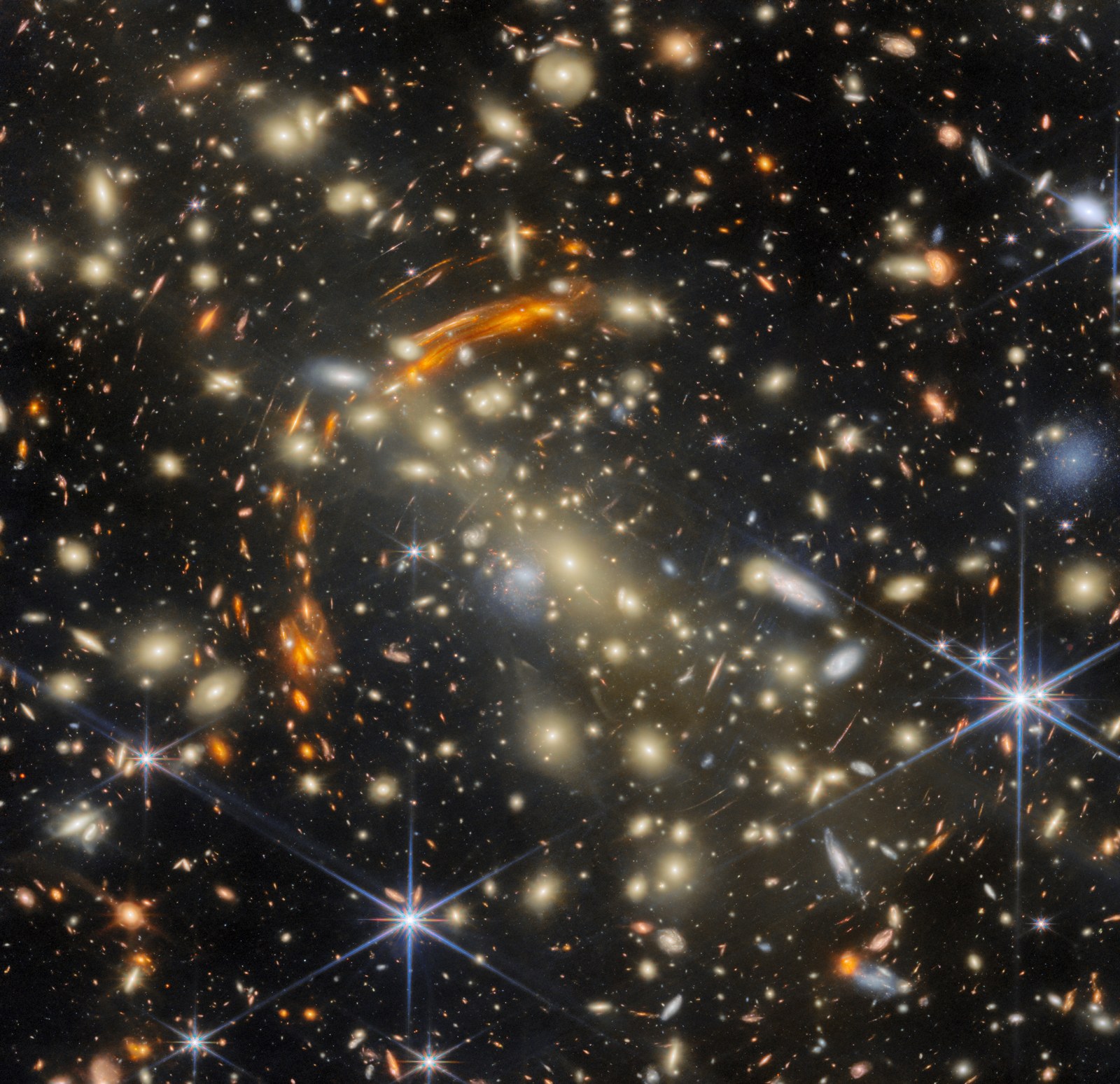
Webb's Picture of the Month for September 2026 shows MACS J0454.1-0300, a galaxy cluster in Orion. Its gravity bends and magnifies the light of far more distant galaxies behind it, and small bright knots in them appear magnified over 300 times in some cases.
The golden cluster and the stretched orange arcs
The golden galaxies scattered across the image belong to MACS J0454.1-0300. We see the cluster as it was when the Universe was about 8 billion years old, so its light has travelled for a little under 6 billion years. That is our own calculation (13.8 minus 8 is 5.8), not an ESA figure. The golden ones are elliptical galaxies, with the single largest and brightest one at the centre.
The golden tint has a physical reason, though the colours are assigned. Elliptical galaxies hold little gas for making new stars, so their light comes mostly from old, cool stars, which give off more light at longer wavelengths. The image uses ten bands from 0.9 to 4.4 micrometres, nearly all infrared, with the longer ones shown redder, so such galaxies come out golden.
The orange arcs on the left are not cluster members. They are much more distant galaxies, and the cluster's gravity has stretched their shapes into arcs. The expansion of space has also stretched their light to redder wavelengths. Webb is far more sensitive than Hubble to such light, which is why it shows hundreds of galaxies that a 2014 Hubble image of the same cluster lacks.
How a cluster magnifies, and where the 300 times comes from
A cluster is a very large mass, and mass bends the path of light. When the alignment is close enough, light from a background galaxy can reach us along several bent paths. The result is arcs and, sometimes, multiple images of one object. Four or more images of one galaxy need a precise alignment, which ESA/Webb says occurs in only 10–20% of clusters.
Lensing does not make any patch of the source brighter, but it stretches the source over a larger area of sky; the magnification is the image's area divided by the source's area, so an image with 300 times the area collects 300 times the light. Magnification peaks near lines on the sky called critical curves. For an idealised point source the theory gives unlimited magnification there; a real source has a finite size, so its magnification stays finite, and the smaller the source, the higher it can climb. That is why the largest figures belong to small knots, not whole galaxies.
The figure of 300 comes from small bright knots within the lensed background galaxies, as small as 5 light-years across, which in some cases appear magnified by more than 300 times. The lens lets Webb study objects too faint for its 6.5-metre mirror to detect on its own.
What this field shows, and what comes next
The field holds multiple images of young-Universe galaxies: a group seen 2 billion years after the Big Bang, and a single galaxy only 800 million years after it. The group appears to be merging, which seems to have triggered a large burst of star formation. Researchers found this rare arrangement twice in MACS J0454.1-0300, the first time it has been seen more than once in the same cluster.
Two Webb programmes supplied the data. One, led by L. Furtak (programme 5058), searches for individual lensed stars in the Universe's first billion years. It will monitor one lensed galaxy here for hugely magnified single stars; that is still ahead, and the release reports no results. The other, led by S. Fujimoto (programme 6882), aims to observe a large sample of galaxy clusters at many wavelengths to study how star formation began in early galaxies.
Where it is, and what you can see yourself
The cluster lies in Orion at right ascension 4h 54m and declination −3° (the sky's longitude and latitude), just south of the celestial equator, so it can be seen from both hemispheres. From the latitude of London it climbs to about 35° above the southern horizon at best. In early December it lies opposite the Sun in the sky, so it is highest around midnight.
Seeing it yourself is another matter. The SIMBAD database lists the brightest cluster galaxy at magnitude 18.1 in the near-infrared I band, and no cluster galaxy has a listed visual (V) magnitude brighter than 19. Galaxies that faint are beyond what the eye can see through amateur telescopes: by a common rule of thumb a 40-centimetre telescope reaches about magnitude 15, and magnitude 19 is about 40 times fainter. The lensed arcs come from Webb's infrared sensitivity, not from anything an eyepiece will show.
Sources and licences
- ESA/Webb Picture of the Month potm2609a (29 September 2026), Galaxies in a cosmic house of mirrors — Used for the cluster's name, constellation and coordinates (RA 4h 54m 11.04s, Dec −3° 0′ 51.75″), the field of view and orientation, the cluster's age in the image, the 10–20% figure, the two rare configurations, the 2-billion-year group and 800-million-year galaxy, the knots as small as 5 light-years magnified over 300 times in some cases, the Hubble 2014 comparison, programmes 5058 and 6882, the image description, band list, credit and licence. https://esawebb.org/images/potm2609a/
- ESA/Webb Usage of Images, Videos and Webb Texts — Used for the licence: images are released under Creative Commons Attribution 4.0 International, the credit line must stay unaltered, and resizing or cropping may be noted. https://esawebb.org/copyright/
- ESA/Webb word bank, Gravitational lensing — Used for the statement that lensing distorts and magnifies distant objects, which lets Webb study objects beyond the sensitivity of its 6.5-metre primary mirror. https://esawebb.org/wordbank/gravitational-lensing/
- Wikipedia, Gravitational lensing formalism — Used for the explanation of magnification: lensing keeps surface brightness the same but changes the apparent size of the source on the sky, magnification is the ratio of image area to source area, and critical curves are lines of infinite magnification in the idealised case. https://en.wikipedia.org/wiki/Gravitational_lensing_formalism
- Wikipedia, Elliptical galaxy — Used for why elliptical galaxies look reddish: they have little gas and dust, little star formation and old stars. https://en.wikipedia.org/wiki/Elliptical_galaxy
- Universe Today, Webb Captures This Golden Galaxy Cluster in All it's Glory (19 October 2026) — A secondary report that prompted this story. We checked its figures against the ESA/Webb page, which makes clear that the 300-fold magnification applies only to small knots, not to the galaxies as a whole. https://www.universetoday.com/articles/webb-captures-the-golden-galaxy-cluster-in-all-its-glory
- SIMBAD astronomical database, entries matching MACS J0454 — Used for the galaxy magnitudes: a query on 21 October 2026 within 2 arcminutes of the ESA position found the brightest cluster galaxy CNOC MS 0451 101234 at I = 18.1 (no V listed), the brightest V entry [KZP2008] F5 at V = 19.05, and the cluster ClG 0451-03 (= MACS J0454.1-0300) at redshift 0.54. https://simbad.cds.unistra.fr/