SkyFlux
Space jellyfish over Florida: why the CRS-35 launch glowed before dawn
Published · Updated
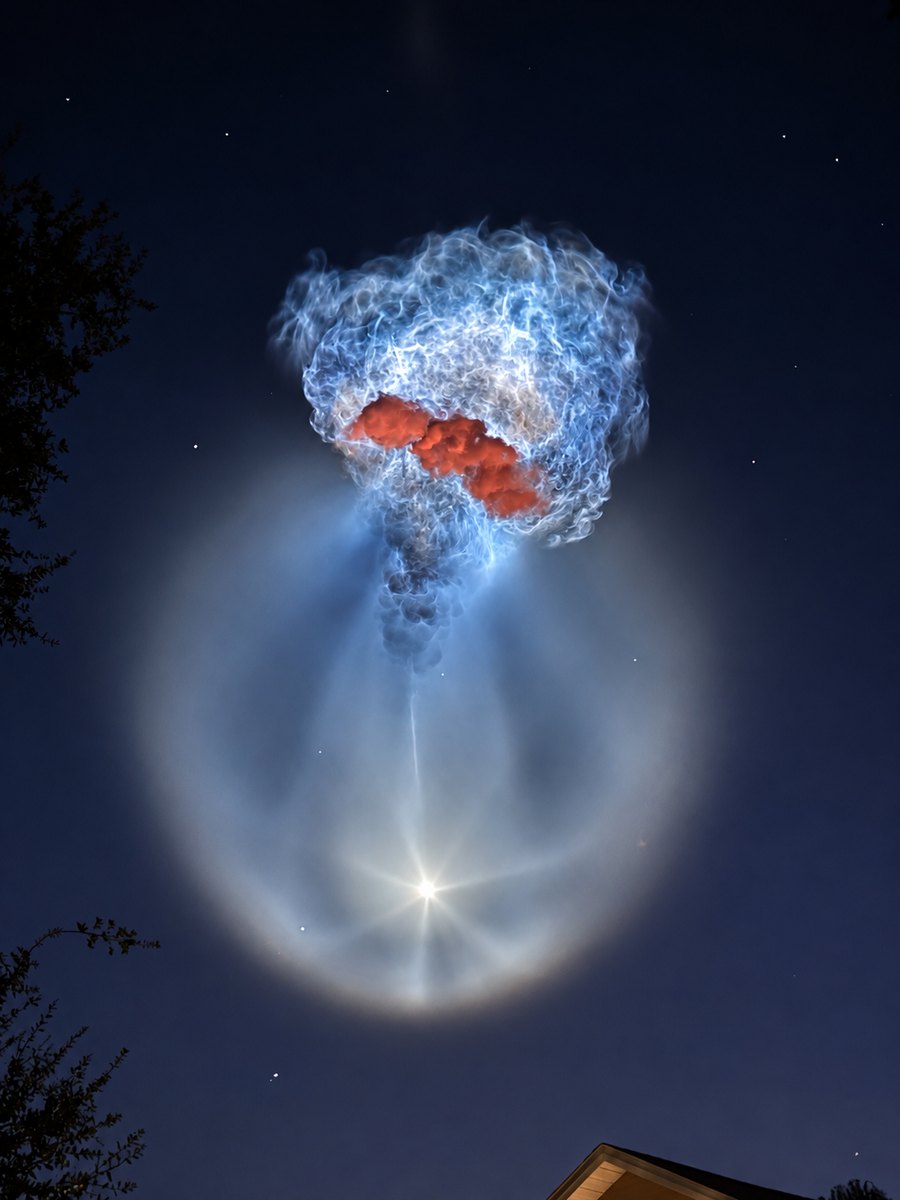
On 13 October at 10:33 UTC, about 50 minutes before sunrise, a Falcon 9 lifted off from Florida with cargo for the International Space Station. The ground was still dark, but as the rocket climbed, its exhaust rose into sunlight and spread across the sky as a glowing "space jellyfish".
A glowing cloud in a dark sky
CRS-35, SpaceX's 35th cargo mission for NASA, launched from Space Launch Complex 40 at Cape Canaveral on Tuesday, 13 October 2026. At the pad, the Sun was still about 11.5° below the horizon; sunrise was roughly 50 minutes away.
As the rocket climbed, its exhaust swelled into a bright, translucent dome with a long tail against a still-dark sky. It was seen far beyond Florida: Space.com published a photograph from Colbert, Georgia, and FOX Carolina reported sightings in South Carolina's Upstate. Space.com said it was visible to millions — a turn of phrase, not a head count.
Why the exhaust glows when the ground is dark
With the Sun below the horizon, the ground lies in Earth's shadow, but air high above it is still in sunlight. NASA's Kennedy Space Center puts it simply: a jellyfish happens near sunrise or sunset, when the exhaust plume becomes brightly illuminated. Such displays typically occur 30 to 60 minutes before sunrise or after sunset; CRS-35 launched about 50 minutes before.
By our own geometric calculation, at launch only air more than about 130 km above the pad was in sunlight — in practice the line sat somewhat higher, because the dense lower atmosphere dims light that skims through it. The rocket flew northeast, out over the ocean towards the brightening eastern sky, where the edge of Earth's shadow sat lower, so the exhaust lit up once it climbed into the sunlit layer.
The shape comes from the thin air. Near the ground, air pressure squeezes exhaust into a narrow trail; high up the pressure is so low that the gas balloons outwards. Pål Brekke of the University Centre in Svalbard says the effect begins in the mesosphere, around 80 to 90 km up, where the exhaust expands, condenses and freezes fast. The ballooning starts below the shadow line and keeps going as the rocket climbs; what glows is the part that has risen into sunlight.
What we see is mostly ice. Ari-Matti Harri of the Finnish Meteorological Institute describes such a bright trail as mainly frozen water vapour, with coloured streaks coming from the fuel's chemistry. Those sunlit ice crystals are what glow.
Did you know?Some details remain open: photographs show white, blue, pink and orange plumes in changing shapes, and beyond the general link to the fuel's chemistry we found no expert source that ties a particular colour or shape to a particular cause.
What the rocket was carrying
CRS-35 flew under NASA's Commercial Resupply Services contract, which pays companies to deliver supplies and experiments. Its Dragon capsule carried more than 2,850 kg (6,300 lb):
- Solar arrays: in the unpressurised trunk, the fourth and final pair of Redwire's iROSA roll-out arrays, each designed to produce more than 20 kW.
- Science: more than 40 studies, among them LambdaVision-1 (artificial retinas), Stellar Spheroids (3D heart tissue), ELF-Unconventional Glass 2 (glass made from elements heavier than those in ordinary silica) and MINDS, which uses brain organoids to study Alzheimer's, Parkinson's and multiple sclerosis.
- Spares: parts for the Canadarm2 robotic arm, and a protective "clamshell" to bring home a failed arm joint removed on a spacewalk on 30 June.
- Hardware: a dose pump for the toilet, sensors that check the quality of its pretreatment fluid, a robotic tool, and a collapsible urinal being tested for the Artemis III mission.
Dragon C211 was on its fourth flight. First stage B1096, on its eighth flight, landed at Landing Zone 40 beside the pad, and its sonic boom rang across the Space Coast.
Dragon docked to the space-facing port of the Harmony module at 14:27 UTC on 15 October, earlier than planned, with the station about 400 km above South Africa. It is due to stay until mid-November and then splash down off California.
Earlier jellyfish, bubbles and spirals
- 9 December 2009, Norway: a spiral hung over northern Norway and Sweden for about ten minutes. Russia confirmed a failed Bulava missile test; astrophysicist Jonathan McDowell suggested a damaged third-stage nozzle set the stage spinning, an idea never confirmed.
- October 2017, over Siberia: Russia's defence ministry attributed a glowing "bubble" in the sky to a Topol-M missile fired from Plesetsk in northern European Russia towards the Kura test range on Kamchatka, a flight path that crosses Siberia.
- 22 December 2017, California: an Iridium launch from Vandenberg about 30 minutes after sunset was seen as far away as Phoenix, and the Los Angeles Fire Department issued a statement about the "mysterious light".
- 6 May 2022, Florida: a pre-dawn Starlink launch was seen as far away as Savannah, Georgia.
- 2 May 2024, Estonia: while people waited for the northern lights, a glowing spiral appeared. It was not a launch plume: Estonian experts explained it as most likely a SpaceX upper stage in orbit, slowly rotating as it vented leftover fuel at the end of its mission.
- Night of 16–17 April 2026, Finland: a Soyuz from Plesetsk lit up the night sky and prompted several emergency calls; it was seen near the eastern border, in Kuopio and Seinäjoki, and also in Norway and in Umeå, Sweden.
Could anyone in Europe have seen it?
No, for two reasons. First, distance: Florida is several thousand kilometres from Europe, and even an object as high as the station, 400 km up, is below the horizon for anyone more than about 2,200 km away — and the exhaust was lower than that. Second, at 10:33 UTC it was already daytime across Europe, and a jellyfish shows only when a sunlit plume is seen against a dark sky.
How to catch one yourself
- Timing: look for launches in the hour or so before sunrise or after sunset.
- Schedules: launch providers publish target times, but launch dates often slip, so check again on the day.
- Direction: face the launch site and its flight path; from a few hundred kilometres away the plume sits fairly low, but spreads wide and can linger.
- In northern Europe: some launches from Plesetsk can be seen from Finland, and an orbiting upper stage venting fuel can appear with no warning at all, as happened over Estonia in 2024.
Sources and licences
- NASA, SpaceX Dragon lifts off (13 October 2026) — Launch time, pad, Commercial Resupply Services contract, SpaceX's 35th mission, cargo mass, Tuesday launch. https://www.nasa.gov/blogs/spacestation/2026/10/13/spacex-dragon-lifts-off-for-thursday-cargo-delivery/
- NASA, SpaceX Dragon docks with science, supplies and roll-out solar arrays (15 October 2026) — Docking time and port, final set of roll-out arrays, stay until mid-November and splashdown off California. https://www.nasa.gov/blogs/spacestation/2026/10/15/spacex-dragon-docks-with-science-supplies-and-roll-out-solar-arrays/
- NASA, Crew unpacks Dragon (16 October 2026) — Unpacking and the start of experiments. https://www.nasa.gov/blogs/spacestation/2026/10/16/crew-unpacks-dragon-and-begins-activating-new-science-experiments/
- Spaceflight Now, launch preview and launch report (13 October 2026) — Dragon C211's earlier flights, booster B1096's eighth flight and landing at LZ-40, the fourth and final iROSA pair and its power, more than 40 studies, Canadarm2 spares. https://spaceflightnow.com/2026/10/13/live-coverage-nasa-spacex-to-launch-new-solar-arrays-6300-pounds-of-cargo-to-the-space-station/ and https://spaceflightnow.com/2026/10/13/spacex-launches-nasa-science-and-cargo-to-the-international-space-station/
- Space.com, CRS-35 launch, jellyfish and docking reports — NASA Kennedy Space Center's explanation of a jellyfish, the photo from Colbert, Georgia, the 'visible to millions' estimate, docking details. https://www.space.com/space-exploration/international-space-station/spacex-crs-35-cargo-launch-international-space-station , https://www.space.com/space-exploration/launches-spacecraft/spacex-rocket-launch-creates-incredible-space-jellyfish-visible-throughout-us-east-coast-photos and https://www.space.com/space-exploration/launches-spacecraft/spacex-crs-35-iss-cargo-mission-docking
- FOX 35 Orlando and FOX Carolina — Named experiments and the Artemis III demonstration; sightings in the South Carolina Upstate. https://www.fox35orlando.com/news/nasa-spacex-crs-35-launch and https://www.foxcarolina.com/2026/10/13/spacex-launch-spotted-upstate-skies-early-tuesday/
- UNIS, Twilight effect from a rocket (22 December 2023) — Pål Brekke on the effect beginning in the mesosphere at about 80–90 km and the exhaust expanding, condensing and freezing. https://www.unis.no/news/twilight-effect-from-a-rocket/
- Wikipedia, Twilight phenomenon and 2009 Norwegian spiral anomaly — The usual 30–60 minute window; the Norwegian spiral, the Bulava test and the suggested explanation. https://en.wikipedia.org/wiki/Twilight_phenomenon and https://en.wikipedia.org/wiki/2009_Norwegian_spiral_anomaly
- Earlier sightings — Iridium launch 2017: https://www.npr.org/sections/thetwo-way/2017/12/23/573194940/spacex-rocket-launch-lights-up-the-california-sky-freaks-out-some-residents and https://space.com/39200-spacex-rocket-launch-not-ufo-spectactular-photos.html ; Siberia 2017: https://www.space.com/38593-glowing-bubble-over-siberia.html ; Starlink 2022: https://news4jax.com/tech/2022/05/06/did-you-see-it-early-morning-rocket-launch-had-some-viewers-rattled ; Estonia 2024: https://news.err.ee/1609331910/mysterious-glowing-spiral-over-estonian-skies-likely-spacex-rocket-debris ; Finland 2026 and Ari-Matti Harri on frozen water vapour: https://yle.fi/a/74-20221102
- JPL Horizons (NASA/JPL) — The Sun's altitude at the launch pad at 10:33 UTC (−11.5°, without refraction) and the time of sunrise there, computed 18 October 2026. The height of Earth's shadow above the pad and the horizon distance from 400 km are our calculations. https://ssd.jpl.nasa.gov/horizons/