SkyFlux
M83, the Southern Pinwheel, Mapped by ALMA in Cold Molecular Gas
Published · Updated
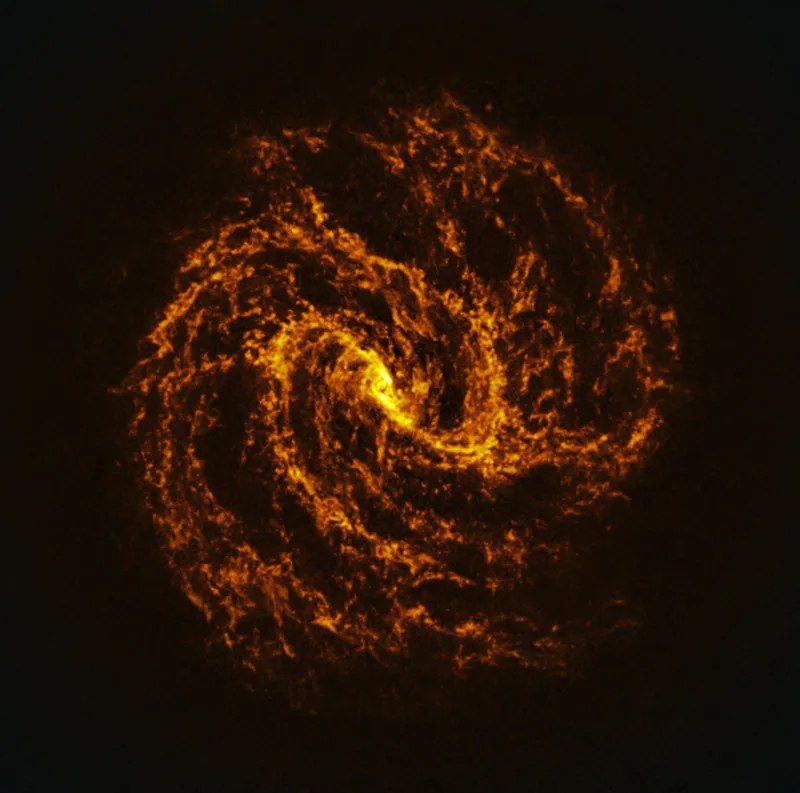
A new image from the ALMA observatory in Chile shows the spiral galaxy M83 not in starlight but in the faint radio glow of cold gas, the raw material of new stars. Measurements of that gas show that the galaxy's rotation, bar and spiral arms, more than its young stars, decide how dense and warm it becomes.
A galaxy drawn in its raw material
M83, also called the Southern Pinwheel, lies about 15 million light-years away in the constellation Hydra. In ordinary photographs it is a bright spiral of stars and dust. ALMA, an array of radio dishes on the Chajnantor plateau in the Chilean Andes, sees something else: millimetre-wave light given off by molecules in cold gas clouds.
Those clouds matter because almost every star forms when such a cloud collapses. Once stars switch on, they heat the gas around them and make further collapse harder, while the galaxy's rotation keeps stirring the gas. Together, these effects control how fast a galaxy builds new stars.
M83 is a useful test case for two reasons. It closely resembles our own Milky Way, which is also a spiral with a central bar, and we see it almost face-on, so its arms, its bar and the gaps between them are all laid out without overlapping.
The galaxy's structure, not its stars, shapes the gas
The image comes from a study led by Jin Koda, published in The Astrophysical Journal in 2025. The team mapped carbon monoxide (CO), the molecule astronomers use to trace cold gas, at two of its characteristic wavelengths, known as spectral lines, resolving features about 150 light-years across. The shorter-wavelength line comes from a higher energy level of the molecule, so it needs denser or warmer gas to shine, and the ratio between the two lines works as a thermometer and density gauge.
The ratio follows the galaxy's structure. It is low in the gaps between the arms, rises in the arms and the bar, and is highest of all at the very centre. In the arms and the bar, the change means that the gas is about two to three times denser, warmer, or both. That rise appears even in sections of the arms where no stars are forming, so it is the arms themselves, not stars, that change the gas there. Near clusters of young stars the ratio climbs higher still, but only locally.
The authors conclude that the state of most of the gas in M83's disc is set by the galaxy's rotation, bar and arms, and that the heating from new stars is limited to their immediate surroundings. Because earlier studies of the Milky Way and other barred spirals reached similar conclusions, the authors expect the pattern to be common among such galaxies.
Where to find M83, and when
M83 lies at right ascension 13h 37m, declination −29° 52′. At that declination it never rises at all for observers north of about 60° N, and from London it climbs no higher than about 9° above the southern horizon, so from most of Europe it is hard to catch. From the southern hemisphere it is an easy target: south of about 60° S it never sets, and around 30° S it passes almost overhead.
In October M83 is close to the Sun in the sky and cannot be observed. It returns to the morning sky towards the end of the year, stands opposite the Sun in mid-April, when it is highest in the middle of the night, and is in the evening sky from May into September.
With an apparent magnitude of about 7.5, M83 is one of the brightest spiral galaxies in the sky, and it can be seen through binoculars from a site where it rises well clear of the horizon, though only as a small, faint, misty patch, not the spiral of the photographs. From mid-northern latitudes it is hard even in a telescope: Charles Messier, observing from Paris in 1781, wrote that it could be seen only with the greatest concentration. NASA names June as the easiest month to observe it; that is when M83 is well placed in the evening. The cold gas in this image, however, cannot be seen with the eye or any optical telescope: it shines at millimetre wavelengths, which only radio telescopes such as ALMA can record.
Sources and licences
- ALMA Observatory, A swirling galaxy (5 October 2026) — The image, the description of what it shows (light from cold gas molecules, the ingredients of star formation), 15 million light-years, M83 resembling the Milky Way, face-on view. Image licence CC BY 4.0 per https://www.almaobservatory.org/en/copyright-notice/ . https://www.almaobservatory.org/en/audiences/a-swirling-galaxy/
- ESO Picture of the Week potw2640a (5 October 2026) — The original release of the same image, with the link to the research paper and a visible-light comparison. https://www.eso.org/public/images/potw2640a/
- Koda, Egusa, Hirota et al., The Astrophysical Journal 986, 29 (2025), Dynamically Driven Evolution of Molecular Gas in the Barred Spiral Galaxy M83 Traced by CO J = 2–1/1–0 Line Ratio Variations — CO 2–1/1–0 line ratio map at 46 pc resolution; low ratio between the arms, high in the bar and arms (density or temperature up by a factor of 2–3), also in arms without star formation, higher near H II regions; stellar feedback localised; gas governed by galactic structure and rotation; likely general among barred spirals. https://doi.org/10.3847/1538-4357/add1dc
- NASA Hubble Messier Catalog, Messier 83 — Constellation Hydra, apparent magnitude 7.5, one of the brightest spiral galaxies, visible in binoculars, easiest in June. https://science.nasa.gov/mission/hubble/science/explore-the-night-sky/hubble-messier-catalog/messier-83/
- SIMBAD (CDS), M 83 — Position RA 13h 37m 00.9s, Dec −29° 51′ 57″ (J2000), V = 7.52. https://simbad.cds.unistra.fr/simbad/sim-id?Ident=M83
- JPL Horizons — Position of the Sun on dates from October 2026 to July 2027, used to work out when M83 is observable. https://ssd.jpl.nasa.gov/horizons/
- SEDS Messier Database, Messier 83 — Charles Messier catalogued M83 from Paris on 17 February 1781 and wrote that it could be seen "only with the greatest concentration"; one of the most difficult Messier objects from mid-northern latitudes. http://www.messier.seds.org/m/m083.html