SkyFlux
Fully Deuterated Methanol Found in Space for the First Time
Published · Updated
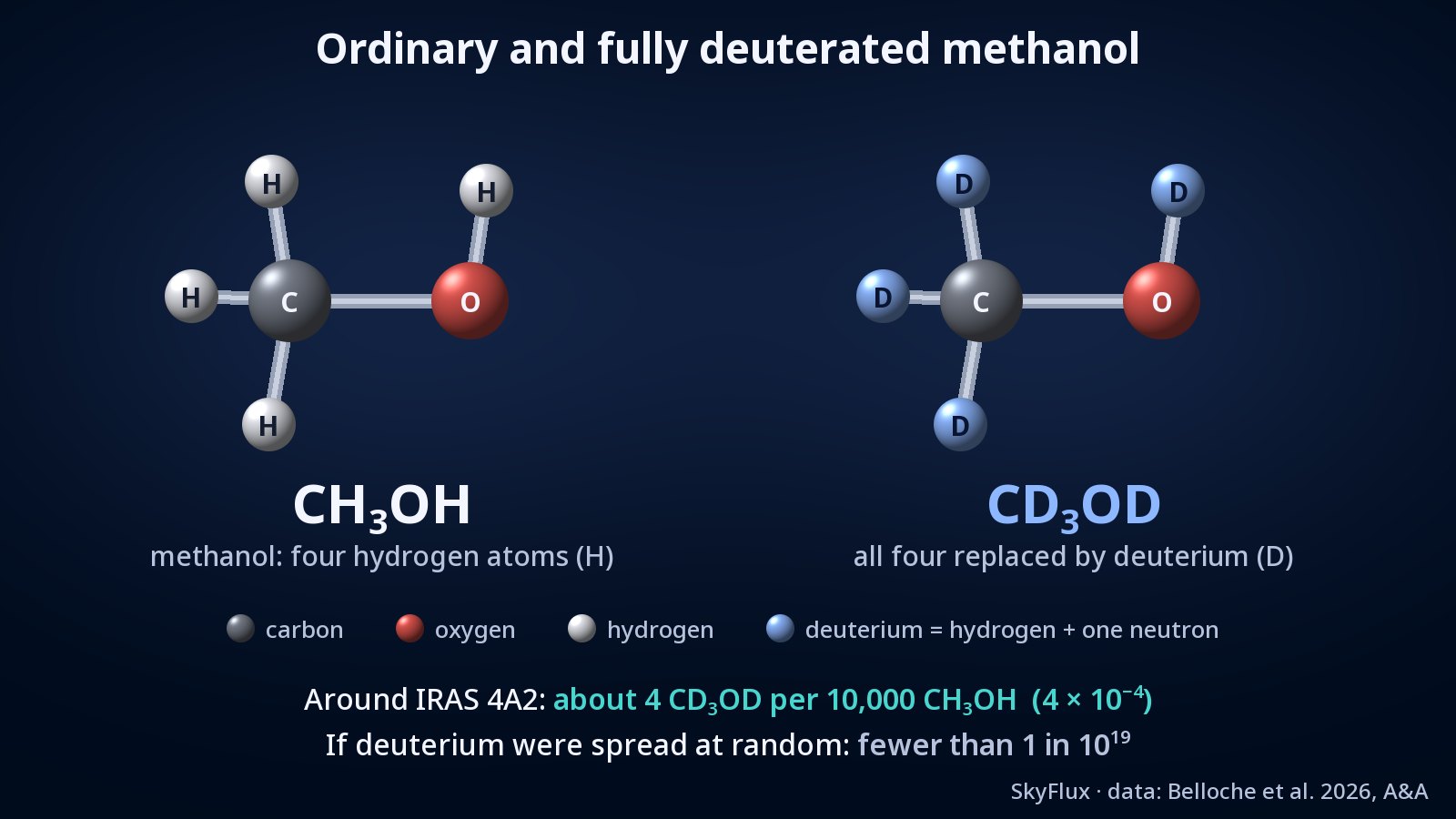
Astronomers using ALMA, the Atacama Large Millimeter/submillimeter Array of radio dishes in Chile, have found methanol in which every hydrogen atom has been replaced by deuterium, the first time this form has been firmly identified in interstellar space. The molecule, CD₃OD, surrounds the young protostar IRAS 4A2 in the Perseus molecular cloud, and there is more of it than current chemical models can explain.
What makes this methanol heavy
Methanol, CH₃OH, is the simplest alcohol: a carbon atom carrying three hydrogen atoms, bonded to an oxygen atom that carries the fourth. Deuterium is hydrogen with a neutron in its nucleus as well as a proton, so it weighs twice as much but forms the same molecules. Versions of a molecule that differ only in their isotopes are called isotopologues.
Four partly deuterated forms of methanol were already known, carrying one, two or three deuterium atoms (a single deuterium can sit on the carbon or on the oxygen). Earlier studies had found only tentative signs of the fully deuterated form. A team led by Arnaud Belloche of the Max Planck Institute for Radio Astronomy now reports the first secure detection of CD₃OD, the first interstellar molecule found with four deuterium atoms.
Its abundance is the surprise. Our Galaxy has only about 1.6 deuterium atoms for every 100,000 hydrogen atoms. If deuterium were spread at random, there would be fewer than one fully deuterated molecule for every ten billion billion molecules of ordinary methanol. Around IRAS 4A2 the team measured about four CD₃OD molecules per 10,000.
How ALMA recognises a molecule it cannot see
Molecules in warm gas spin, but only at certain fixed rates. Each time a molecule drops to a slower rate, it gives off a radio wave at one precise frequency. Heavier atoms change how a molecule spins, so every isotopologue has its own set of frequencies, a fingerprint that must first be measured in the laboratory. For CD₃OD, that work was published in 2023.
The observations were made by COMPASS, a large ALMA programme that surveyed 11 young, Sun-like protostars, stars still forming, at frequencies from 279.0 to 311.7 GHz (wavelengths of about one millimetre). ALMA picks out detail within about 100 astronomical units of each protostar (100 times the Earth–Sun distance), a region the size of a planetary system. Toward IRAS 4A2, ten spectral lines of CD₃OD were strong and not significantly blended with lines of other molecules, which makes the identification secure.
A second COMPASS study found a methanol line at 302.9 GHz amplified by the gas, as light is in a laser, in 7 of the 11 protostars: a maser. Six of them are at the earliest stage, called Class 0; the seventh is probably driven by a more massive neighbour's outflow.
Why the chemistry matters for planets and comets
Methanol forms in icy coatings on dust grains, as hydrogen atoms attach one by one to frozen carbon monoxide during the cold stage before the protostar forms. At such low temperatures, deuterium's extra mass tilts some reactions in its favour, so molecules become far richer in deuterium than its cosmic abundance. Methanol's deuterium content therefore records how the ice formed. Once the young star warms its surroundings, the ice turns to gas, about 200 kelvin (−73 °C) in IRAS 4A2, and ALMA can measure it.
Models of this chemistry fall short: for the forms with two or three deuterium atoms they predict amounts ten to a hundred times lower than observed, and CD₃OD widens the gap. The authors suggest that the models are missing a key ingredient.
Comets link this chemistry to our Solar System. When ALMA observations of another young system, IRAS 16293-2422, were set against the Rosetta spacecraft's measurements at comet 67P/Churyumov-Gerasimenko, the relative amounts of many molecules were correlated, with some scatter. That suggests some of the ice in comets and other planetary building blocks is inherited from the stage IRAS 4A2 is in now.
Where to look, and what you can see
IRAS 4A2 lies on the southern side of NGC 1333, a young star cluster in Perseus wrapped in a reflection nebula, dust lit by nearby stars. Its position is right ascension 3h 29m, declination +31° 14′, about 950 light-years (290 parsecs) away. In mid-November the cluster is opposite the Sun and highest in the middle of the night; from December to February it is well placed in the evening. Observers south of about latitude 59° S never see it rise, and from 35° S it climbs only about 24° above the northern horizon.
The protostar is invisible to amateur telescopes, buried in the gas and dust it is forming from; its methanol shows up only in millimetre-wave spectra. No reliable visual brightness for the surrounding nebula seems to have been published.
Sources and licences
- Belloche, Spezzano, Coutens et al., Astronomy & Astrophysics 714, A55 (2026), COMPASS VII. First interstellar detection of fully deuterated methanol — First robust interstellar detection of CD₃OD toward IRAS4A2, first quadruply deuterated interstellar molecule, previously detected deuterated isotopologues, ten CD₃OD lines clearly detected (two partially contaminated, Sect. 3.2), survey 279.0–311.7 GHz, distance 290 pc, rotational temperature about 200 K, CD₃OD/CH₃OH about 4 × 10⁻⁴, Galactic D/H about 1.6 × 10⁻⁵, methanol formed by hydrogenation of CO in grain ices, models short by one to two orders of magnitude, a missing process, spectroscopy from CDMS (Ilyushin et al. 2023). Open access, CC BY 4.0. https://doi.org/10.1051/0004-6361/202659642 (arXiv: https://arxiv.org/abs/2610.07279)
- ALMA press release, 7 October 2026 — COMPASS large programme, 11 young Sun-like stars, more than 100 hours of observing and seven papers in A&A. https://www.almaobservatory.org/en/press-releases/cosmic-cocktail-alma-reveals-exotic-methanol-around-young-stars/
- Max Planck Institute for Radio Astronomy press release, 7 October 2026 (in German) — Methanol as a starting point for larger molecules on icy grains, release into the gas when the star heats its surroundings, unidentified lines possibly from CH₂DOD and CHD₂OD, laboratory work in progress. https://www.mpifr-bonn.mpg.de/pressemeldungen/2026/erster-nachweis-von-schwerem-methanol-im-weltraum?c=8727
- Jeong, Lee, Jørgensen et al., Astronomy & Astrophysics 714, A54 (2026), COMPASS VI — Class I methanol maser at 302.913 GHz in 7 of 11 sources; HOPS 108 likely driven by the outflow of the intermediate-mass protostar HOPS 370; excluding it, 6 of 10 low-mass protostars, all of them Class 0. https://doi.org/10.1051/0004-6361/202558734
- Jørgensen, Coutens, Drozdovskaya et al., Astronomy & Astrophysics 714, A49 (2026), COMPASS I. Overview — 11 line-rich Class 0 and I solar-type protostars, 279.0–311.7 GHz, the inner ~100 au around each source. https://doi.org/10.1051/0004-6361/202558725
- Drozdovskaya et al., Monthly Notices of the Royal Astronomical Society 490, 50–79 (2019) — Relative molecular abundances in the protostar IRAS 16293-2422 B correlate with comet 67P measured by Rosetta; comet volatiles partly inherited. https://doi.org/10.1093/mnras/stz2430 (arXiv: https://arxiv.org/abs/1908.11290)
- SIMBAD, [JCC87] IRAS 4A2 and NGC 1333 — IRAS 4A2 at RA 03h 29m 10.4s, Dec +31° 13′ 32″ (ICRS); NGC 1333 centre RA 03h 29m 11.3s, Dec +31° 18′ 36″, size 8′. https://simbad.cds.unistra.fr/simbad/sim-id?Ident=%5BJCC87%5D+IRAS+4A2