SkyFlux
METEORS
Geminid meteor shower peak: the best nights and where to look
Published · Updated
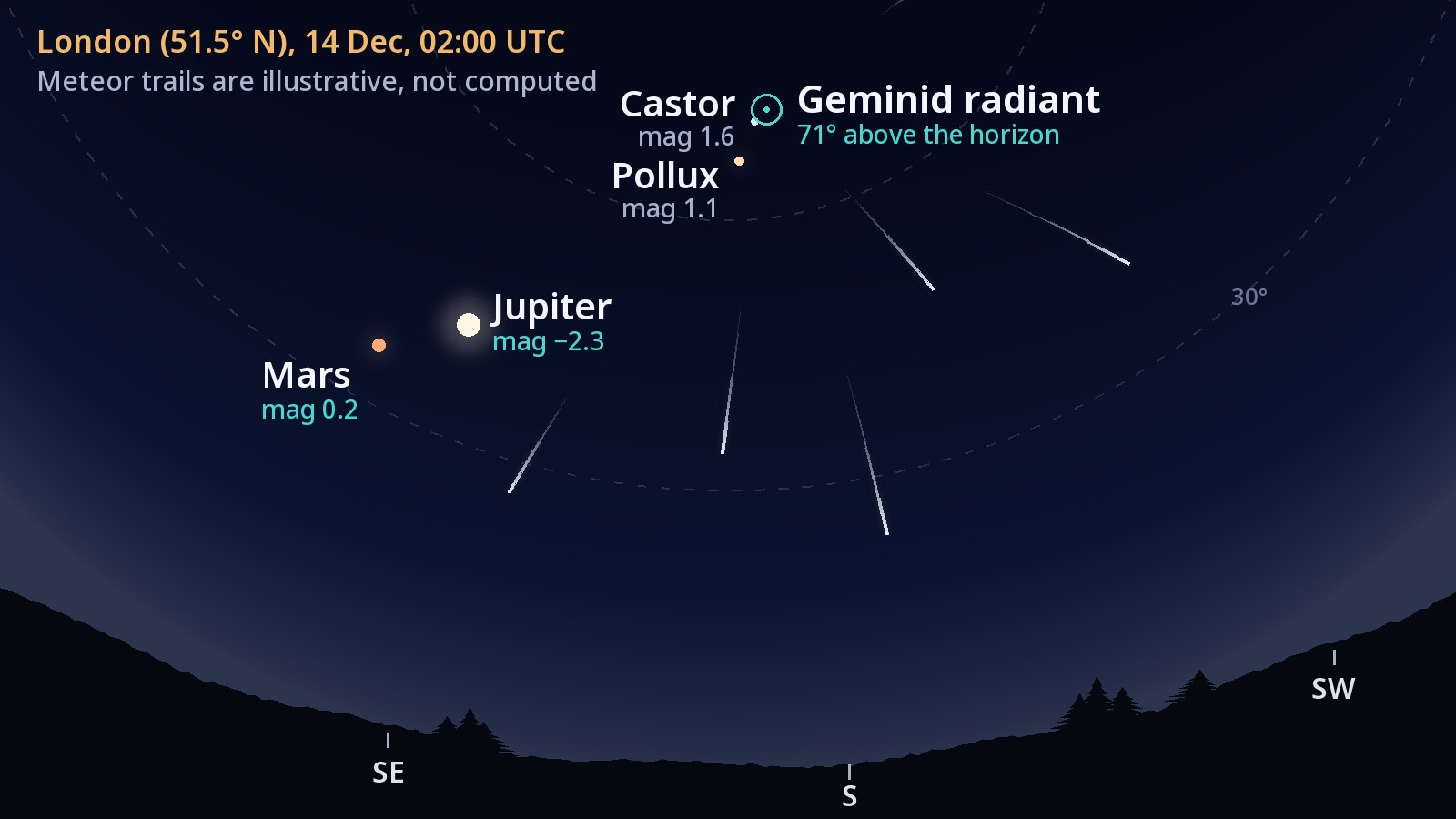
The Geminids, the most reliable major annual shower according to the International Meteor Organization (IMO), peak on 14 December around 14:00 UTC. Across Europe that hour falls in daylight or twilight, with the radiant low or below the horizon. But in the past two decades the maximum has come as much as 17 hours early, so the night of 13–14 December is the best bet.
Which night to choose
The rate is high (a ZHR of 100 or more; see 'What you will see') for only 10 to 12 hours around the maximum. The IMO notes that the timing has varied little in recent years: over the past two decades, well-observed maxima have all arrived between about 17 hours before and 4 hours after the predicted time. In 2026 that means any time from 21:00 UTC on 13 December to 18:00 UTC on the 14th.
Most of Europe's night of 13–14 December lies inside that window, so if the maximum comes early, Europe sees it with the radiant high. The evening of the 14th is closer to the predicted time, but the radiant is still low early in the evening (until about 21:00 UTC from London, earlier farther east); still worth a look, as the IMO notes that bright Geminids become more common later in the peak. On the North American west coast the night of 13–14 December ends within about an hour of the predicted maximum; further east, dawn comes earlier.
Where to look
Geminids can appear anywhere in the sky, but traced backwards, their trails lead to one point, the radiant, near the bright star Castor in Gemini.
From mid-northern latitudes the radiant rises in the north-northeast around sunset and is highest in the south in the middle of the night. From London (51.5° N) it climbs to 71° above the horizon at about 02:00 UTC on 14 December, and stays above 40° from about 22:00 to 06:00 UTC; north of about 57° N it never sets. The higher the radiant, the more meteors you see, so most of the night is good.
You don't need to look at the radiant itself: meteors near it leave short trails, those farther away longer ones. Face the darkest part of your sky, about halfway up. The SkyFlux sky map shows the radiant's position from your location.
Southern-hemisphere observers see fewer Geminids. The radiant lies 33° north of the celestial equator, so from Sydney (34° S) it reaches at most 23° above the northern horizon, and south of 57° S it never rises. The predicted peak falls in darkness for eastern Australia, but expect only about a third of the rate seen with the radiant high.
What you will see
The IMO gives a zenithal hourly rate (ZHR) of 150: the number of meteors a single observer would count in an hour under a perfectly clear sky, with stars to magnitude 6.5 visible and the radiant overhead. Actual counts are lower, mostly because of sky brightness: for the Geminids, each magnitude of fainter stars lost to light pollution divides the count by about 2.6. At the peak, with the radiant 60° up, a suburban sky showing stars to magnitude 5.5 gives about 50 an hour, a bright town sky about 30, and a dark rural sky about 80. These are peak rates; Europe's night of 13–14 December comes about 12 hours before the predicted peak, so expect fewer unless the maximum is early.
Geminids enter the atmosphere at 35 km/s, slower than the Perseids (59 km/s), so they look noticeably slower. The shower is known for bright meteors and fireballs.
The Moon will be a crescent, 19–27% lit, setting at about 20:00 UTC on 13 December and 21:00 UTC on the 14th from London; then the sky is moonless until dawn.
A shower from an asteroid
Did you know?Most meteor showers come from comets; the Geminids come from 3200 Phaethon, an asteroid about 6 km across. It passes 0.14 astronomical units (about 21 million km) from the Sun, less than half of Mercury's closest distance to it. Near the Sun it shows a short tail, which solar observatories revealed in 2023 to be sodium gas, not dust. What made Phaethon shed so much dust is still a mystery.
Sources and licences
- IMO 2026 Meteor Shower Calendar (J. Rendtel, ed.) — Maximum 14 December 14h UT (λ☉ 262.2°), ZHR 150, activity 4–20 December, radiant α 112° δ +33°, V∞ 35 km/s, r 2.6, maxima window 13 Dec 21h – 14 Dec 18h UT, ZHR 100+ over 10–12 hours, bright Geminids toward the end of the maximum, waxing crescent at the maximum, ZHR definition. The PDF is no longer on imo.net (site rebuilding, 17 October 2026); identical archived copy: https://web.archive.org/web/20251223170423/https://imo.net/files/meteor-shower/cal2026.pdf
- Ryabova & Rendtel 2017, MNRAS Letters, doi:10.1093/mnrasl/slx205 (arXiv:1712.01516) — ZHR formula with the sky-brightness factor r^(6.5−LM) and the radiant-altitude factor sin h (eq. 4); r = 2.6 for most of the Geminid activity period. https://arxiv.org/abs/1712.01516
- JPL Horizons (NASA/JPL) — Moon illumination and topocentric altitude, Sun altitude, computed 17 October 2026. https://ssd.jpl.nasa.gov/horizons/
- JPL Small-Body Database — Orbit and diameter of 3200 Phaethon (q 0.14 au, diameter 6.25 km). https://ssd.jpl.nasa.gov/tools/sbdb_lookup.html#/?sstr=3200
- NASA Science: Geminids — Phaethon as the parent body; most showers come from comets. https://science.nasa.gov/solar-system/meteors-meteorites/geminids/
- SIMBAD (CDS, Strasbourg) — Position of Castor (alf Gem). https://simbad.cds.unistra.fr/simbad/
- NASA NSSDC Mercury Fact Sheet — Mercury's perihelion distance (46.0 million km = 0.31 au). https://nssdc.gsfc.nasa.gov/planetary/factsheet/mercuryfact.html
- NASA, 25 April 2023: Asteroid's comet-like tail is not made of dust — Phaethon's tail is sodium gas (SOHO/STEREO); a disruptive event a few thousand years ago suspected, 'remains a mystery'. https://www.nasa.gov/solar-system/asteroids-comets-meteors/asteroids/asteroids-comet-like-tail-is-not-made-of-dust-solar-observatories-reveal/