SkyFlux
PLANETS
BepiColombo: Mercury orbit insertion planned for 21 November
Published · Updated
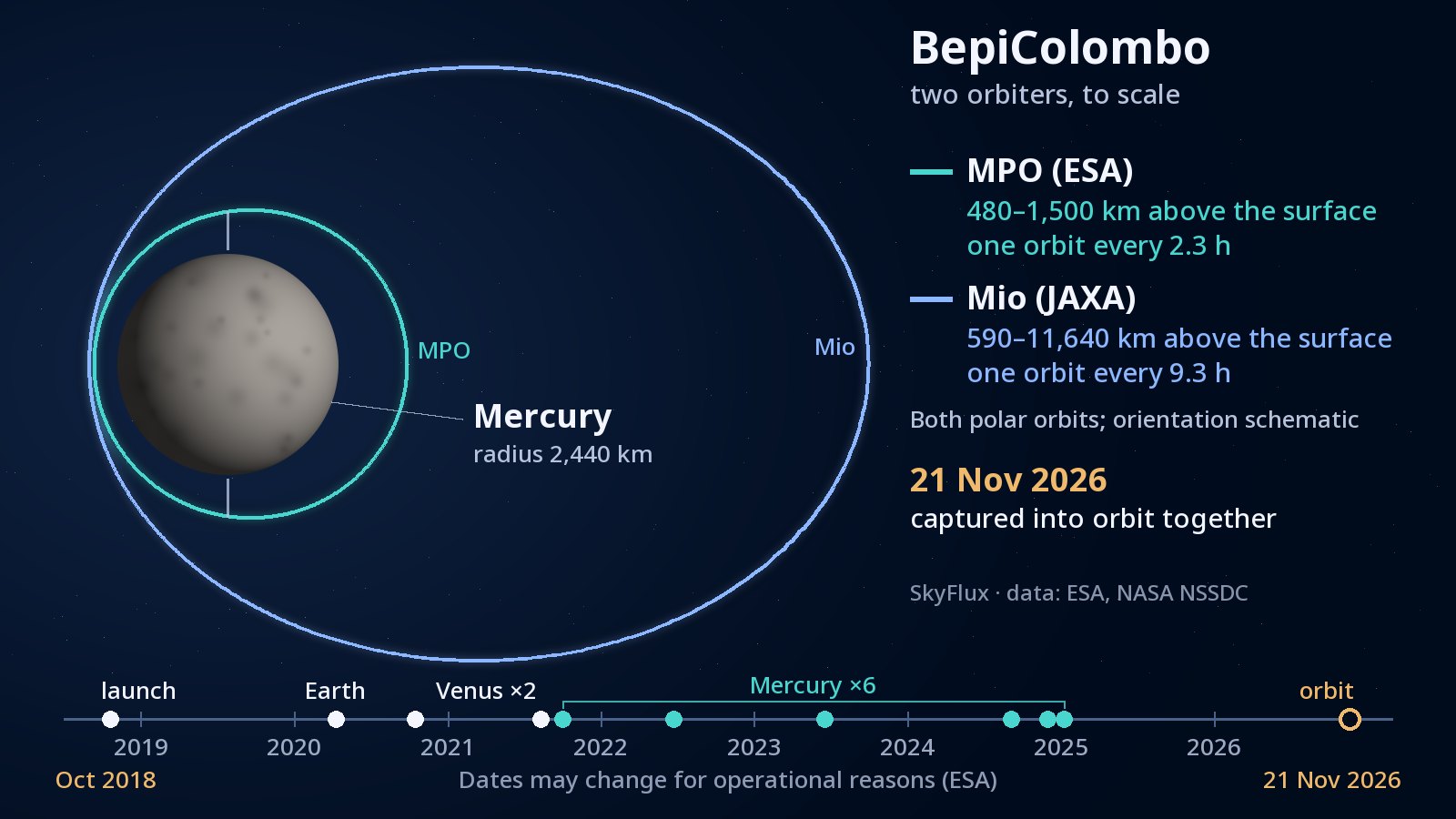
The European-Japanese spacecraft BepiColombo is due to enter orbit around Mercury on 21 November, according to ESA's plan (no time has been announced). The journey began in October 2018 and required nine planetary flybys, not because Mercury is distant, but because a spacecraft falling towards the Sun arrives much too fast to be captured.
What happens on 21 November and afterwards
BepiColombo is now two spacecraft travelling as one: ESA's Mercury Planetary Orbiter (MPO) and JAXA's Mercury Magnetospheric Orbiter, called Mio. A third craft, the Mercury Transfer Module, carried and pushed them with its ion engines until mid-June; it was released on 3 September, and since then MPO's own thrusters have steered the pair.
On 21 November the two still-joined spacecraft are to enter a polar orbit, passing over both poles so that, as Mercury turns, its whole surface comes into view. ESA's published sequence after that is:
- 9–10 December: MPO releases Mio into its own orbit.
- 16 December: MPO jettisons Mio's sunshield and begins descending to its own orbit.
- 10 March 2027: MPO reaches its final orbit.
- April 2027: science operations begin.
How firm is the date? ESA's update of 6 October 2026 still gives 21 November, but its timeline adds that exact dates may change for operational reasons. It has moved before: in April 2024 a power fault kept the ion engines below full thrust, and the orbit insertion planned for December 2025 slipped to November 2026. Some ESA pages give December 2026 as the arrival, apparently counting from 9–10 December, when the two orbiters fly as separate spacecraft.
Two orbiters, two jobs
MPO will circle 480 to 1,500 km above the surface every 2.3 hours. Most of its eleven instruments will study the planet itself: a laser altimeter will map surface elevation, X-ray and gamma-ray spectrometers will measure the surface's composition, and radio tracking will map the gravity field and, from it, reveal the size and state of the core.
Mio will follow an elongated orbit, from 590 to 11,640 km above the surface, once every 9.3 hours. Its five instruments will measure Mercury's magnetic field, the charged particles trapped in it, the planet's thin exosphere (including its sodium) and the dust along Mercury's orbit.
Among ESA's questions: why a planet this small still has a magnetic field, why there is ice in craters near the poles of a world this close to the Sun, and how the surface features called hollows formed. BepiColombo will be the second mission to orbit Mercury, after NASA's MESSENGER (2011–2015), and the first to put two orbiters there.
Why it took eight years
Mercury is never more than about 220 million km from Earth, yet BepiColombo has travelled 9.9 billion km to get there. The problem is speed, not distance. A spacecraft falling inwards towards the Sun gathers speed all the way: coasting down from Earth's orbit on the cheapest path, it would reach Mercury's distance at about 57 km/s, some 10 km/s faster than the planet itself moves there. Mercury's gravity is weak (its escape speed is 4.3 km/s), so to be captured a spacecraft must approach with nearly the planet's own speed and direction.
So BepiColombo spent eight years shedding that excess speed. Its ion engines pushed gently for weeks at a time, and nine flybys changed its speed and direction: Earth (April 2020), Venus twice (October 2020 and August 2021) and Mercury six times (October 2021 to January 2025). Each pass brought its orbit around the Sun closer to Mercury's own, until the planet could capture it.
Mercury in the sky the same week
Mercury also reaches its greatest angular distance west of the Sun late on 20 November (UTC), so the mornings around orbit insertion are a good time to see the planet from mid-northern latitudes: from London it stands about 10° above the southeastern horizon at civil dawn, when the Sun is 6° below the horizon. Our story "Mercury in the morning sky: use Venus to find it before sunrise" shows where to look. From around 34° S (Sydney or Cape Town), Mercury is only about 4° up at the same point of twilight and hard to catch.
The spacecraft itself cannot be seen. A craft about ten metres across, 150 million km away and only about 20° from the Sun, is far beyond the reach of any telescope.
Sources and licences
- ESA, Latest updates: BepiColombo's arrival at Mercury (6 October 2026) — Insertion on 21 November 2026, Mio separation 9–10 December, science phase from April 2027, the first trajectory correction on 24 September (11.4 m/s), instrument first-light tests. https://www.esa.int/Science_Exploration/Space_Science/BepiColombo/Latest_updates_BepiColombo_s_arrival_at_Mercury
- ESA, BepiColombo arrival at Mercury timeline (updated July 2026) — Arrival sequence with dates (3 September, 21 November, 9–10 December, 16 December 2026; 10 March and 6 April 2027), polar orbit, and the note that exact dates may change for operational reasons. https://www.esa.int/ESA_Multimedia/Images/2018/10/BepiColombo_arrival_at_Mercury_timeline
- ESA, BepiColombo begins Mercury arrival with MTM separation success (7 September 2026) — 9.9 billion km travelled, nine flybys, ion engines switched off on 15 June 2026, the transfer module's two 15-metre solar wings, two orbiters in Mercury orbit in December 2026. https://www.esa.int/Enabling_Support/Operations/BepiColombo_begins_Mercury_arrival_with_MTM_separation_success
- ESA, BepiColombo factsheet and mission page — Dates of all nine flybys, the 2026–2027 milestones, earlier missions to Mercury, the science questions (magnetic field, polar ice, hollows). https://www.esa.int/Science_Exploration/Space_Science/BepiColombo/BepiColombo_factsheet and https://www.esa.int/Science_Exploration/Space_Science/BepiColombo
- ESA, Mercury Planetary Orbiter and Mercury Magnetospheric Orbiter (Mio) pages — Orbits (480 × 1,500 km, 2.3 hours; 590 × 11,640 km, 9.3 hours), MPO's size (body 2.4 × 2.2 × 1.7 m, solar wing 7.5 m), Mio's spin, the instruments of both orbiters. https://www.esa.int/Science_Exploration/Space_Science/BepiColombo/Mercury_Planetary_Orbiter and https://www.esa.int/Science_Exploration/Space_Science/BepiColombo/Mercury_Magnetospheric_Orbiter_Mio
- ESA, Fourth Mercury flyby begins BepiColombo's new trajectory (2 September 2024) — The April 2024 thrust fault, the December 2025 insertion it ruled out, the new arrival in November 2026, and why gravity-assist flybys are needed to slow down. https://www.esa.int/Science_Exploration/Space_Science/BepiColombo/Fourth_Mercury_flyby_begins_BepiColombo_s_new_trajectory
- NASA NSSDC Mercury Fact Sheet — Mean orbital speeds of Mercury (47.36 km/s) and Earth (29.78 km/s), Mercury's escape speed (4.3 km/s), radius, semimajor axis and aphelion, Earth's semimajor axis and aphelion, https://nssdc.gsfc.nasa.gov/planetary/factsheet/mercuryfact.html ; the Sun's GM (132,712 × 10⁶ km³/s²) from https://nssdc.gsfc.nasa.gov/planetary/factsheet/sunfact.html . Arrival speed on the cheapest (Hohmann) transfer from Earth's orbit, 57.5 km/s against 47.9 km/s for a circular orbit at Mercury's mean distance, is our calculation.
- JPL Horizons (NASA/JPL) — Earth–Mercury distance on 21 November 2026, Mercury's angular distance from the Sun, and its altitude at civil dawn from London, Sydney and Cape Town, computed 17 October 2026. https://ssd.jpl.nasa.gov/horizons/