 SkyFlux
SR-1 Freedom: NASA's Nuclear-Powered Spacecraft to Carry Three Helicopters to Mars
Published · Updated
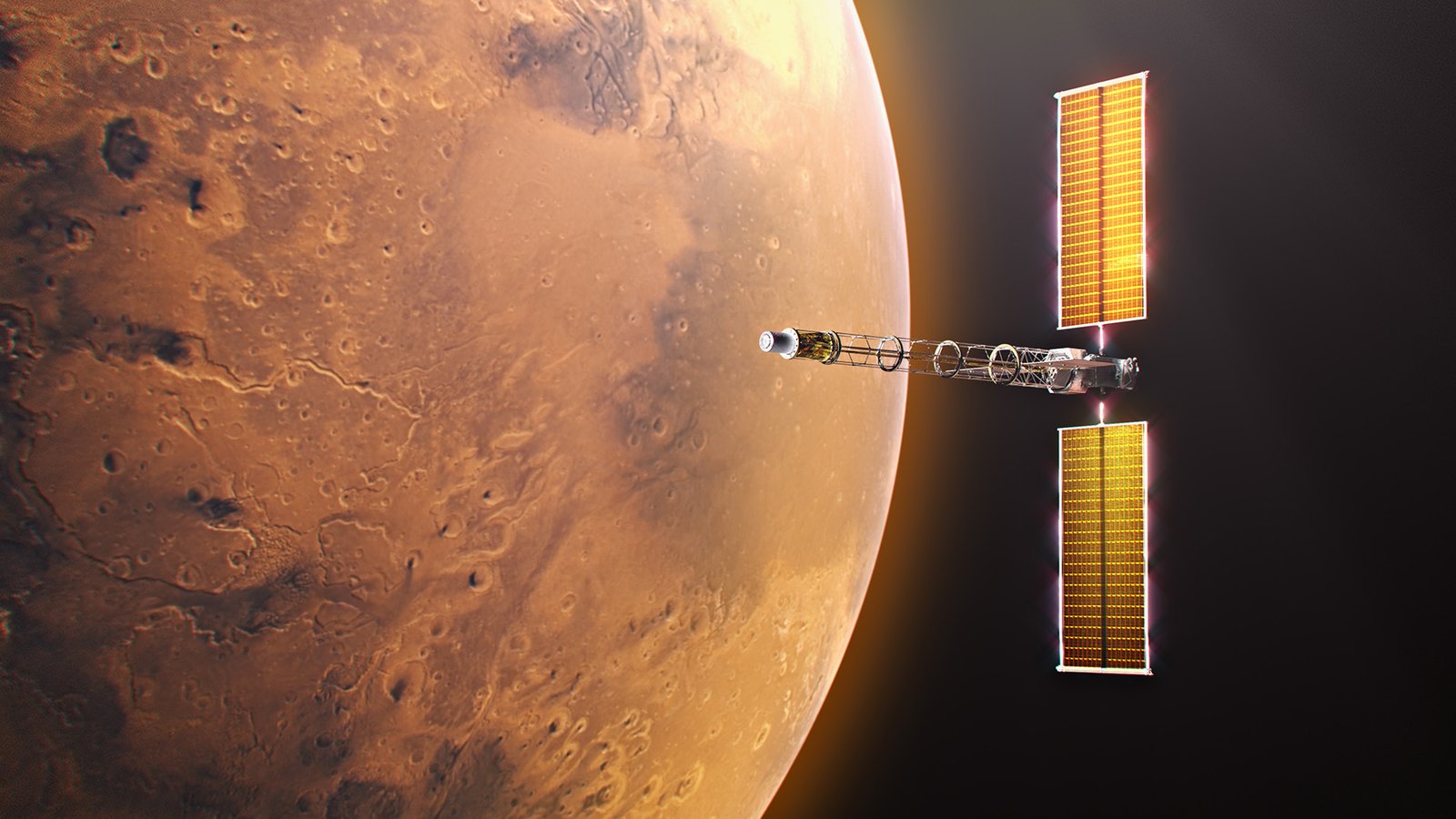
NASA is building SR-1 Freedom, a spacecraft that would be the first to run a nuclear fission reactor beyond Earth orbit. It is planned to launch in late 2028 and carry SkyFall, three Mars helicopters evolved from Ingenuity.
What NASA announced on 20 October
On 20 October 2026, NASA reported progress on the nuclear power module of Space Reactor-1 (SR-1) Freedom. The module has two parts: a reactor that makes heat by nuclear fission, and a power conversion system that turns that heat into electricity for the spacecraft and its electric thrusters.
The reactor is being designed by the US Department of Energy's Idaho National Laboratory. The conversion system is a closed Brayton cycle, in which a gas circulates in a loop, is heated by the reactor and spins a turbine. Sierra Lobo Inc. will supply it under a contract managed at NASA's Glenn Research Center in Cleveland. NASA says these contract actions reduce technical risk and help keep the mission on schedule.
Everything about the flight is still planned: NASA targets a launch in late 2028 and arrival at Mars in 2029. NASA also says the reactor will stay inactive until the spacecraft has left Earth orbit, so it is not running during launch or while the craft circles Earth; the fact sheet says it starts within 48 hours after that.
Why nuclear electric propulsion?
A chemical rocket delivers a short, powerful burst and then coasts. An electric thruster does the opposite: it ionises a gas, such as xenon, and pushes the ions out with electric and magnetic fields. The thrust is gentle, but it can last for months, and it uses far less propellant. NASA says electric propulsion can cut the propellant needed by up to 90% compared with chemical systems.
Electric thrusters are only as strong as their power supply, which can be solar arrays or a nuclear reactor. NASA notes that Martian dust storms can block sunlight at the surface for weeks, and that on the Moon even the best polar sites face days of darkness, so a reactor offers power that does not depend on the Sun. SR-1 Freedom is meant to prove the technology in space first, ahead of a reactor on the Moon (Lunar Reactor-1, targeted for 2030).
NASA lists the reactor's electrical output as more than 20 kilowatts. The spacecraft uses a 12-kilowatt Hall thruster, a type of electric thruster, runs on High-Assay Low-Enriched Uranium fuel, and has a mass of about 12,000 kilograms. It is built on an existing spacecraft body, the Power and Propulsion Element, whose own solar arrays generate 48 kilowatts; the reactor is the new part being demonstrated. For comparison, Perseverance's radioisotope generator gave about 110 watts at launch, so the SR-1 reactor is planned to deliver roughly 180 times as much.
- Reactor versus radioisotope generator: Perseverance's generator gets its heat from the natural decay of plutonium-238. A fission reactor instead makes heat by splitting uranium atoms, so SR-1's reactor is planned to produce more than 20 kilowatts rather than about 110 watts.
- A rare step: NASA says the United States has flown only one reactor before, SNAP-10A in 1965, and it never left Earth orbit.
SkyFall: three helicopters for Mars
SR-1 Freedom's cargo is SkyFall, three helicopters evolved from Ingenuity, which made the first powered, controlled flight on another planet. The mission is a Mars flyby that deploys the helicopters; NASA has yet to choose where they will land.
Flying there is hard. Gravity is about a third of Earth's, which helps, but the air pressure at the surface is only about 1% of ours, so the rotor blades have few air molecules to push against. The three helicopters will carry ground-penetrating radar and cameras to look for subsurface ice, and will measure air temperature, wind speed and wind direction. NASA hopes this can help select future landing sites for humans, and says the helicopters could keep working for months, perhaps years.
What can an amateur see?
Nothing, for now: the spacecraft has not launched, and its reactor will only be switched on once it has left Earth orbit. This is a space-technology story rather than a sky event, so there is nothing to look for in the night sky.
What you can follow is the schedule. The 2028 Mars launch window is a fixed constraint, because Earth and Mars must be in the right positions; if the mission misses it, the next window opens about 26 months later. NASA's mission page and news releases give the latest status.
Sources and licences
- NASA, SR-1 Freedom Advances with Progress on Nuclear Power Module (20 October 2026) — Used for the reactor and power conversion module, the Idaho National Laboratory and Sierra Lobo roles, the closed Brayton cycle, the safety statement, the late-2028 launch and SkyFall. https://www.nasa.gov/centers-and-facilities/glenn/sr-1-freedom-advances-with-progress-on-nuclear-power-module/
- NASA, Space Reactor-1 Freedom mission page — Used for the launch and arrival years, mass, fuel, 20 kilowatts electric, the 12-kilowatt Hall thruster, the SkyFall instruments, and Martian gravity and air pressure. https://www.nasa.gov/mission/space-reactor-1-freedom/
- NASA, America Underway in Space on Nuclear Power (fact sheet) — Used for the 20-kilowatt figure, Mars dust storms, SNAP-10A in 1965 and the reactor start within 48 hours of leaving Earth orbit. https://www.nasa.gov/wp-content/uploads/2026/03/america-underway-in-space-on-nuclear-power.pdf
- NASA, The Propulsion We're Supplying, It's Electrifying (2020) — Used for how electric propulsion works and the up-to-90% propellant saving over chemical propulsion. https://www.nasa.gov/humans-in-space/the-propulsion-were-supplying-its-electrifying/
- NASA/JPL, Mars 2020 Perseverance rover components — Used for the radioisotope generator, plutonium-238 and about 110 watts at launch. https://science.nasa.gov/mission/mars-2020-perseverance/rover-components/