 SkyFlux
ALMA Cycle 13: Record Demand and the New Band 2 Receivers
Published · Updated
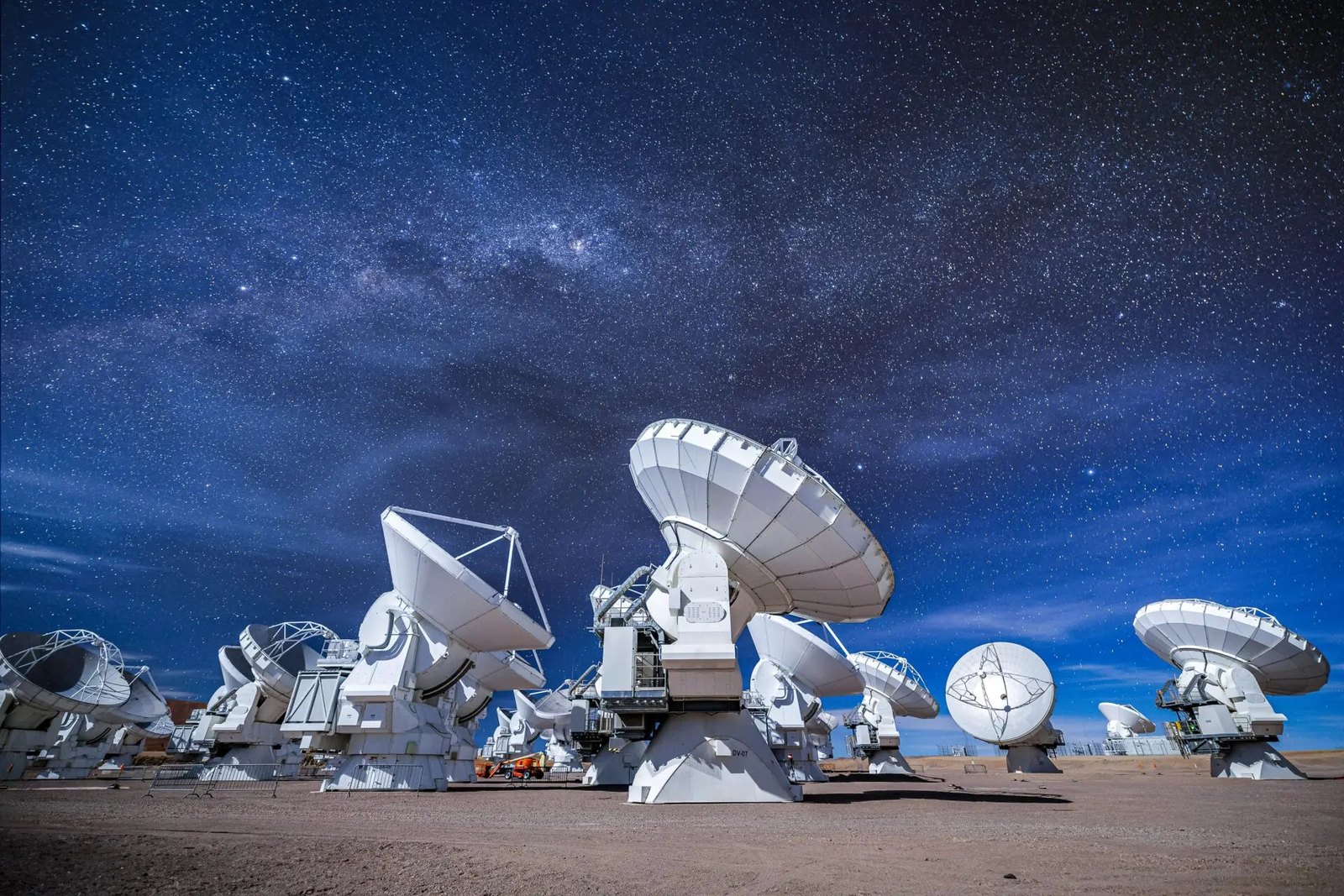
The ALMA observatory in Chile began its thirteenth observing cycle on 1 October 2026, with record demand: astronomers asked for almost nine times as much time on its main 12-metre array as was on offer. The cycle also opened a new set of receivers, called Band 2, to general observers for the first time.
What ALMA is and why it looks at millimetre waves
ALMA, the Atacama Large Millimeter/submillimeter Array, consists of 66 antennas on the Chajnantor Plateau in northern Chile. They work together through interferometry: every antenna records the signal from the same object, and a central computer combines the recordings. The result is as sharp as an image from a single dish whose diameter equals the longest distance between antennas, which at ALMA reaches 16 kilometres.
ALMA observes millimetre and submillimetre waves, radio waves that are a kind of light the eye cannot see. They matter because stars and planets form in cold, dark clouds of gas and dust that glow at these wavelengths, and the dust that hides such clouds from visible-light telescopes does not block ALMA's view. Very distant galaxies show up there too, since the expansion of the Universe stretches their emission into the millimetre range. Air absorbs and delays such waves, even at 5,000 metres in the dry Atacama Desert, so ALMA measures the water vapour along each antenna's line of sight and corrects for it.
How observing time is awarded
ALMA works in yearly cycles, and Cycle 13 runs from 1 October 2026 to 30 September 2027. Proposals could be submitted from 19 March until 23 April 2026. The observatory received 1,839, asking for 37,471 hours on the 12-metre Array; both figures are the highest of any ALMA cycle so far. The 12-metre Array had a nominal 4,300 hours on offer, so requests were 8.7 times the time available, a ratio astronomers call oversubscription.
The ranking comes from peer review, meaning that other astronomers judge the proposals. A committee of 20 members and a chair, helped by 80 external assessors, evaluated the 47 proposals for Large Programs, the biggest projects. The remaining proposals were reviewed by 1,216 astronomers, who wrote nearly 17,900 reviews between them. The ranking was then weighed against practical limits: weather, receiver availability, array configuration and the position of the targets in the sky.
In the end 229 proposals received the top grades, A or B, an acceptance rate of about 12%. They were allocated 4,257 hours on the 12-metre Array, 2,089 hours on the 7-metre Array and 1,739 hours on the Total Power Array, a set of dishes that work singly rather than as an interferometer. The 12-metre figure is slightly below the 4,300 hours on offer because some unfinished Grade A observations from Cycle 12 were expected to carry over into Cycle 13.
What is new in Cycle 13
The main novelty is Band 2, a receiver covering about 67 to 116 gigahertz. Converted from frequency, that is a wavelength of roughly 2.6 to 4.5 millimetres. It is the last of ALMA's ten planned receiver bands to become available, and it lets astronomers observe molecular transitions, signals given off by molecules, that trace cold gas in the interstellar medium and in nearby and distant galaxies. Demand was strong: 210 proposals asked for Band 2, making it the fourth most requested band by observing time, while Bands 6 and 7 drew the largest share of the requested hours.
Four new Large Programs will study the surroundings of aging stars, take a census of star formation in a deep survey of a distant patch of sky beyond our galaxy, follow planet-forming disks from their earliest embedded stages to later ones, and trace how solid material evolves where planetary systems assemble. A record 91 joint proposals were also submitted to combine ALMA with the James Webb Space Telescope, the US Very Large Array radio telescope or ESO's Very Large Telescope.
A larger change comes later. The Wideband Sensitivity Upgrade will at least double the range of frequencies the receivers record at once and replace the correlator, the computer that combines the antenna signals. ALMA expects its first stages to be in place by the end of this decade, around 2030.
What you can follow
You cannot point ALMA at the sky yourself: its time goes only to the research proposals chosen through the peer review described above. What you can follow are the results. Titles, abstracts and teams of the highest-priority Cycle 13 projects are public on the ALMA Science Portal, and the observatory publishes announcements and pictures of the week that are free to reuse with credit.
Sources and licences
- ALMA Observatory, announcement "ALMA Cycle 13 Set to Begin" — Used for the cycle's start and end dates, the numbers of proposals and hours, the grades and allocations, the peer-review figures, Band 2, the Large Programs and the joint proposals. https://www.almaobservatory.org/en/announcements/alma-cycle-13-set-to-begin/
- ALMA Observatory, announcement "ALMA Cycle 13 Call for Proposals is Now Open" — Used for the call dates, the 4,300 hours originally offered, baselines of up to 16 km and what Band 2 observes. https://www.almaobservatory.org/en/announcements/alma-cycle-13-call-for-proposals-to-open-soon/
- ALMA Observatory, "How ALMA works" — Used for the 66 antennas, how interferometry works, atmospheric absorption at 5,000 metres and the water-vapour correction. https://www.almaobservatory.org/en/about-alma/how-alma-works/
- ALMA Observatory, "ALMA Wideband Sensitivity Upgrade" and "ALMA2030 WSU" — Used for why cold, dark regions are where stars and planets are born, and for the upgrade's goals and timing. https://www.almaobservatory.org/en/almas-next-frontier-the-wideband-sensitivity-upgrade/ and https://www.almaobservatory.org/en/scientists/alma-2030-wsu/
- ALMA Observatory, "Capabilities" and copyright notice — Used for distant galaxies being stretched into the millimetre range, and for the licence that lets the observatory's images and announcements be reused with credit. https://www.almaobservatory.org/en/about-alma/how-alma-works/capabilities/ and https://www.almaobservatory.org/en/copyright-notice/
- Our own arithmetic — We calculated Band 2's wavelengths by dividing the speed of light by the frequency, and checked that 37,471 hours divided by 4,300 hours gives 8.7, which matches ALMA's figure.