 SkyFlux
Some White Dwarfs Would Look Green, Pink or Purple Up Close, a New Study Finds
Published · Updated
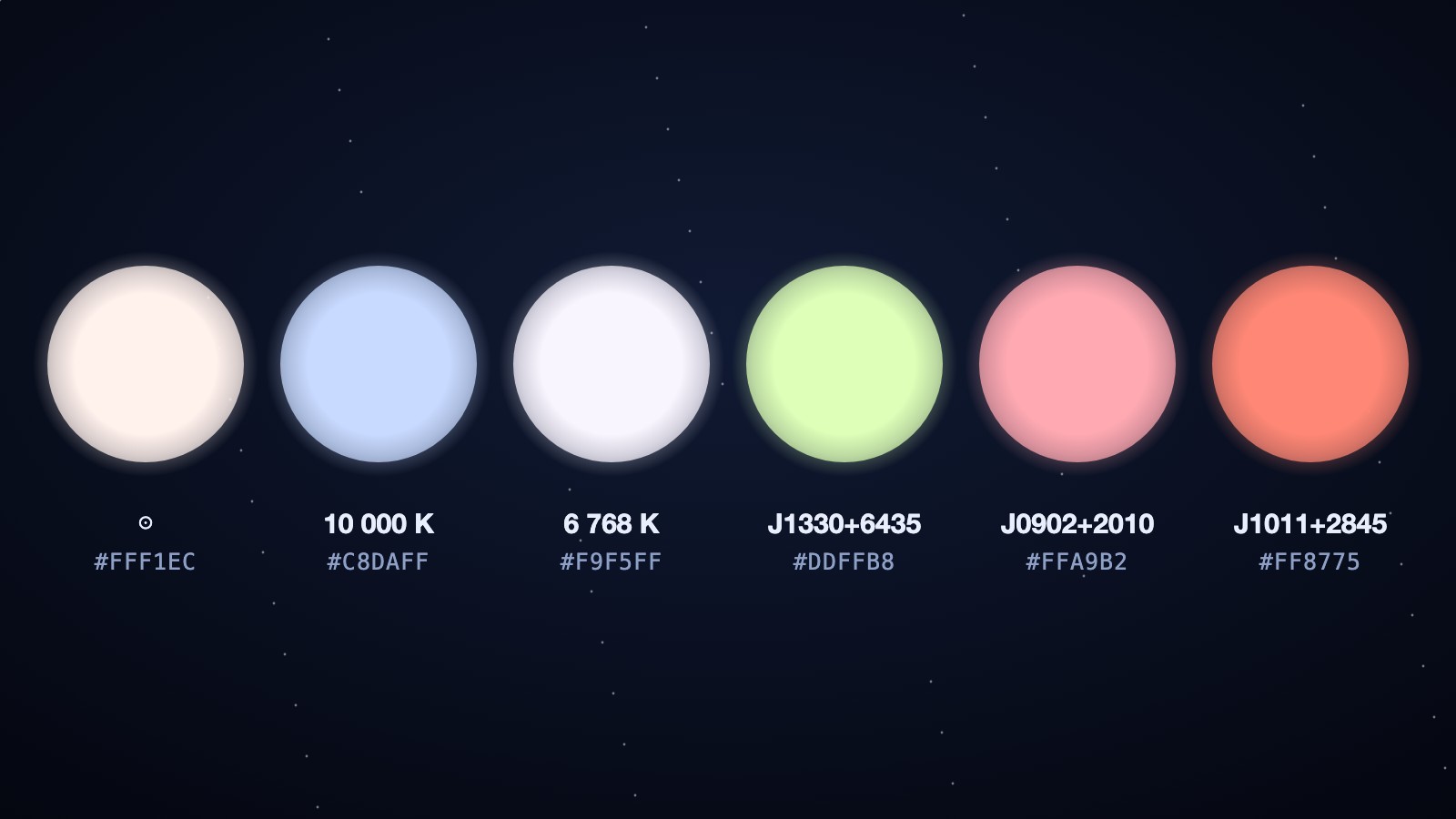
White dwarfs are the dense remnants of Sun-like stars, and we usually picture them as white or pale blue. A study led by Mark Hollands at the University of Warwick, published in RAS Techniques and Instruments on 15 October 2026, computes the colour that an observer close enough to resolve a white dwarf's disc would see. Most are indeed white: among the 152 white dwarfs nearest the Sun, only about one in thirty departs clearly from the colour of a glowing body, and those few look pink or yellow. Among rarer, hand-picked stars the team also found one that would look distinctly green.
What the study did
The team worked with two kinds of samples. One is every known white dwarf within 20 parsecs of the Sun (about 65 light-years), 152 stars, which shows what is typical; it is defined by distance, not by brightness. The others are hand-picked groups chosen to show the extremes: 36 carbon-rich white dwarfs, 36 rich in heavier elements such as sodium, calcium and magnesium (astronomers call every element heavier than helium a metal, but this group excludes carbon) and 15 very cool ones with mixed hydrogen and helium atmospheres. For each star the colour was computed either from its observed spectrum or from a model spectrum matching the star's measured temperature and composition. A spectrum is the star's light split by wavelength. The team ran it through the CIE 1931 colour-matching functions, the international standard for how human daylight vision responds to each wavelength, and converted the result to sRGB, the colour system screens use.
The result is a hue and a saturation, not a brightness. No white dwarf is close enough for us to see its disc, so these are computed colours, not photographs.
Most white dwarfs really are white
The typical white dwarf in the sample has a colour temperature of about 6,800 K (6,768 K in the paper): the temperature at which a perfect glowing body, a blackbody, would show the same colour. That is a very pale white, close to daylight. The familiar picture of blue-tinted white dwarfs comes from the hottest ones: they are brighter, so they are over-represented in surveys that pick the brightest objects. The authors call the common depiction of blue white dwarfs unrepresentative.
Of the 152, 147 have colours close to a blackbody's, the sequence from red through white to blue that the Sun's colour also follows. Five do not: two are yellow and three pink, and none is green. Five of 152 is 3.3%. For white dwarfs in general the paper estimates 3.4%, allowing for the small sample (roughly 2% to 5%), or about one in thirty, with a colour clearly unlike a glowing body. The unusual colours are rare, but they are real.
The green one: WD J1330+6435
The most vivid green in the paper is WD J1330+6435, a cool white dwarf of about 4,240 K (roughly 4,000 °C). It is not one of the 152 nearest white dwarfs but one of the 36 metal-rich ones. Its helium atmosphere carries traces of sodium, calcium and lithium, which, as in other such white dwarfs, come from rocky debris of its planetary system that has fallen onto the star. The sodium absorbs orange light and the calcium absorbs violet, so the star's light is strongest near 500 nm (a nanometre, nm, is a billionth of a metre). The paper gives the resulting colour as chartreuse green, a yellow-green.
The green comes with two limits. First, it is a modelled colour: the authors fitted a model to an observed spectrum that they call somewhat noisy, so the real colour may differ slightly. Second, the star is not unique: two more of the 36 metal-rich white dwarfs, WD J0851+1543 and WD J1351+2645, also look green, though much paler. Some headlines call WD J1330+6435 the first green star. The paper claims less: only that, to the authors' knowledge, no star other than a white dwarf has been claimed to look green. We call it the most vivid green among the white dwarfs the authors examined.
Pink, yellow, cyan and purple
The pink and salmon colours belong to white dwarfs with carbon in their atmospheres. WD J0902+2010 is pink in the paper's simulated images, and WD J1011+2845, 14.73 parsecs or about 48 light-years away, is a deep salmon pink. Most of its light is at wavelengths longer than 600 nm (orange and red), and the paper calls it likely the reddest star known in perceived colour. That describes how it looks, not how cool it is: its temperature, about 4,300 K, is similar to the green star's. Among the 36 carbon-rich white dwarfs, the warmest look pale blue, a few slightly cooler ones pale purple, and most of the cooler ones shades of pink, a few peach.
The two yellow white dwarfs in the 152 are metal-rich stars, like the green one. Cyan appears in a different group: very cool white dwarfs with mixed hydrogen and helium atmospheres, in which collisions between hydrogen molecules and helium atoms absorb visible light. The paper studied 15 of these separately, so they are not a representative sample.
Why density changes the colour
The cause is the atmosphere. A white dwarf's outer layer is squeezed by gravity so strongly that in the coolest stars it reaches about 1 g/cm³, roughly the density of water. In such a dense gas, the strongest absorption lines of metal atoms are smeared out into bands tens to hundreds of nanometres wide. A trace of sodium or calcium can then remove a whole colour from the light, instead of a thin slice of the spectrum.
- Sodium absorbing orange, with calcium absorbing violet, leaves green.
- Carbon molecules absorb in broad bands in the middle of the visible spectrum, giving pale purple in somewhat warmer stars. In the coolest, densest atmospheres the density distorts the bands (in at least one star perhaps a magnetic field does too), and the colour turns pink.
- Collisions of hydrogen and helium in the coolest mixed atmospheres push the colour towards cyan.
Can you see it?
No. None of these stars is visible to the naked eye, and in a telescope our eyes are poor colour detectors in faint light, so the colours would not show reliably. Seen from close up, the stars would also be far brighter than any screen can show. These colours are what the physics of the light predicts, so nothing here can be checked in tonight's sky.
Sources and licences
- Hollands, Gänsicke, Tremblay and Koester, Any colour you like: the diverse chromaticities of white dwarfs, RAS Techniques and Instruments 5, rzag069 (2026) — Main source for the method, the sample (152 white dwarfs within 20 pc, five of them with colours far from a blackbody's), the 6,768 K median, the 3.4% estimate, the data on WD J1330+6435 and WD J1011+2845, the densities and the colour codes in the picture. Published 15 October 2026 as an open-access article under CC BY 4.0. https://doi.org/10.1093/rasti/rzag069
- University of Warwick press release, 15 October 2026 — Used for the plain-language description and the three-colour overview. Its counts (151 and 146) differ from the paper's 152 and 147, so we use the paper's. Its pictures carry no stated licence and are not used. https://warwick.ac.uk/news/pressreleases/astronomers-reveal-true-colours-of-white-dwarf-stars/
- arXiv:2610.18966, the preprint of the paper — Read to check the wording and the numbers in the paper's text. https://arxiv.org/abs/2610.18966