 SkyFlux
Comet Euclid: ESA's Galaxy-Mapping Telescope Discovers Its First Comet
Published · Updated
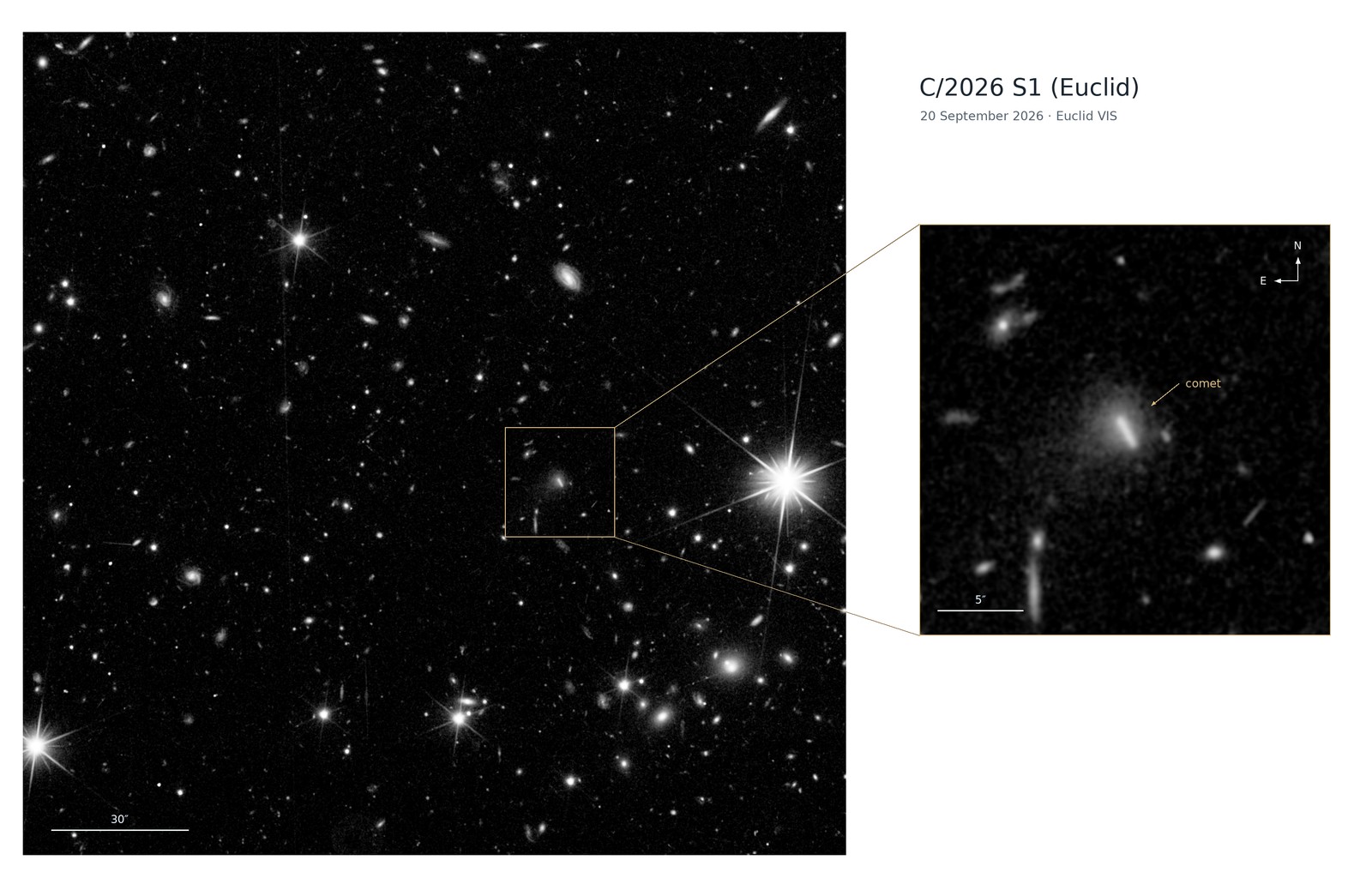
ESA's Euclid space telescope, built to map galaxies, has discovered its first comet, now named C/2026 S1 (Euclid). It is about 1.3 billion kilometers from Earth and lies high above the plane the planets travel in, almost directly over the Sun; its orbit is tilted 85° to that plane.
A comet in a galaxy survey
Euclid measures the shapes and positions of billions of galaxies to trace dark matter and dark energy. It is not built to follow moving objects: it usually images each patch of sky once and avoids the band along the planets' plane, which is crowded with asteroids and comets and brightened by Solar System dust.
The comet turned up in the Euclid Deep Field North, a 20-square-degree patch in the constellation Draco that Euclid observes repeatedly. The field lies near the north ecliptic pole, the sky's point directly above the planets' plane. Because the comet sits so high above that plane, from Earth it appears within a few degrees of that pole, inside the field. ESA calls the catch a happy coincidence of the comet's path and Euclid's schedule.
Mikko Pöntinen, a PhD student at the University of Helsinki, wrote software to find moving objects in Euclid's images. The software flagged a streak across several frames. Pöntinen predicted where the object should be next and found it in 16 exposures taken between September 16 and 24, 2026, surrounded by a fuzzy cloud that marked it as a comet. The Minor Planet Center, the International Astronomical Union's clearing house for such finds, announced it on October 8, after follow-up by telescopes on the ground.
An orbit standing almost on end
The planets circle the Sun in nearly one plane; this comet's orbit is tilted 85° to it. On October 28, 2026, the comet will be 8.9 astronomical units (au) from the Sun (1 au is the distance from Earth to the Sun), and almost all of that distance is height above the planets' plane. Its light takes 74 minutes to reach us.
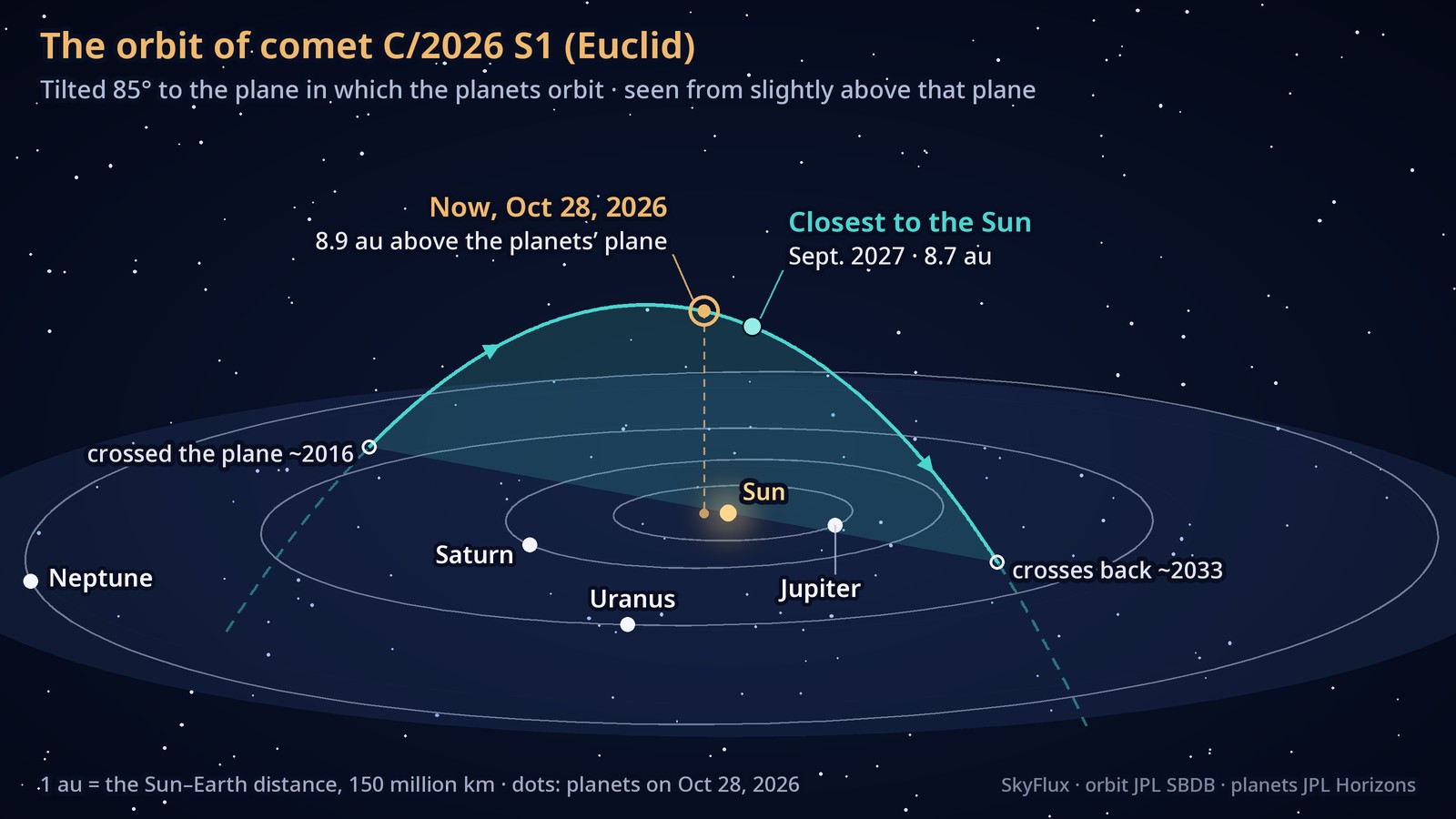
It will be closest to the Sun in September 2027, at 8.7 au. That is closer to the Sun than Saturn ever gets, but the comet will still be about 8.5 au above the plane, so it comes nowhere near any planet. JPL puts the date at September 20, the Minor Planet Center at September 2; both orbit calculations are based on less than a month of observations.
ESA speaks only of an orbit taking thousands of years, which understates it: the current orbits from JPL and the Minor Planet Center point to roughly 190,000 and 89,000 years. With so few observations, neither can rule out that this is the comet's first and only pass.
Why it has a coma so far from the Sun
Comets are icy, dusty leftovers from the birth of the Solar System. Near the Sun their ice turns to gas, and gas and dust form the coma and tail. Water ice, the most common kind, hardly turns to gas beyond about 3 au, so activity at almost 9 au is likely driven by more volatile ices such as carbon monoxide. No measurement of gas from this comet has been published yet, so the cause remains unconfirmed.
Euclid and two ground-based observers measured a coma about 10 arcseconds across, roughly 65,000 kilometers at the comet's distance, or five Earth diameters.
Can you see it yourself?
Not by eye, even through a large backyard telescope. Its predicted brightness in late October is about magnitude 20.5 (JPL) or 20.7 (Minor Planet Center). By an optimistic rule of thumb, an experienced observer with a 50-centimeter telescope under a dark sky reaches about magnitude 17; the comet is roughly 25 times fainter, its light smeared into a haze. Long-exposure images can record it, and amateur observatories with telescopes 30 to 43 centimeters across were among those that followed it up.
It is in Draco, at declination +62°. In the US north of about 28° N, roughly Orlando, it never sets. When the sky is fully dark it stands about 57° above the horizon from New York and 51° from Los Angeles, then sinks to about 12° and 6°, low in the north, before dawn. From Hawaii and southern Florida it sets for part of the night, and from São Paulo and farther south it never gets higher than 5° after dark.
Sources and licences
- ESA, Euclid discovers new comet (October 19, 2026) — Used for the discovery, the dates of the images (September 16–24, 2026), the 16 exposures, the discoverer and his software, the Euclid Deep Field North, the Minor Planet Center confirmation on October 8, the 1.3 billion km distance, the 'straight up' position, the orbit of thousands of years, Euclid's survey strategy. https://www.esa.int/Science_Exploration/Space_Science/Euclid/Euclid_discovers_new_comet
- ESA image pages for the comet — Used for the hero image and its description (September 20, 2026, 560.52-second exposure), the card image (eight 89.5-second exposures aligned on the comet), the credit and the licence. https://www.esa.int/ESA_Multimedia/Images/2026/10/Comet_C_2026_S1_Euclid_observations_in_context and https://www.esa.int/ESA_Multimedia/Images/2026/10/A_composite_of_eight_Euclid_VIS_exposures_of_Comet_C_2026_S1_Euclid
- ESA, Euclid's wide and deep surveys — Used for the Euclid Deep Field North: 20 square degrees in Draco, very close to the north ecliptic pole, chosen for coverage throughout the year. https://www.esa.int/ESA_Multimedia/Images/2023/02/Euclid_s_wide_and_deep_surveys
- Minor Planet Center, MPEC 2026-T146: Comet C/2026 S1 (Euclid) (October 8, 2026) — Used for the reports of the coma, the list of follow-up observatories and their telescopes, the MPC orbit (q = 8.754 au, e = 0.9956, so a ≈ 1,993 au and a period of about 89,000 years), the MPC perihelion date (September 2, 2027) and the MPC brightness prediction. https://minorplanetcenter.net/mpec/K26/K26TE6.html
- JPL Small-Body Database, C/2026 S1 (Euclid), orbit solution JPL#2 — Used for the inclination (85.2°), perihelion distance (8.74 au), eccentricity, perihelion date (September 20, 2027, uncertainty 28 days), the size of the orbit (a = 3,310 au, giving a period of about 190,000 years), its uncertainty, and an eccentricity of 0.997 ± 0.007, which allows an open orbit, and the observation arc (September 16–October 13, 2026). https://ssd.jpl.nasa.gov/tools/sbdb_lookup.html#/?sstr=C/2026%20S1
- JPL Horizons — Used for the comet's distances from the Sun and Earth, its height above the planets' plane, its position in the sky and predicted brightness, the dates and distances at which it crosses the planets' plane, the planets' positions and orbits in the figure, and the visibility from New York, Los Angeles and São Paulo (the 28° N limit for a body that never sets is our calculation: 90° − 61.8°). https://ssd.jpl.nasa.gov/horizons/
- M. Womack, G. Sarid, K. Wierzchos, CO in distantly active comets (2017) — Used for the water-ice sublimation limit of about 3 au and for carbon monoxide as a driver of comets active farther out. https://arxiv.org/abs/1611.00051
- Journal of the British Astronomical Association, letters on telescope limiting magnitude (1999) — Used for the rule of thumb 3.7 + 5 log D (D in mm) for an experienced observer using averted vision in good conditions; for 500 mm it gives magnitude 17.2. https://britastro.org/journal_old/archive/ap99ltrs.htm