SkyFlux
METEORS
The Leonids peak on the night of 17–18 November — a quiet year from the shower that once fell like snow
Published · Updated
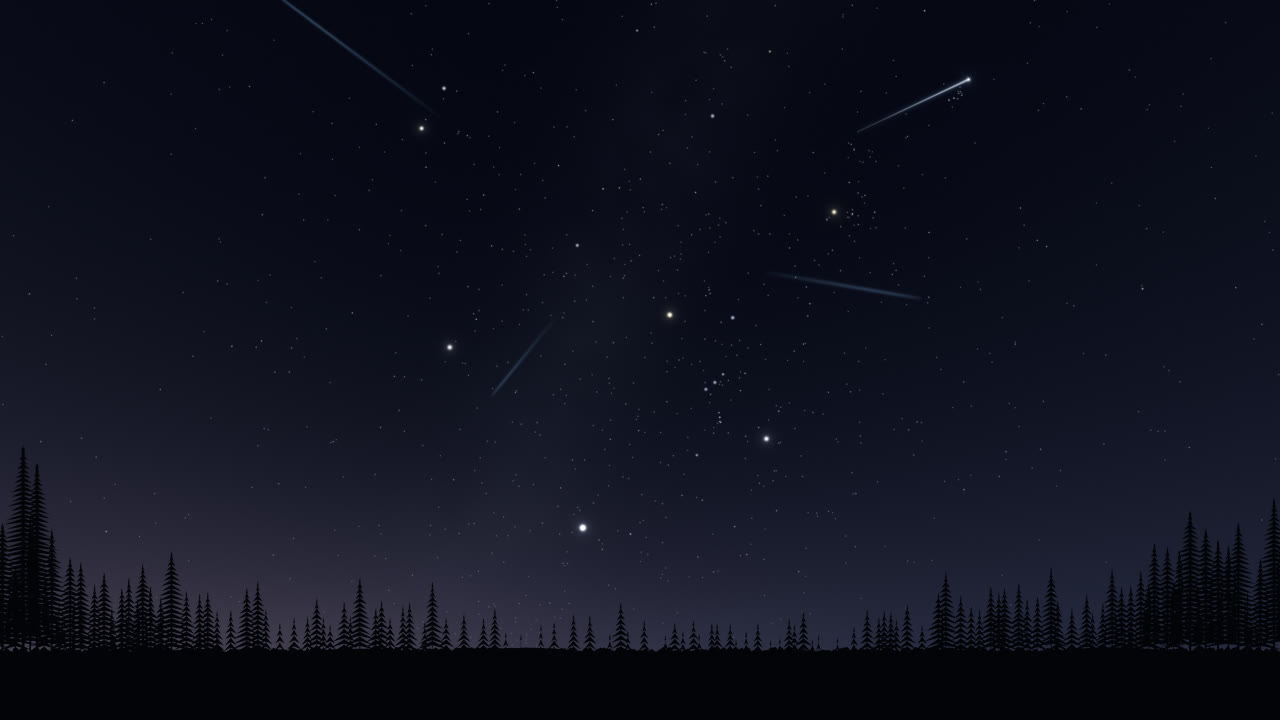
Just before midnight UTC on the night of 17–18 November 2026, Earth passes through the dust of comet 55P/Tempel–Tuttle and the Leonids reach their maximum. This year they will be modest — a ZHR of about 15 (the zenithal hourly rate, a count for ideal skies, explained below), and the 2026 trail model finds no dust trail that would raise the rate noticeably. But the conditions are good: the half-lit Moon sets before midnight in the north and an hour or two after it in the south, and the radiant, the point the meteors seem to fly out of, stands high in the last dark hours before dawn. And the Leonids are not an ordinary shower. They are the fastest of the major showers, they hit Earth almost head-on, and on one night in 1833 they turned meteors from weather into astronomy. This piece covers when and where to look, why the meteors are so fast, the storms of 1833, 1966 and 1999 — and what the models say about the next one.
When: the night of 17–18 November, best in the hours before dawn
The maximum falls on 17 November 2026 at about 23:45 UTC. That is the moment Earth crosses the plane of the comet’s orbit, and two independent sources agree on it: the International Meteor Organization’s figure for the maximum and the comet’s orbit from NASA’s Horizons system put Earth in the same place, to the hundredth of a degree that the IMO quotes. One model of the shower’s background dust puts its gentle maximum about eight hours earlier, at about 16:00 UTC. The peak is broad enough that the difference hardly matters: what counts is the night of 17–18 November, wherever you are.
The Moon will not spoil it. It is at first quarter that day, half lit. In the northern mid-latitudes it sets in the late evening, before the radiant has climbed high enough to matter; in the southern hemisphere it sets an hour or two after midnight. Everything after that is moonless until dawn, and the SkyFlux app shows your own moonset.
At 59° N, for example, the radiant rises in the late evening. A couple of hours after midnight it stands about 28 degrees up in the east, and it keeps climbing for the rest of the night, to about 51 degrees by the time astronomical dawn begins and the sky starts to brighten. So the best hours there are the last three before dawn: the radiant is high, the Moon is long gone and the sky is still fully dark. The SkyFlux app computes the best hours for your own coordinates.
| 59° N, night of 17–18 Nov | radiant height |
|---|---|
| Moon sets | 10° |
| a couple of hours after midnight | 28° |
| two hours later | 43° |
| astronomical dawn begins | 51° |
If the night of 17–18 November is cloudy, the next night is a second chance, though a weaker one: by then the shower’s background activity has dropped to about a quarter of its peak, according to the activity profile SkyFlux uses. The Moon is brighter too and sets about an hour and a half later. One model predicts a few extra meteors at about 02:50 UTC on 19 November from dust the comet shed in 1699.
A quiet year — and how quiet
The Leonids are famous for storms, so it is worth being plain about 2026: no storm and no outburst is expected. Mikhail Maslov, who computes where each of the comet’s old dust trails lies, found no significant trail encounter for this year, and expects the shower to be made up of its broad background dust. His figure for the maximum is a ZHR, or zenithal hourly rate, of 15, and the IMO’s catalogue gives the same.
The ZHR is how many meteors one observer would see in an hour with the radiant directly overhead under a perfectly dark sky. Nobody actually gets those conditions. Worked out for the real radiant height before dawn at 59° N, the hourly count comes to about 10 meteors an hour under a very dark sky, 3 to 4 in the countryside near a town, and 1 or 2 at the edge of a city. That is a model, and it could be about 50 per cent out either way. It is not a show. It is a good, dark, moonless morning with a meteor every few minutes if you are far enough from the lights.
Where to look: find the Sickle, then look away from it
The radiant — the point the shower’s meteors appear to fly out of — lies in the head of Leo, the Lion, in a curve of stars shaped like a backwards question mark and known as the Sickle. The shower is named after Leo. The Sickle is also how you tell a Leonid from a sporadic meteor, one that belongs to no shower: trace a meteor’s streak backwards, and if it leads to the Sickle, it was a Leonid.
You do not stare at the radiant to see the shower. A meteor near it is coming almost straight at you, so its streak is short; a meteor appearing further from it is foreshortened less and draws a longer line. NASA’s own advice is to look away from the radiant for that reason. In the northern hemisphere, face east or south-east, so that the radiant is in your part of the sky, but do not fix your gaze on it; lie back, look up, and let your eyes take in as much of the sky as they can. Give them up to half an hour to adapt to the dark first.
Why they are so fast: a head-on collision
Leonids enter the atmosphere at about 71 kilometres a second — the highest speed in the IMO’s whole list of showers. That is roughly 255,000 km/h, fast enough to cover 100 kilometres in under a second and a half.
The reason is the comet’s orbit. Comet 55P/Tempel–Tuttle and all its dust go round the Sun the opposite way to Earth — the orbit is tilted 162.5 degrees, so far over that the comet travels backwards relative to the planets — what astronomers call a retrograde orbit. On the night of the maximum, Earth moves along its orbit at 30 km/s, and a grain of the comet’s dust at the same distance from the Sun moves at about 41 km/s in nearly the opposite direction. Because they meet almost head-on, the two speeds roughly add up: about 71 km/s. A Leonid is a head-on collision.
That is also why the shower belongs to the morning. Through the hours after midnight you stand on Earth’s leading side, the side driving forward along the orbit, and the Leonid radiant lies within ten degrees of the point Earth is heading toward. The radiant rises late in the evening and is highest in the last dark hours because it sits almost exactly in Earth’s path.
The particles themselves are tiny — most are smaller than a grain of sand. But at this speed each kilogram of dust carries about 2.5 gigajoules of energy, some 600 times as much as a kilogram of TNT, and about four times as much per kilogram as a Geminid arriving at 35 km/s. All of it is spent high in the atmosphere, and the streak you see is that energy being released; the brightest can leave a faint glowing streak, called a train, hanging in the sky for a while after the meteor has gone.
The comet behind them: 55P/Tempel–Tuttle
The parent of the Leonids is comet 55P/Tempel–Tuttle, whose nucleus is about 3.6 kilometres across. It was found independently by Tempel in 1865 and by Tuttle in 1866. It goes round the Sun every 33.2 years. It last passed closest to the Sun on 28 February 1998, and its next return is due on 20 May 2031.
Each time the comet comes close to the Sun, it sheds dust that stays on its orbit as a narrow, dense trail. Young trails are still tight and close to the comet, so Earth tends to meet them in the few years either side of the comet’s return — which is why Leonid storms come in clusters roughly 33 years apart. But not every return brings one. Whether Earth goes through the heart of a trail depends on how the pull of the planets, Jupiter above all, has shifted that trail since it was released. In 2026 the comet is far from the Sun, and Earth passes no dense part of its young trails: the shower will be made mostly of old, spread-out dust, with only minor contributions from a few trails.
1833: the night meteor science began
People had seen Leonid storms long before anyone understood them. Astronomers in China and observers in what is now Egypt and Italy recorded one in 902. In 1799, Humboldt and Bonpland watched one from Cumaná in Venezuela: Humboldt wrote of thousands of fireballs and shooting stars falling one after another for four hours, and Bonpland said there was not a patch of sky three Moon-widths across that was not filled with meteors.
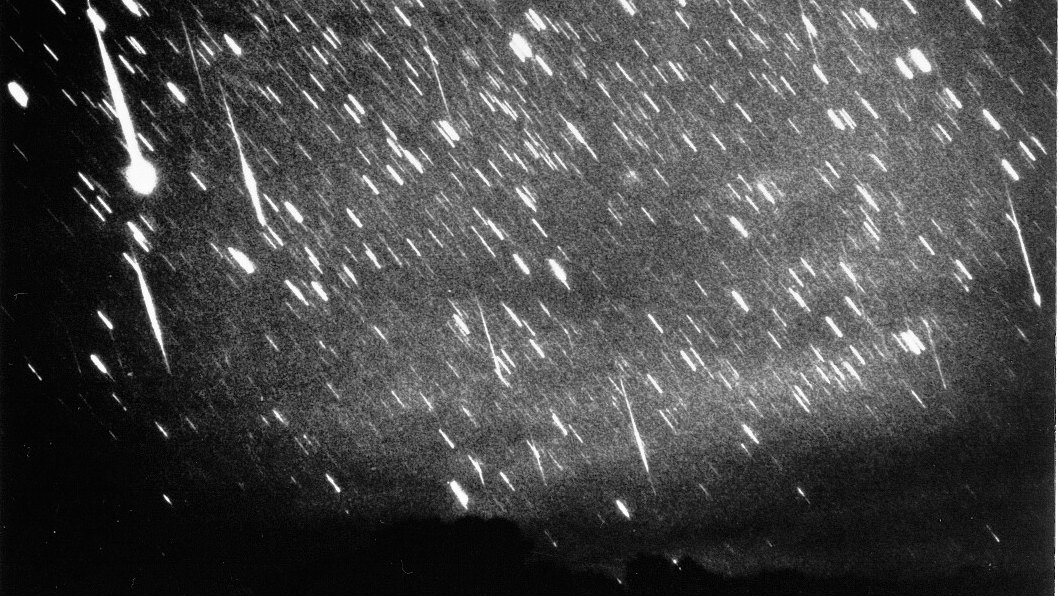
On the night of 12–13 November 1833 the storm came over eastern North America, from dust that had left the comet in 1800. In Boston the meteors were reckoned to fall at about half the rate of snowflakes in an ordinary snowstorm. From the rate as the storm died down, one contemporary estimate put the total at 240,000 meteors visible in nine hours — an estimate, not a count, but it puts the rate at tens of thousands an hour. A man in Washington wrote in his diary that it frightened the people half to death.
Denison Olmsted, a professor at Yale, noticed something that made the night matter for science. The meteors were not falling at random: they all streamed out of one point in Leo, and as the night went on that point moved across the sky with the stars. Anything in the atmosphere would have stayed put relative to the ground and gone round with Earth. Something that kept pace with the stars had to lie beyond the atmosphere, out in space. Olmsted gathered reports from observers in America and Europe and set out the argument in the American Journal of Science in 1834. It was the start of the study of meteors as astronomy.
From 1866 to 1966: a comet found, a storm missed, a storm counted
In 1866, the year Tuttle found the comet, another storm fell over Europe. The comet’s orbital period had just been worked out at about 33 years, and within months astronomers saw that the Leonid stream followed the same path. Along with the Perseids, the Leonids became one of the first two meteor showers to be tied to a particular comet.
Thirty-three years later everyone expected the storm to come back. In 1899 scientists in Paris even sent up a balloon carrying Dorothea Klumpke, the first astronomer to watch for meteors from the air. The storm never came.
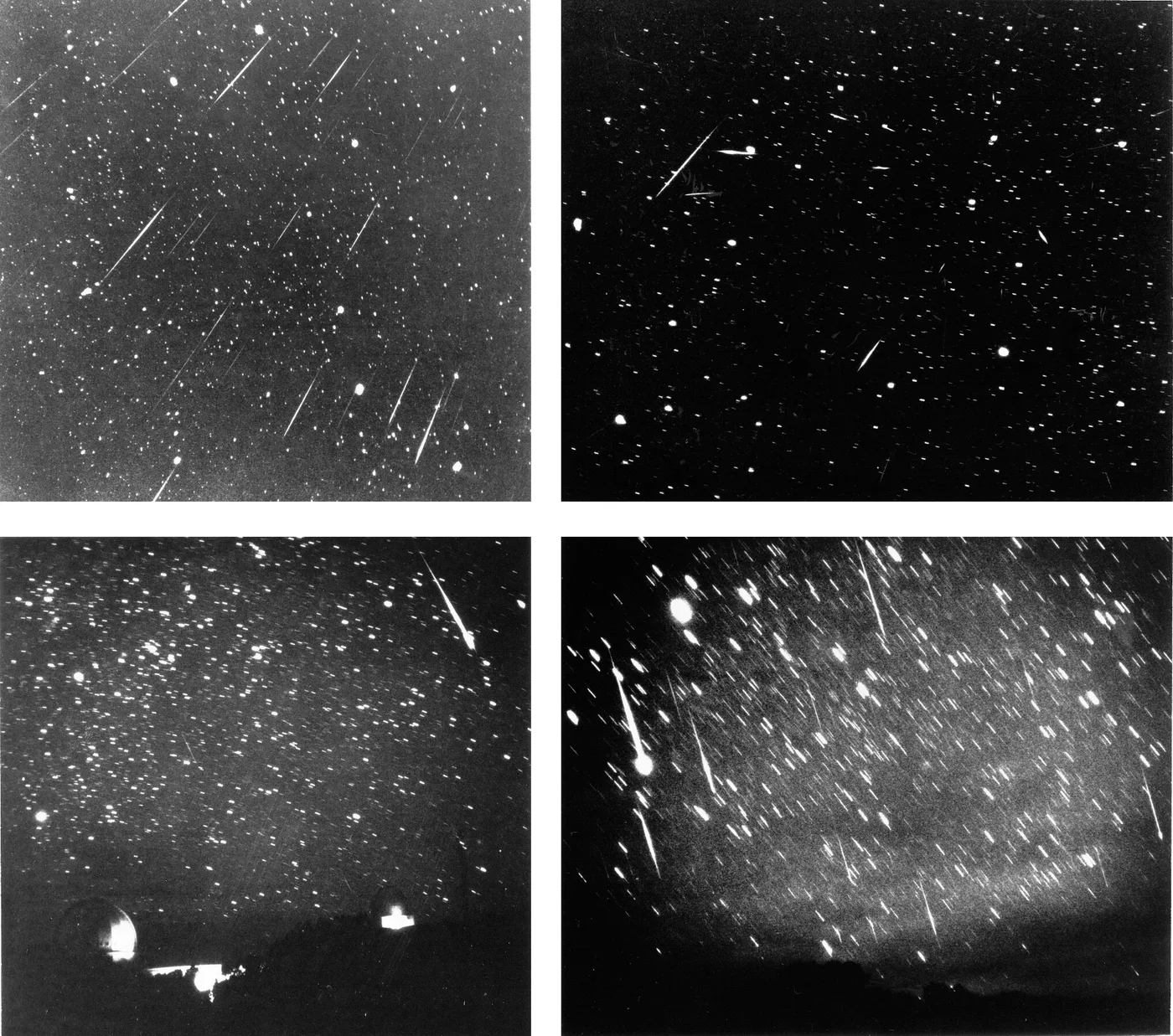
It returned in 1966, though not where it had been predicted. Some had forecast a storm over Europe; it broke over the Americas instead. At Kitt Peak in Arizona a team led by Dennis Milon counted 33 Leonids in their first hour. At 11:54 UTC, about three and a half hours after they had started counting, the rate was 40 meteors a second, and it stayed near that for about twenty minutes. A later analysis of radar records from that night found that the core of the storm lasted less than half an hour (the rate stayed above half its peak for 23 minutes). How that night should be expressed as a ZHR is still argued over, and estimates differ by a factor of ten; what is not in doubt is what was counted on the mountain.
Did you know?The dust behind the great storm of 1966 left the comet in 1899 — the very year everyone was waiting for a storm that did not come. Thirty-three years on, that same trail gave the storm of 1999 too. The comet’s return that disappointed everyone in 1899 had laid down the dust for the next two storms.
| year | what happened |
|---|---|
| 902 | first recorded Leonid storm — China, Egypt, Italy |
| 1799 | Humboldt in Venezuela: thousands of meteors for four hours |
| 1833 | eastern North America; one estimate 240,000 in nine hours; dust from 1800 |
| 1866 | storm over Europe; soon after, the shower is linked to the comet |
| 1899 | expected, and did not come |
| 1966 | 33 an hour to 40 a second in about 3.5 h at Kitt Peak; dust from 1899 |
| 1998 | bright fireballs about 16 h early; dust from 1333 |
| 1999 | first storm correctly predicted by trail models; dust from 1899 |
| 2001 | two storms in one day, each with a ZHR above 1,000 |
| 2002 | two peaks, ZHR about 2,350 and 2,660 — the last storm so far |
1998 and 1999: Hubble turns away, the Moon is struck
By the late 1990s the worry was for spacecraft. Ahead of the 1998 shower, controllers turned the Hubble Space Telescope so that its back faced the stream for ten hours, with its solar panels edge-on to it, although they put the chance of a hit at less than one in ten thousand. That year the shower brought a different surprise: a burst of bright fireballs about 16 hours before the predicted maximum, from dust shed in 1333 and held together ever since by a 5:14 resonance with Jupiter: the dust goes round the Sun five times while Jupiter goes round fourteen times, so Jupiter’s pull keeps repeating in the same place and keeps the dust bunched together instead of letting it spread out.
1999 was the first Leonid storm predicted correctly in advance by modelling where each old dust trail lies. The models said when Earth would meet the 1899 trail, and on 18 November, at about 02:00 UTC, it did: a ZHR in the thousands, between about 3,700 and 5,000 depending on how the count is made. This figure, like the later storm figures, is a ZHR: the rate under the ideal sky described above. It is not a raw count like the one the Kitt Peak team made in 1966.
That night also gave something nobody had seen before. Leonids do not only strike Earth; they strike the Moon too, with nothing there to slow them. Watching the unlit part of the Moon’s face, a team led by Ortiz recorded five brief flashes, each lasting less than a fiftieth of a second — the first impact flashes from meteoroids on the Moon to be confirmed beyond doubt.
The stream stormed again in 2001 and 2002: in 2001, two in one day, one over the Americas and one over East Asia and Australia, each with a ZHR above 1,000; and in 2002, two peaks with a ZHR of about 2,350 and 2,660. Since then there has been none.
From both hemispheres, but not equally
The Leonid radiant lies 22 degrees north of the celestial equator, so the shower can be seen from almost the whole world. It is better from the north. At 59° N the radiant climbs all through the dark hours and stands about 51 degrees up when astronomical dawn begins; its highest point, 53 degrees, comes later, when the sky is already clearly lighter.
From the latitude of Sydney, Cape Town, Buenos Aires or Santiago, about 34 degrees south, it can get no higher than about 34 degrees, and it would reach that only after sunrise, in daylight. When astronomical dawn begins there, it stands only about 17 to 19 degrees above the horizon. Southern observers will see Leonids, but fewer, in a shorter dark window with the radiant low. South of 68 degrees south the radiant never rises at all.
When is the next storm? The models disagree
A meteor storm is usually taken to mean a ZHR of at least 1,000. The comet returns in 2031, and the years around it are the obvious place to look — but the people who model the trails do not agree on what they will bring.
For 2027, the IMO’s calendar lists several possible small outbursts, each up to a ZHR of roughly 40 to 50. For the early 2030s, Maslov’s calculations give strong but not storm-level years: a ZHR of up to about 400 in 2033, 500 in 2034 and 350 in 2035. His next true storm comes only in 2094. A study by Abe, posted in August 2026 and not yet peer-reviewed, finds much more: a ZHR of about 1,400 in 2033, from the same 1899 trail that gave the 1999 storm, and two strong peaks with a ZHR of about 1,400 and 1,200 in 2034.
So the honest answer is that nobody can promise the next storm. One model puts it seven years away, another nearly seventy. What the models do agree on is that the years around 2033 will be well above an ordinary year — and that 2026 is not one of those years.
Why go out in a quiet year
A ZHR of about 15, and perhaps ten an hour from a properly dark site — that is all 2026 promises, so do not oversell it if you bring a friend. Cloud is the bigger risk: mid-November is often overcast at northern latitudes, so check the forecast and keep the second night in reserve.
But a quiet year from this shower is still worth an early alarm. The Moon is out of the way, the radiant climbs through a fully dark sky, and each meteor you see is one of the fastest things that ever reaches the atmosphere: a grain of dust from a comet that last came by in 1998, meeting Earth head-on at 71 kilometres a second. You are watching the same stream that fell like snow over Boston in 1833 and gave forty meteors a second over Arizona in 1966.
Go out for the last dark hours before dawn if you can, somewhere away from town lights, and dress warmly. In SkyFlux, the meteor showers view shows the radiant’s height and direction in your own sky, the dark-sky places list tells you how far to drive, and the sky journal records the date, the place and the state of the sky for you when you see something.
Sources and licences
- Maximum, ZHR, speed and radiant — IMO 2026 Meteor Shower Calendar (IMO INFO(3-25), ed. J. Rendtel), Leonids and Table 5 · web.archive.org/web/20260308033848/https://www.imo.net/files/meteor-shower/cal2026.pdf, archived copy (Wayback Machine, 8 Mar 2026) · accessed 16 Oct 2026
- Trail predictions for 2026 and beyond — M. Maslov, Leonids 2026; Leonids 2021–2030; Leonids 1901–2100 summary · feraj.ru · accessed 9 Oct 2026
- Comet orbit, Moon and Sun — NASA/JPL-Caltech, Horizons: 55P/Tempel–Tuttle, solution JPL#J985/69; Moon rise and set for 59.44° N, 24.75° E · accessed 9 Oct 2026
- Times, radiant heights and expected rates — Computed with astronomy-engine 2.1.19 (MIT) for an observer at 59.44° N / 24.75° E · SkyFlux
- History of the storms — NASA Ames Leonid MAC history (P. Jenniskens), archived copy · NASA Science, Leonids · Linda Hall Library, Denison Olmsted · Asher 1999, MNRAS 307, 919 · Asher, Bailey & Emel’yanenko 1999, MNRAS 304, L53
- 1966 at Kitt Peak — McLean 1967, Communications of the Lunar and Planetary Laboratory no. 82 · Brown, Šimek & Jones 1997, A&A 322, 687
- 1998 and 1999 — NASA/STScI 1998, “Leonid Meteor Storm Won’t Deter Hubble” · Brown et al. 2002, PSS 50, 45 · Ortiz et al. 2000, Nature 405, 921
- 2001 and 2002 — Australian Bureau of Meteorology, Space Weather Services · IMO, Leonids 2002 (archived copy)
- Future storms — S. Abe 2026, arXiv 2608.25456 (preprint, not peer-reviewed) · M. Maslov, Leonids 1901–2100 · IMO 2027 calendar