SkyFlux
METEORS
The Orionids, dust from Halley’s Comet, peak on the night of 21–22 October — best in the dark hours before dawn
Published · Updated
Every October Earth runs through a stream of dust shed by Halley’s Comet, and the grains strike the upper atmosphere at 66 kilometres a second — among the fastest of any major shower. The 2026 maximum falls on 21 October, at about 18:30 UTC, and the best night is 21–22 October. This year a bright Moon, about 80 per cent lit, sits in the sky until well after midnight, so the useful hours are the ones after it sets and before dawn begins — SkyFlux gives both times for where you are. Below: when and where to look, why the meteors are so fast and the dust so old, why Earth meets it at all, and how Jupiter now and then gathers it into an outburst. It ends with an honest number: about 9 to 15 meteors an hour under a dark country sky, and fewer near town.
When: the night of 21–22 October, after moonset and before dawn
The Orionids are active for more than a month, from 2 October to 7 November, but the rate climbs to a maximum only once. According to the International Meteor Organization’s working list, that maximum comes when Earth reaches a particular point on its orbit; by our calculation, in 2026 it does so on 21 October at about 18:30 UTC. The maximum is broad — “about a day or so”, in the IMO’s words — so the exact minute matters far less than the choice of night. NASA and the American Meteor Society both name 21–22 October as the peak night.
This year the night has a complication: the Moon. It is a waxing Moon, about 80 per cent lit, and it stays above the horizon until well after midnight. Moonlight brightens the whole sky, not only the patch around the Moon, and the fainter meteors disappear into it. The hours that count are therefore the ones between moonset and the first light of dawn.
At 59° north, for example, that window on the morning of 22 October lasts a little over three hours, and it is also the stretch in which the radiant, the point the meteors appear to come from, is highest: it rises in the late evening but stays low for hours, and reaches its highest point shortly before the sky starts to brighten. Where the maximum, 18:30 UTC, comes in the evening, the radiant is still low or below the horizon at that moment. The peak is broad, so the dark window matters more than the exact time of maximum. SkyFlux works out the same window for your own position: moonset, dawn and the radiant’s height all change with where you are standing.
The night before is nearly as good, and in the western hemisphere it falls even closer to the maximum. Because the maximum is broad, the morning of 21 October is well inside it wherever you are. The Moon, then about 71 per cent lit, sets earlier, so the dark window is longer. At 59° north the dark, moonless window that morning lasts about four and a half hours, against a little over three on the peak morning. If only one of the two nights looks clear, go out on that one, whichever it is.
Where to look: north-east of Betelgeuse, then away from the radiant
The radiant is the point in the sky from which a shower’s meteors seem to fly outwards. It is a trick of perspective: the grains travel along parallel paths, and parallel lines, like railway tracks, appear to meet in the distance. The Orionid radiant lies in the constellation Orion, about ten degrees north-east of the bright orange star Betelgeuse, close to the border with Gemini. From the northern hemisphere it stands in the south-east in the small hours, and swings towards the south as dawn approaches.
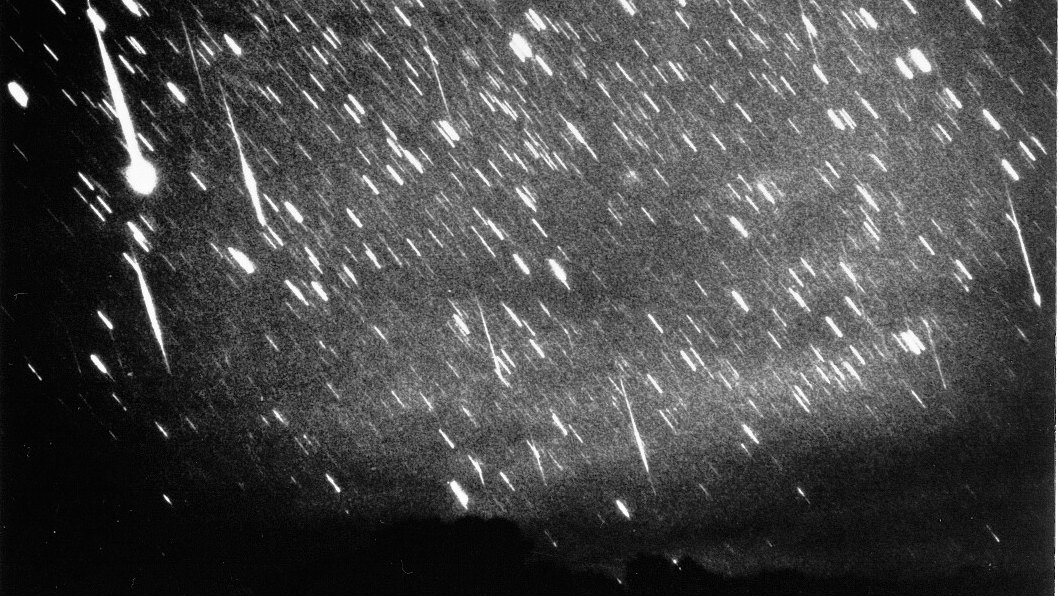
That is where the meteors come from, not where to look. A meteor near the radiant is coming almost straight at you, so it draws only a short stub of a trail. A meteor further from the radiant crosses the sky side-on and leaves a long streak. Look at a broad patch of dark sky away from the radiant and, before moonset, away from the Moon, which sets in the west-south-west.
NASA’s advice is plain and it works: in the northern hemisphere, lie flat on your back with your feet towards the south-east, so that the radiant sits near the edge of your view and the whole sky overhead is open to you; give your eyes about 30 minutes in the dark to adapt, and keep looking up. The meteor showers view in SkyFlux gives the radiant’s height and direction in your own sky, hour by hour.
Not every fast meteor that night will be an Orionid. The small Epsilon Geminid shower is active at the same time, its radiant only about 13 degrees from the Orionids’, and its meteors arrive at 70 km/s — to the naked eye the two are practically indistinguishable. The Taurids, also active in October, are easy to tell apart: their meteors move at 27 to 29 km/s, less than half as fast, and they come from the direction of Taurus.
What you are seeing: grains from Halley’s Comet
Each Orionid is a fragment of comet 1P/Halley. Every time Halley swings close to the Sun, sunlight warms its icy surface, the ice turns to gas, and the gas carries dust away with it. The dust does not stay with the comet. It spreads along the comet’s orbit, and over many centuries it has become a broad stream of particles, most of them between the size of a grain of sand and a pea.
The comet that sheds them is not large. Its nucleus measures about 16 by 8 by 8 kilometres, and its surface reflects only 3 per cent of the light that falls on it, which makes it, as NASA puts it, one of the darkest objects in the solar system. People have been writing down its returns for a long time: the earliest identified record is in Chinese chronicles of 240 BC, and the comet is stitched into the Bayeux Tapestry, which tells the story of the Norman Conquest of 1066. In 1705 Edmond Halley showed that the comets of 1531, 1607 and 1682 were one and the same object, and predicted its return; it came back in 1758.
66 kilometres a second: why the meteors arrive head-on
Orionids enter the atmosphere at 66 kilometres a second. Among the major showers only the Leonids, at 71 km/s, are faster. The reason lies in Halley’s orbit: the comet goes round the Sun the wrong way. The planets all orbit in one direction. Halley’s orbit has an inclination of 162 degrees, which means its plane lies only 18 degrees from Earth’s but the comet travels round it the other way. Its dust therefore meets Earth almost head-on, and Earth’s own orbital speed of 29.78 km/s adds to the grains’ speed instead of subtracting from it.
Speed is what turns a speck into a visible streak, because the energy grows with the square of the speed. At 66 km/s a single kilogram of dust carries about 2.2 gigajoules of energy — around 520 times the energy of a kilogram of TNT. The grains themselves are far lighter: many have a mass of around a hundred-millionth of a kilogram, and such a grain carries about 22 joules: roughly the energy of a 2-kilogram weight dropped from a height of one metre. Delivered in a fraction of a second, high in the atmosphere, that is enough to heat the grain and the air around it until they glow.
You can see the speed. Orionids are quick, and NASA notes that fast meteors can leave glowing trains — faint glows left along the meteor’s path that hang in the sky for several seconds, occasionally minutes, after the meteor itself has gone — and that fast meteors can also sometimes become fireballs.
Dust at least 2,800 years old
The grains burning up over your head did not leave Halley recently. A 2020 model of the comet’s dust by Egal and colleagues found that no particle released after 800 BC reaches Earth as an Orionid today. The dust in this year’s shower is therefore, in that model, at least about 2,800 years old — and the Orionids carry a larger share of old dust than the comet’s other shower, the Eta Aquariids in May (more on them below).
The reason is geometry that has changed over time. The gap between Halley’s orbit and Earth’s at the October crossing has not always been the same: it was smallest around 800 BC. The dust released in that era was laid down where Earth passes today; the comet’s more recent dust was laid down elsewhere.
The unusually strong display of 2006 — an outburst, explained below — can be traced even further back. Simulations by Sato and Watanabe tied it to grains released from the comet in 1266, 1198 and 911 BC. The oldest of those had been travelling for 3,271 years — dozens of trips round the Sun — before it ended as a streak in the 2006 sky.
In October, Halley’s orbit passes 23 million kilometres from ours — and we still hit its dust
Here is a fact that sounds as if it cannot be right. At the time of the Orionids, Earth comes no closer to Halley’s orbit than 0.154 astronomical units — about 23 million kilometres. Yet every October Earth collects the comet’s dust.
It works because the stream is not a thin line along the orbit. Over thousands of years the planets’ gravity has pulled the dust off the comet’s path and spread it into a wide, diffuse band. Earth spends 36 days inside it, from 2 October to 7 November, and in that time travels about 92.6 million kilometres along its own orbit. Along Earth’s path, the stream stretches at least that far.
The same comet, twice a year
Halley’s orbit crosses the plane of Earth’s orbit at two points, and Earth passes near both of them each year. The October crossing gives the Orionids. The other, in May, gives the Eta Aquariids, a second shower of Halley’s dust. Without a telescope, and without waiting for Halley’s return in 2061, you can see pieces of Halley’s Comet twice a year.
The two showers are not equal. The Eta Aquariids are usually two to three times stronger, and the reason is that gap between the orbits again: in May Earth comes within 0.065 astronomical units of Halley’s orbit, less than half the October gap of 0.154. Closer to the orbit, the dust is likely to be denser.
Did you know?Every Orionid is a grain of Halley’s Comet. The comet itself is more than five billion kilometres away and will not return until 2061 — but its dust arrives at 66 kilometres a second, twice a year, and you need nothing but your eyes to see it.
Jupiter’s rhythm: why some years bring an outburst
In most years the Orionids reach a zenithal hourly rate, or ZHR, of about 20 — the number one observer would see in an hour under ideal conditions (more on that in the last section). In 2006 and 2007 they reached about three times that: published estimates put the peak ZHR at about 60 or a little more. Those years were not random, and the cause was Jupiter.
Some of Halley’s grains move in what astronomers call a 1:6 resonance with Jupiter: they go round the Sun once while Jupiter goes round six times — about 71 years, close to Halley’s own period. On every one of its orbits, such a grain meets Jupiter at the same point of its own orbit and receives the same gravitational nudge, again and again. Instead of scattering, as dust normally does, these grains stay bunched together in a dense filament. When Earth runs into one, the rate jumps. Halley itself was in that resonance between 1404 and 690 BC, and some of the dust it shed then is still held together by it — including the 1266, 1198 and 911 BC dust behind the 2006 outburst. The 800 BC limit above still applies: the model finds no dust from after 800 BC reaching Earth today, trapped or not.
A second resonance, 2:13 — two orbits of a grain for every thirteen of Jupiter’s — accounts for the raised activity of 1916 and 1993. Over the long run, the shower’s strength appears to rise and fall in a rhythm of about 12 years, which matches Jupiter’s orbit of 11.86 years. The same research group that found this pattern has also written that a longer run of observations is needed to confirm it, so it is best treated as likely rather than settled.
And 2026? No outburst is predicted. Egal and colleagues’ model expects no significant Orionid outburst up to and including 2050; an earlier study by Sekhar and Asher predicts the next one in 2070. This year should be an ordinary Orionid year.
AD 585: an outburst in the written record
Models of these resonances do not only predict the future; they can be checked against the past. In 2020 Kinsman and Asher modelled Halley’s dust back across the first millennium and found probable outbursts in AD 417 and 585, driven by Jupiter’s 1:6 and 1:7 resonances. The dust of 585 came from two of Halley’s passages, in 1266 BC and 911 BC.
For 585 there is a witness. An Orionid outburst in that year was recorded in China, and the model confirms that what the Chinese observers saw was an outburst of Halley’s dust. A link with Maya inscriptions from around 585 has also been proposed, but it is only probable, not confirmed — a difference worth keeping. Either way, the people who saw those meteors fourteen centuries ago were looking at grains that had already been in space for more than a thousand years.
Where Halley is on the peak night
Halley last passed the Sun on 9 February 1986. It then travelled outwards until 9 December 2023, when it reached its farthest point from the Sun, about 35 astronomical units away. It has now turned back. On the peak night of 2026 it is 5.26 billion kilometres from Earth, in the constellation Hydra, and shines at magnitude 25.6. The faintest stars the eye can see under a very dark sky are about magnitude 6.5 (higher numbers are fainter), so the comet is hopelessly out of sight. Its light takes 4 hours and 52 minutes to get here.
Its next pass close to the Sun is due on 28 July 2061. Until then the only part of Halley anyone will see without a large telescope is the dust that arrives every May and every October. Do not look for the comet at the radiant: the radiant marks the direction the dust arrives from, not where the comet is.
Both hemispheres can see it
Unlike showers whose radiant sits far to the north, the Orionids belong to the whole world. The radiant lies 16 degrees north of the celestial equator, so it rises everywhere north of latitude 74 degrees south. NASA’s advice is the same in both hemispheres: the hours after midnight are best. In the southern hemisphere, lie with your feet towards the north-east rather than the south-east.
At the equator the radiant climbs to about 74 degrees, and at latitude 16° north it passes directly overhead. North of 16° its highest point is 106 degrees minus your latitude — about 47 degrees at 59° north. South of the equator it is 74 degrees minus your latitude: about 50 in São Paulo, 40 in Sydney. In Sydney this year two things work against you: the radiant is highest only as dawn arrives, and the Moon leaves a dark, moonless window of only about one hour on the peak morning.
Honestly: what to expect
The Orionids’ standard figure is a ZHR of 20. ZHR, the zenithal hourly rate, is the number of meteors one observer would see in an hour with the radiant directly overhead and a perfectly dark sky. It is a ceiling, not a promise. At 59° north the radiant climbs to only about 47 degrees before dawn and never stands overhead; further south, down to latitude 16° north, it climbs higher and the counts rise with it, and the darkness of the sky decides the rest. The table uses the peak rate for a radiant about 45 degrees up — the last two dark hours before dawn on 22 October at 59° north.
| your sky | meteors an hour, before dawn |
|---|---|
| very dark country sky | about 13–15 |
| good country sky | about 9 |
| edge of town | about 5–6 |
| in town | about 3–4 |
Before moonset the numbers are lower still, because the Moon brightens the sky as town lights do. That is why the advice in this piece points to the small hours: they are when the radiant is high and the Moon is gone at the same time. The dark-sky places list in SkyFlux shows how far out of town you need to go.
So the Orionids of 2026 are a quiet watch, not a display: one meteor every few minutes under a good sky, some of them quick, bright streaks that leave a glowing train behind. Set an alarm, dress warmly, and give your eyes half an hour to adjust to the dark. Each meteor you do see is a grain that left Halley’s Comet at least 2,800 years ago, according to a 2020 model by Egal and colleagues.
Sources and licences
- Activity, maximum, radiant, speed and ZHR — IMO Meteor Shower Calendar 2027 (Rendtel), working list, table 5 and radiant drift table 6 — values that do not change from year to year · imo.net/ShCal27s.pdf · accessed 9 Oct 2026. IAU Meteor Data Center, shower 00008 ORI · accessed 9 Oct 2026. NASA Science, Orionids; American Meteor Society calendar (peak night 21–22 October) · accessed 9 Oct 2026
- Moon, twilight and radiant times — NASA/JPL-Caltech, Horizons (Moon, topocentric, 59.4° N / 24.8° E) · computed with astronomy-engine 2.1.19 (MIT) for 59.4° N / 24.8° E, for Sydney and for the equator · SkyFlux
- Hourly rates under different skies — Computed from ZHR 20 and population index 2.5 (IMO) with the standard ZHR formula, radiant altitude 43–47° · SkyFlux
- Halley’s orbit and position — NASA/JPL-Caltech, Horizons (1P) and Small-Body Database, solution JPL#75 · accessed 9 Oct 2026. Nucleus size, albedo and the Bayeux Tapestry: NASA Science. Earliest records (240 BC) and Halley’s 1705 identification: Egal et al. 2020. Earth’s orbital speed: NASA NSSDC Earth Fact Sheet. TNT equivalent: NIST SP 811, Appendix B.9
- Dust age, distances and outbursts — Egal et al. 2020, “Activity of the Eta-Aquariid and Orionid meteor showers”, A&A (arXiv:2006.08576) · Egal et al. 2020, “Modeling the past and future activity of the Halleyids”, A&A (arXiv:2008.03589) · CBET 1518 (Jenniskens, Sato & Watanabe) · Sekhar & Asher, “Resonant behavior of comet Halley and the Orionid stream” (arXiv:1303.2928)
- AD 417 and 585 — Kinsman & Asher 2020, MNRAS 493, 551–558 (arXiv:2002.00106)
- What could not be checked — Sato & Watanabe 2007 (PASJ 59, L21) could not be opened and is cited through Egal et al. 2020 and CBET 1518