SkyFlux
METEORS
The Draconids peak on 8–9 October 2026 — from northern latitudes the radiant is highest in the evening, but the peak follows its own time
Published · Updated
This story was written before the event: its times and expectations are a forecast, not a result.
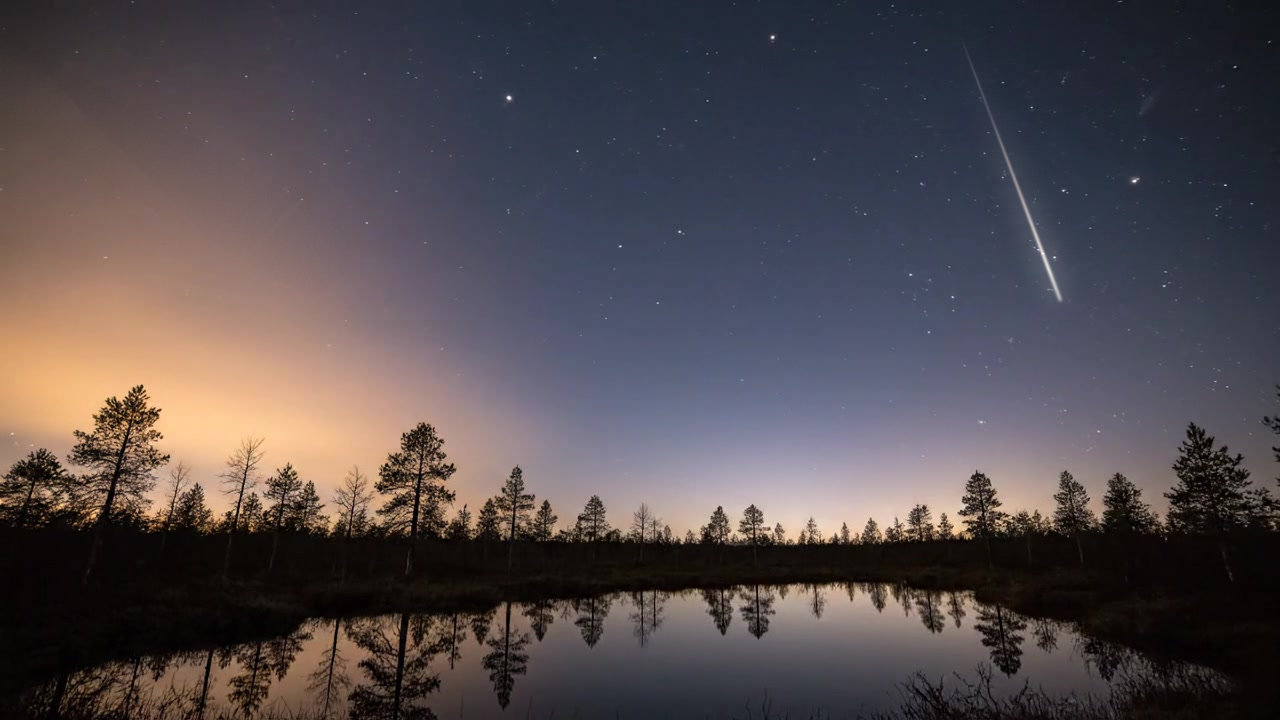
On 9 October 2026, at about 01:20 UTC, Earth crosses the dust stream of comet 21P/Giacobini-Zinner — across Europe, Africa and the Americas that is the night of 8–9 October. Most meteor showers show more meteors toward morning, and there is a good reason for that. The Draconids do the opposite, and the reason is not the one most guides give. This piece has the computed arc that proves the shower really does run the other way, an explanation that also accounts for why the Perseids and the Geminids build toward morning, a look at the comet whose stream Earth is crossing — and an honest expectation for 2026: a ZHR of about five, not a show. It also carries the part most guides leave out: from northern latitudes the radiant is highest in the evening, but the shower’s own maximum is fixed in UTC — so which hour of your night is the best one depends on where you are — above all your longitude, and your latitude too.
When: the night of 8–9 October — and wait for full darkness
The Draconids reach maximum on 9 October 2026, at about 01:20 UTC — about, because the models predict the moment of the peak to within half an hour, not to the minute. Your own clock shows that instant in your own time zone, and across much of the world it falls into the night that follows the evening of 8 October. That is why this piece carries two dates: the event is a single instant, but it may fall on either of two calendar dates. If a date and a clock time are ever going to disagree, this is where they do it.
The peak is not a sharp one, and that is good news. According to the activity profile the app uses for this shower, the rate falls to half about three hours either side of the peak — some six hours from half-strength to half-strength. Observed outbursts were clearly shorter — two to five hours from start to finish — but they still lasted hours, not minutes. So you do not have to time it to the minute. You have to pick the right night.
And here is the detail that changes the whole evening: go out when the sky is properly dark, not when the Sun goes down. Between those two moments can lie anything from an hour and a half to over two hours, and by the end of it the radiant is already as high as it will get all night. But altitude is only half of what reaches your eye. The other half is the shower’s own activity curve, and it keeps a clock of its own: the maximum falls at 01:20 UTC wherever you happen to be standing. Combine the two and the best hour slides with your longitude. Near 88° W the maximum lands just as darkness falls, and there the first dark hour really is the best one. In Europe it lands near the end of the night instead — for a reader at 59° N and 25° E the peak falls at about 03:00 local solar time, and the night’s last hour gives more than twice as many meteors as its first.
| observer’s latitude | from sunset to full darkness |
|---|---|
| 59° N | 2 h 15 min |
| 51° N | 1 h 50 min |
| 41° N | 1 h 31 min |
A table like this one can only carry three rows. Your own sunset, your own twilight and your own radiant altitude are computed from your coordinates in the app — and it does that for every evening, not just this one.
Why most showers show more meteors toward morning
Earth moves along its orbit in one particular direction, and from roughly midnight to noon you are on the planet’s leading side — the side driving into the dust. The dark part of that stretch runs from midnight to dawn. Through the evening you are on the trailing side, and the dust has to catch up with you. A car in rain does exactly the same thing: the windscreen collects the drops, the rear window hardly any.
This is the apex effect; the apex is the point in the sky Earth is heading toward, and the morning sky faces it. The effect is real and measurable, and it is why, for most showers, an hour near dawn yields more meteors than an hour in the evening.
One thing this does not say: when you are allowed to look. You can look at any dark hour, exactly as you can look at anything else in the sky. There is no rule — there is only quantity. And that is what makes the next part an exception rather than a caprice: if the apex effect is true, then anything that runs against it needs explaining.
The Draconid arc runs the other way — and it can be measured
The radiant is the point in the sky a shower’s meteors appear to fly out of. The Draconid radiant sits in the head of Draco, the Dragon — which is where the name comes from. The radiant’s altitude decides the quantity: the higher it stands, the larger the share of the shower’s meteors that arrive above your horizon, where you can see them.
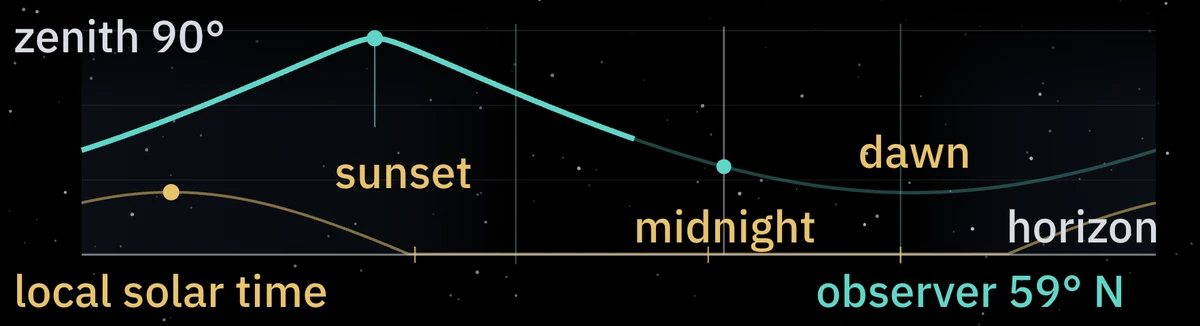
At latitude 59° N, astronomical darkness lasts about eight and a half hours. At the first instant of that window the Draconid radiant stands close to 65 degrees high, at the last instant 25 degrees. In between it never climbs back: the arc only descends — and it reaches its lowest point only once the sky is already brightening toward dawn. The app computes your own window from your own coordinates.
This is the part of the story you can check. At no moment of that night is the radiant higher than at the first instant of darkness — so “right after nightfall” is not observing lore or a matter of taste, it is the shape of a computed arc. The radiant ends the night at the bottom of a curve it never climbed back up. What the arc does not settle on its own is which hour is best: it gives the altitude, and the altitude is one of the two numbers that decide what you see.
And the reason is not the one usually given
The reason is not that the radiant sits near the celestial pole — that is the explanation you hear most often, and a single number disposes of it. The Perseid radiant’s declination is nearly 58 degrees — closer to the pole than the Draconids’ +56 degrees — and the Perseids are at their best just before dawn, exactly as the apex effect predicts. If nearness to the pole decided this, the two would have to behave alike. They do not.
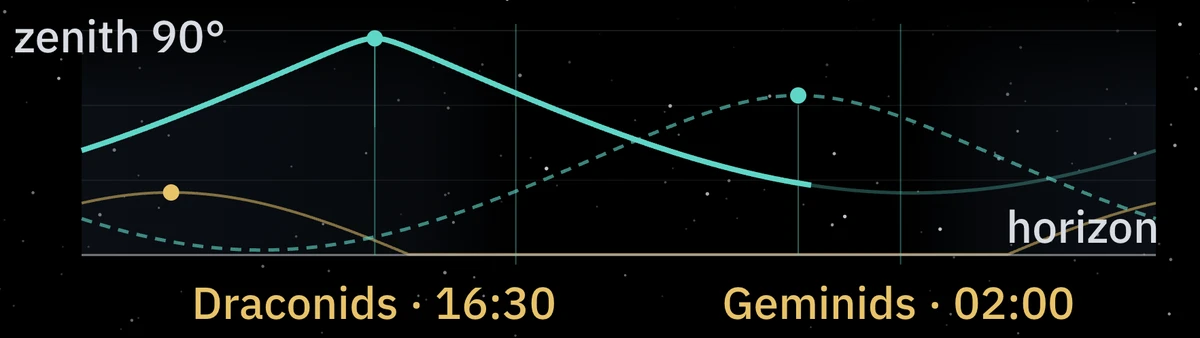
The real reason is right ascension. That is the sky coordinate that says how far east of the vernal equinox a point lies, measured in hours; the difference between the Sun’s right ascension and an object’s says how far east or west of the Sun that object currently lies. Every point in the sky reaches its highest at the moment it crosses the meridian — the north–south line through the top of your sky — and that happens almost exactly as many hours after local noon as it lies east of the Sun. At maximum the Sun’s right ascension is 12.97 hours and the Draconid radiant’s is 17.47 hours — a difference of 4.5 hours.
Everything else follows from that: the radiant culminates at about 16:30 local solar time, at every longitude. That is the most location-neutral sentence in this piece — it does not depend on your time zone or on when your Sun sets. At latitude 59° N the radiant reaches about 87 degrees at that moment, with the Sun still six degrees above the horizon. By the time the sky finally darkens, the radiant’s highest point has already gone by.
| shower | radiant relative to the Sun | culminates, local solar time |
|---|---|---|
| Draconids, 9 October | 4.5 h east | ~16:30 |
| Geminids, 14 December | 10 h west | ~02:00 |
Same arithmetic, opposite answer — and it never once uses declination. The Geminid radiant’s declination is +33 degrees, twenty-three degrees lower than the Draconids’, and that number does not enter the calculation at all. That is the whole division: declination decides how high the radiant gets at your latitude, and right ascension decides when it gets there. Two different things, easy to confuse — and confusing them is exactly where the wrong explanation comes from.
Why the radiant never sets — and who this piece does not apply to
This is a second fact, not the same one. The previous part explained why the radiant is already high in the evening. This one explains why it stays at a usable height all night, and the answer is simple arithmetic.
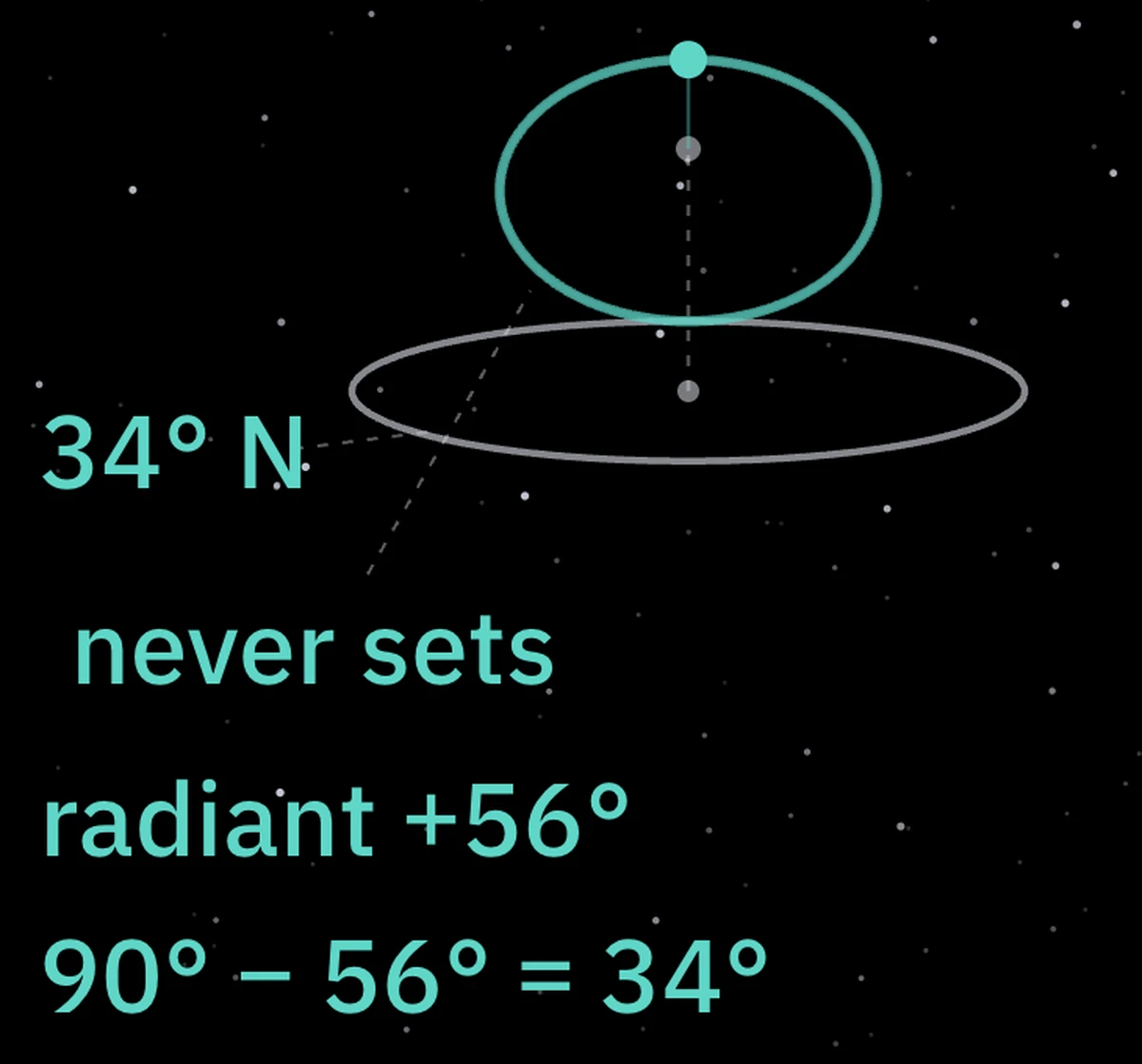
The radiant’s declination is +56 degrees. An object never sets if the observer’s latitude is greater than 90 minus its declination — here, 34 degrees. North of latitude 34° N the Draconid radiant never sets at all: it sinks, but it does not go away. After culminating it swings west and ends the dark hours close to due north, near the bottom of its arc — and still above the horizon.
The same arithmetic settles the other half, the half observing guides usually leave out. South of latitude 34° S this radiant never rises at all. At 20° S its highest point is 14 degrees — low, behind thick air, and brief. If you are reading this from the southern hemisphere, the shower is barely for you, and that is better to know beforehand than afterwards: the Draconids are a northern-hemisphere event.
Where the dust comes from: one comet and its trail
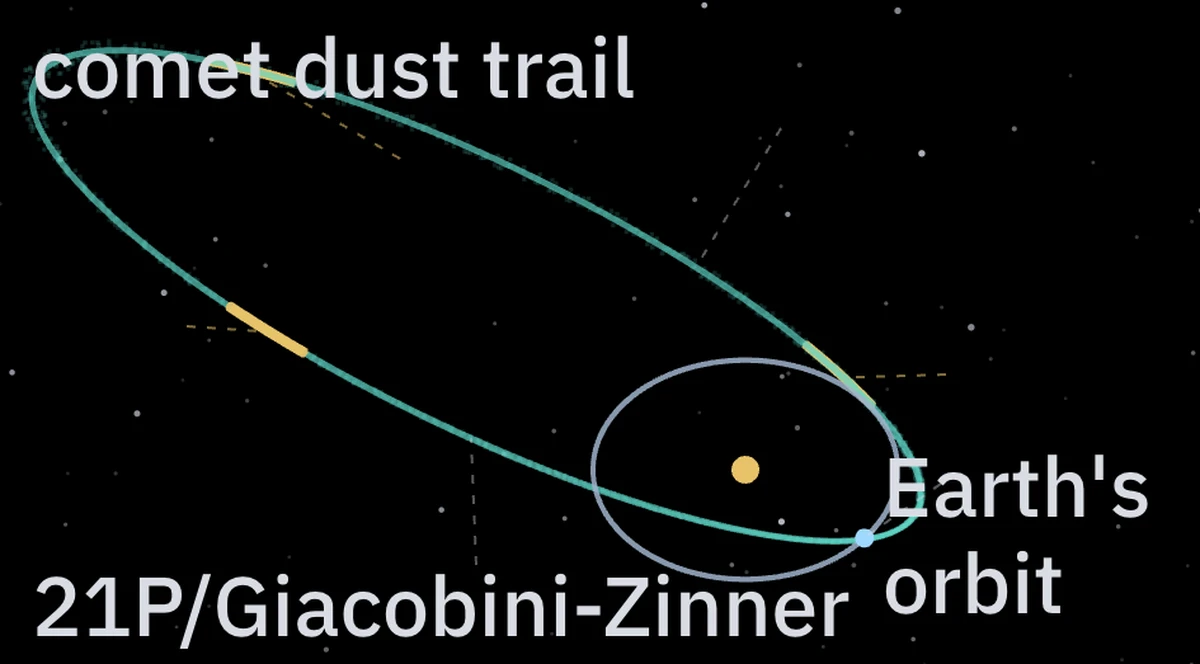
A meteor shower is not “something happening in the sky”. It comes from the trail of debris left by one particular parent body — usually a comet. Earth crosses that trail at the same time every year. The Draconids’ parent comet is 21P/Giacobini-Zinner: an icy body about two kilometres across that goes round the Sun every 6.55 years and last passed close to it on 25 March 2025.
Every time the comet nears the Sun, ice vaporises from its surface and dust is released. The dust does not stay with the comet. It stays on the comet’s orbit, stretches out along it into a long trail, and over decades drifts slowly out of place under the pull of the planets. So a comet is not followed by one trail but by a whole bundle of them — each passage leaves its own.
And here is the number that explains all the rest. The comet’s path crosses the plane of Earth’s orbit 1.0168 astronomical units from the Sun; Earth itself is 0.999 units out at the moment of maximum. The gap is 2.66 million kilometres, and Earth passes by on the inside of the comet’s track. In most years the dust simply goes by — which is exactly why the Draconids are usually quiet.
Why the Draconids are unpredictable
Outbursts do not come from the comet being nearby. They come from Earth running into a fresh dust trail — one trail out of many, left on a single passage, that the pull of the planets happened to nudge onto Earth’s path. The storms of 1933 and 1946 both came mainly from two such trails: the dust released in 1900 and the dust released in 1907. In 1933 those trails were 33 and 26 years old; by 1946 they were 46 and 39 — and both times they were in the right place at the right time.
How many meteors an hour, then? Here is where to be careful: this is the number most often inflated elsewhere. For 1933 the published estimates run from 5,400 to 30,000 meteors an hour, and they are not counts. They are ZHR, the zenithal hourly rate: how many meteors one observer would see in an hour if the radiant stood exactly overhead under a perfectly dark sky. A real observer will usually see fewer. The estimates differ by a factor of five and a half, and Egal and co-authors themselves call the estimates very disparate — so the honest answer is not one number but a range.
1946 was a storm too: observed estimates fall between ZHR 2,000 and 10,000, yet the models place it above 1933. Which of the two was the bigger is therefore not a settled question — and “not known” is an honest answer here, not a dodge. In 2011 came a smaller outburst, ZHR 300 to 560 — the kind you can watch from start to finish in one evening and remember for life.
That is why two things that look contradictory are both true of the Draconids: most years give a ZHR of a few, and an occasional year a ZHR in the thousands. The shower is the same. The trail is not.
Is 2026 a special year? No model predicts an outburst — and that answer rests on computed dust trails, not a hunch
The longer answer is the interesting one, because it says how that is known.
Two recent modelling studies are especially relevant here. In 2019 Egal and co-authors modelled the stream over 1850–2030 and predicted three outbursts still ahead at the time, all of them radio outbursts — faint meteors that radar picks up but the eye mostly misses: 2019, 2025 and 2029, the strongest in 2025 when Earth meets the young 2012 trail. The year 2026 fell inside the computed range, and it is never named. The same group’s 2025 paper, which calibrated three independent models against the more recent outbursts, makes predictions only for 2025. But the models do not name everything they later have to explain: on 8 October 2024 the shower produced a weak outburst nobody had predicted — ZHR about 16, with preliminary modelling suggesting that it may have come from dust the comet shed in 1900. A year the models do not name is a year they have not ruled out.
And one explanation that is easy to arrive at on your own has to be set aside here: that 2026 is quiet because the comet is far away. Egal and co-authors say the opposite outright — Draconid outbursts are not tied to where the comet currently sits relative to Earth. The trail decides, not the comet. And for 2026 no published trail lands on Earth’s path.
The consequence is simple, and it is also a commitment: this piece does not promise a show. If someone else does, it is worth asking which model they are leaning on. The Draconids have surprised people before and may do so again — but a surprise is, by definition, the thing nobody announced.
What the eye actually sees: a slow streak, not a flash
The Draconids enter the atmosphere at about 20 kilometres a second. For meteors that is slow: the Perseids come in at 59 kilometres a second, nearly three times faster.
The difference is visible, and it changes what to expect. A typical fast meteor is a flash — you notice it only once it is gone. A Draconid drifts. It draws a calm, often yellowish streak that visibly lasts longer than a summer Perseid does. There are fewer of them, but each one is watchable, and you can follow it with your eye.
The speed comes from how the comet’s path cuts across Earth’s. 21P orbits the Sun in the same direction as Earth and its path is tilted 32 degrees to the plane of Earth’s orbit, so the meeting is more of an overtaking than a head-on collision. And from that low speed comes the long calm streak.
One thing that will not be in the way: the Moon
Apart from cloud, the worst enemy of most meteor showers is the Moon: under a bright gibbous or a full Moon many of the fainter meteors simply vanish into the skyglow. The 2026 Draconids escape that, and it is a rare enough coincidence to be worth saying out loud.
New Moon falls on 10 October at 15:50 UTC, about a day and a half after maximum. On the night of 8–9 October the Moon is a waning crescent, three per cent lit. At latitude 59° N it sets before the Sun and does not rise again until after dawn has begun — for the whole of the dark it is below the horizon. If you miss anything that night, it will be cloud or town lights, not the Moon.
Honestly: what to expect, and how to get the most out of it
About five meteors an hour — and even that number is a ZHR, the figure for a perfect sky with the radiant overhead. Under a real sky, at the radiant’s real altitude, there will be fewer. Near the moment of maximum, with the radiant high, a good site may give a meteor or two an hour. Under town lights it may give none.
This is not a show, and it is not worth promising a friend that it will be one. It is quiet watching: you go out, you give your eyes twenty minutes to adapt, and you wait. When a meteor does come, it is a slow yellowish streak that lasts noticeably longer than you expected — and its grain of dust drifted along the comet’s path for decades before burning up over your head.
The practical part comes down to three things. Go out when the sky is properly dark, not at sunset. You will lose an hour and a half to two and a quarter hours waiting, and that is exactly the stretch in which the radiant stands highest — but nothing can be done about it: twilight hides all but the brightest meteors. Just look up, not at the radiant: a meteor can light up anywhere in the sky, and near the radiant a meteor’s trail is shortest, because it is coming almost straight at you. And take a warm coat: whichever hour turns out to be the best where you stand, it is an October night.
If you trace the streak backwards and it leads to Draco’s head, it was a Draconid. If it leads elsewhere, it was a sporadic — a stray meteor that belongs to no shower — there are some every night, shower or no shower. In SkyFlux, the meteor showers view gives the radiant’s altitude and bearing in your own sky, the dark-sky places list tells you how far out of town you need to drive, and the sky journal writes down the date, the place and the state of the sky for you if you see something.
Sources and licences
- Time of maximum and speed — IAU Meteor Data Center, shower 00009 DRA (Jenniskens 2023) · ta3.sk/IAUC22DB · accessed 16 Sept 2026; radiant RA 262.8° / Dec +55.9° from the same entry, accessed 23 Sept 2026. The IMO 2026 meteor shower calendar gives Dec +56°.
- Comet orbit — NASA/JPL-Caltech, Horizons, 21P/Giacobini-Zinner, solution JPL#K253/4 · accessed 16 Sept 2026
- Outbursts and models — Egal et al. 2019, Icarus 330, 123–141 · Egal et al. 2025, MNRAS Letters 544, L102 (CC BY 4.0)
- Arcs, twilight and the Moon — Computed with astronomy-engine 2.1.19 (MIT) for an observer at 59.0° N / 25.0° E · SkyFlux
- Shower catalogue values — SkyFlux shower catalogue: ZHR 5 · activity-profile slope B 2.5 per degree of solar longitude (larger B = narrower peak) · 20 km/s · Perseids 59 km/s
- Checked against the IMO 2026 calendar — IMO 2026 Meteor Shower Calendar (IMO INFO(3-25), ed. J. Rendtel), Draconids (009 DRA) · web.archive.org/web/20260308033848/https://www.imo.net/files/meteor-shower/cal2026.pdf, archived copy (Wayback Machine, 8 Mar 2026) · accessed 16 Oct 2026. It gives the maximum on 9 October around 01h UT, ZHR 5 (marked uncertain), radiant RA 263° / Dec +56° and 20 km/s, and no prediction of enhanced rates for 2026 — consistent with this story. It does not give the activity-profile slope B, so the B value above is the SkyFlux catalogue’s own and has not been checked against a primary source.
- Photo on the news card — NASA/Bill Ingalls, public domain