SkyFlux
PLANETS
Saturn is up all night on 4 October — here is how to find it
Published · Updated
This story was written before the event: its times and expectations are a forecast, not a result.
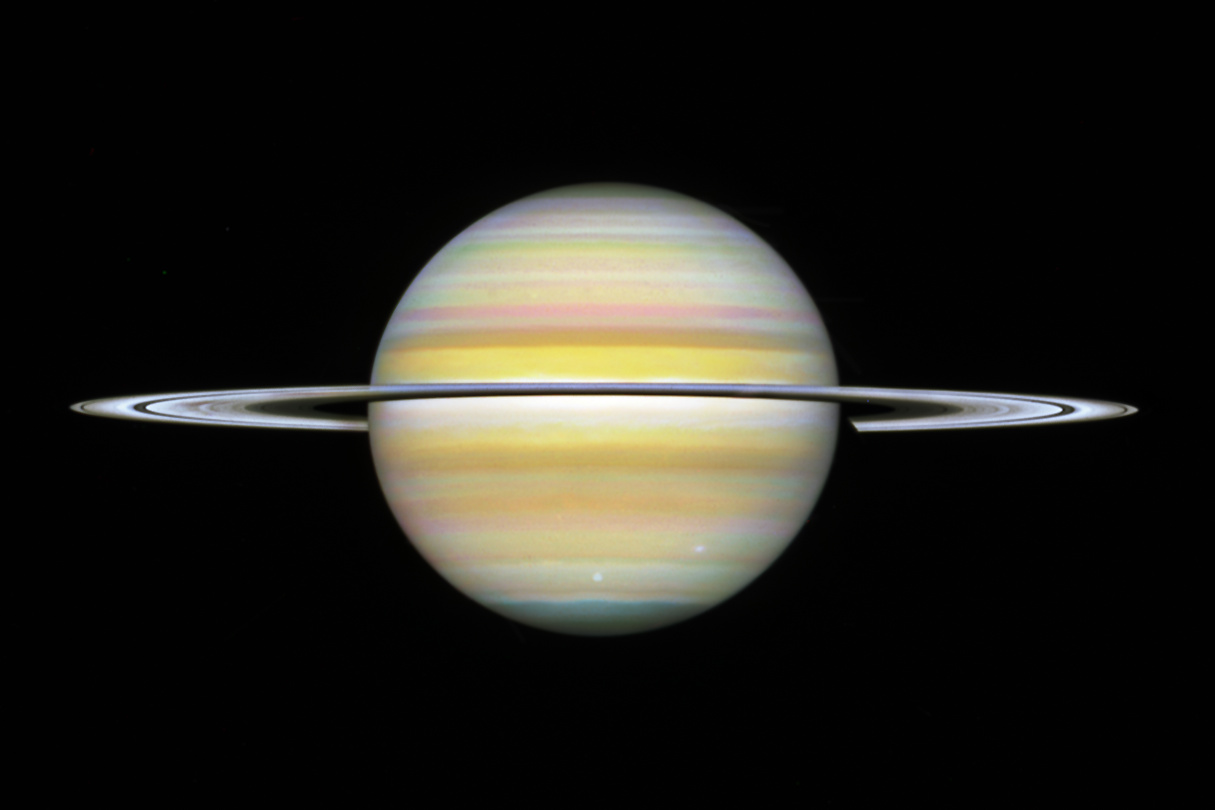
On 4 October 2026 Saturn reaches opposition — Earth passes between the Sun and Saturn, and the planet comes as close to us as it will all year. This is not just a calendar entry. It means three things at once: Saturn rises at sunset, is up all night, and is at its brightest of the year. This piece gives you the shape of the night, the compass bearings and an honest account of what you will actually see with the naked eye, binoculars and a telescope — and one computed surprise: the best night may not be 4 October.
What is opposition, and why does it turn one evening into a whole night?
Saturn circles the Sun outside Earth’s orbit. Roughly once a year — about every 378 days — Earth, on its faster inside track, catches up and passes between the Sun and Saturn as Saturn reaches opposition. At that instant Saturn sits exactly opposite the Sun in our sky, and the whole geometry of the night follows from that single fact:
- The Sun sets in the west → Saturn rises in the east, at almost the same minute.
- The Sun is deepest below the horizon in the middle of the night → Saturn is at its highest at the same moment.
- The Sun rises → Saturn sets.
And because Earth is then very close to its minimum distance from Saturn, the planet is also at its brightest, and shows its largest disc in a telescope. Up all night, brightest of the year, largest in a telescope — all of it falls on the same night.
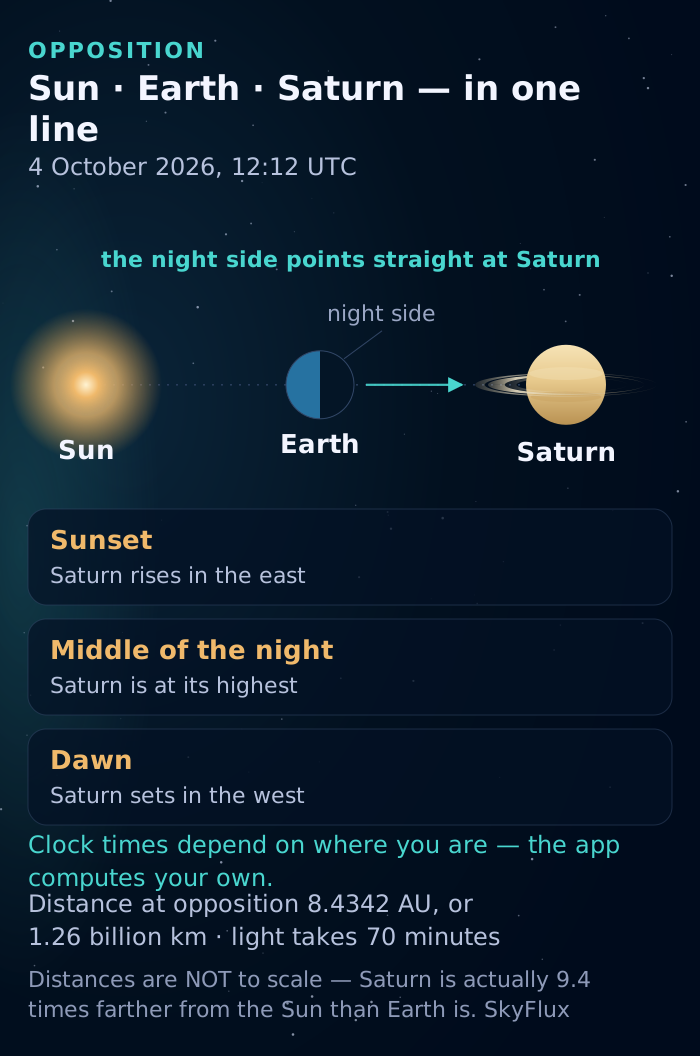
4 October 2026: the numbers
- Moment of opposition: 4 October 2026, 12:12 UTC — the instant Saturn stands directly opposite the Sun in our sky, measured east–west along the ecliptic, the Sun’s yearly path among the stars. (Saturn sits 2.7 degrees south of that path, so the three bodies are not in a perfectly straight line.) Allowing for the 70 minutes Saturn’s light takes to reach us, JPL’s ephemeris puts it 17 minutes later, at 12:29 UTC. Either way it is one and the same instant everywhere on Earth; your clock just labels it with your own time zone.
- Distance from Earth: 8.4342 astronomical units, or 1.26 billion kilometres.
- Closest point of the year: about an hour and forty minutes after opposition. The orbits are ellipses, so the two moments do not always coincide — this year that costs us roughly 106 kilometres out of 1.26 billion kilometres, and nobody will see it.
- Brightness: magnitude +0.33 — brighter than any star in that part of the sky.
- Apparent diameter: 19.7 arcseconds — the Moon that night is about a hundred times wider.
- Ring tilt: 7.5 degrees, and we are looking at the rings’ southern face.
- Constellation: Cetus — which is a story of its own, below.
Did you know?The light that reaches your eye on the night of 4 October left Saturn 70 minutes and 9 seconds earlier. If Saturn vanished at the very moment you were looking at it, you would keep seeing it for another hour and ten minutes. Everything you see of that planet is news that is already an hour and ten minutes old.
When should you go outside? The night has much the same shape almost everywhere
At opposition, Saturn’s timetable follows from simple geometry, and that geometry barely changes with where you stand: Saturn rises near sunset and sets near dawn. We worked it through for ten places on six continents, from Reykjavík to Ushuaia: everywhere, Saturn reaches its highest point around the middle of the night. The hour on your clock differs from the hour on the other side of the world, but the night itself has much the same shape.
| part of the night | what is happening |
|---|---|
| sunset | Saturn rises in the east almost the same minute the Sun sets in the west. It is still in the horizon murk — a fine sign that the night has begun, though Saturn is too low for a telescope. |
| darkness | The Sun is eighteen degrees below the horizon and the sky is properly black. By now Saturn has climbed clear of the roofs and the treetops. |
| highest | In the middle of the night Saturn reaches the top of its arc, shining through less air than at any other hour of the night. This is the hour for the rings. |
| dawn | Saturn sets in the west as the Sun comes up in the east. The whole night, end to end. |
If all you have is an evening, the answer is simple: wait until darkness is complete and then go out — Saturn is well up by then. If you want the rings as sharp as your telescope can show them, it is worth waiting for the middle of the night.
And here is the thing a printed table cannot do: give you the clock times for where you are. The four moments come in the same order everywhere, but the hour on the clock shifts from city to city — and your phone knows when they fall in your own sky.
The northern and southern hemispheres face opposite ways
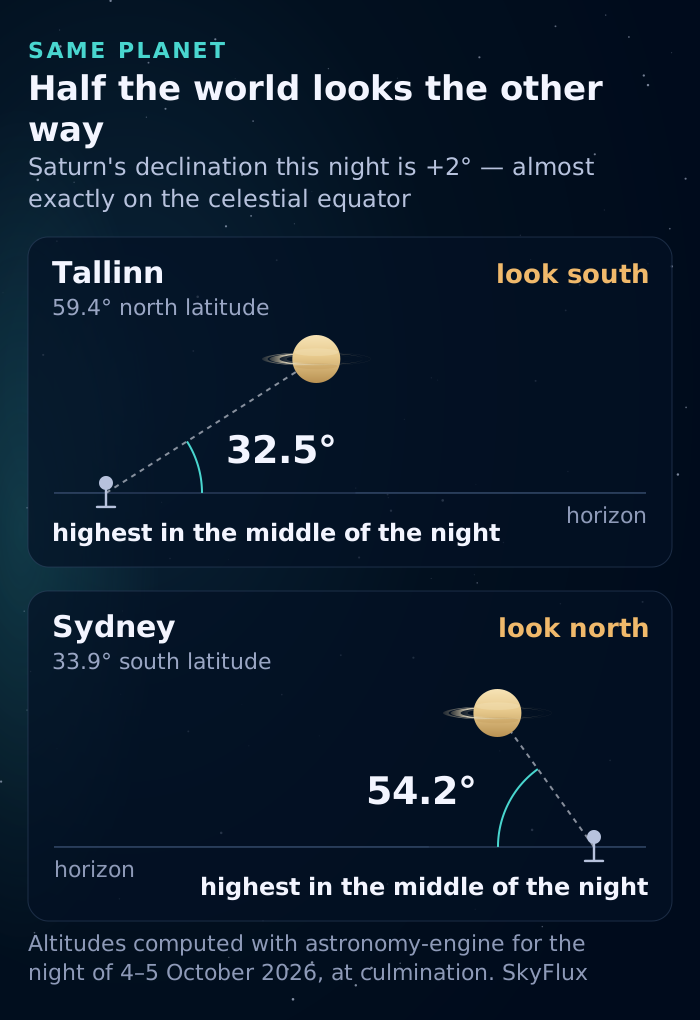
Saturn’s declination that night is +1.8 degrees — almost exactly on the celestial equator. That makes it an unusually even-handed object: it is visible from essentially the whole inhabited world. But not everyone faces the same way, and not everyone sees it equally high.
| Reykjavík | 01:18 UTC | 27.8° | south |
| Tallinn | 01:12 UTC+3 | 32.5° | south |
| London | 00:51 UTC+1 | 40.5° | south |
| New York | 00:46 UTC−4 | 51.3° | south |
| Singapore | 00:56 UTC+8 | 89.4° | overhead |
| Nairobi | 00:24 UTC+3 | 86.7° | north |
| Sydney | 00:47 UTC+11 | 54.2° | north |
| Cape Town | 00:37 UTC+2 | 54.1° | north |
| Buenos Aires | 00:43 UTC−3 | 53.5° | north |
| Ushuaia | 01:23 UTC−3 | 33.3° | north |
In the southern hemisphere you look for Saturn in the northern sky — not the south, which a good deal of observing advice written in the northern hemisphere quietly assumes. And if you are in Sydney or Cape Town you simply have the better seat: Saturn stands more than 20 degrees higher there than it does at high northern latitudes, which means a thinner layer of air, a steadier image in a telescope, and more hours above the treetops.
Honestly, though: you do not need to travel anywhere for this. Even the lowest altitude in that table is plenty — close to thirty degrees is roughly three fist-widths at arm’s length above the horizon, and Saturn is far and away the brightest thing up there.
Where in the sky? In Cetus — and that is not a zodiac constellation
Here is something most observing guides do not bother to mention. On 4 October 2026 Saturn is not in any zodiac constellation at all. It is in Cetus, the Whale — a sea monster that the ecliptic misses by a quarter of a degree at its nearest corner. The reason is the tilt of Saturn’s own orbit: that night it sits 2.7 degrees south of the ecliptic, which carries it across the Pisces border into Cetus territory. It stays there from 6 September 2026 until 24 February 2027.
The practical consequence is better than you would expect: that patch of sky is nearly empty. The nearest neighbour is η Ceti, 13 degrees away at magnitude 3.5 — Saturn is about twenty times brighter. The brightest rival is β Ceti, Diphda, at magnitude 2.0 — but it is a full 20 degrees away, and Saturn still outshines it five times over. Nearer than Diphda, at 15 degrees, γ Pegasi, Algenib, at magnitude 2.8 is about ten times fainter. Which is to say: you cannot get this wrong. If you look in the right direction at the right hour and there is one steady yellowish point there, that is it.
One more bonus in the same frame: Neptune sits 8.6 degrees from Saturn — less than a fist-width. It came to opposition itself eight days earlier, on 26 September. At magnitude 7.7 it is not a naked-eye object, but with binoculars and an accurate chart it is within reach, and then you have two outer planets in one evening.
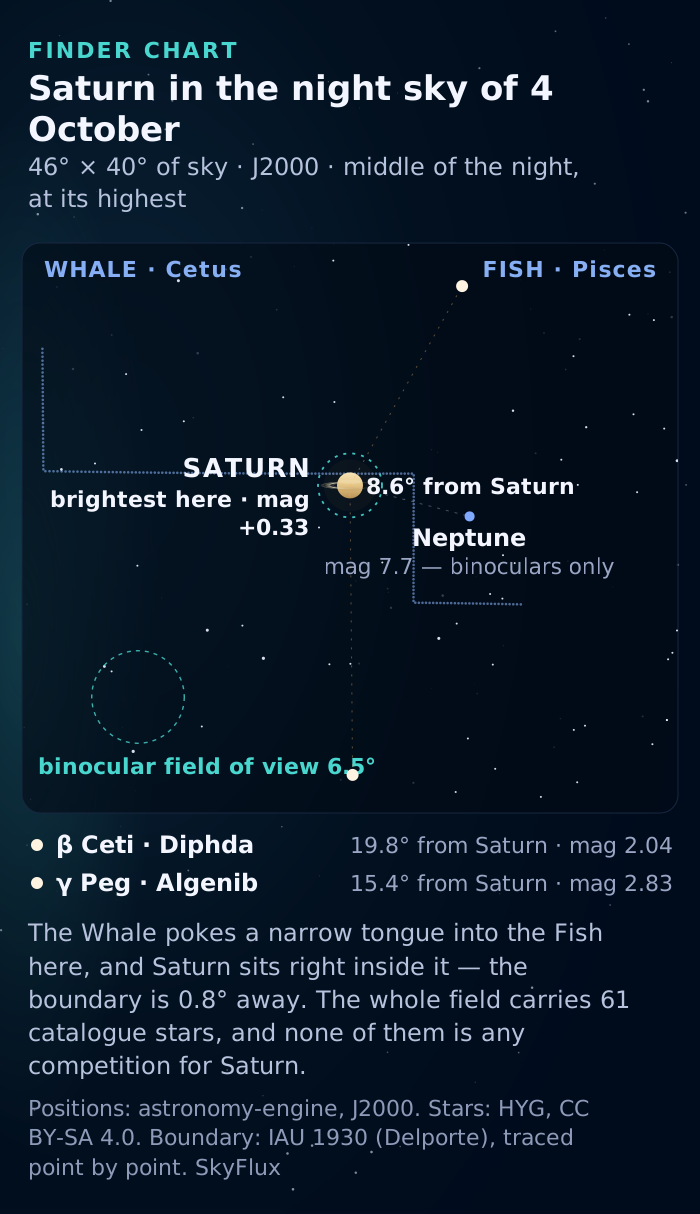
What you will actually see
With the naked eye. A steady yellowish point that does not twinkle. That is a good test, though not a perfect one: stars tend to twinkle, while planets usually shine more steadily, because a planet’s disc is wide enough for much of the atmosphere’s shimmer to average out. You will see nothing of the rings. To Galileo in 1610 Saturn looked like three bodies — a large disc with a smaller companion on each side; in 1612 the companions vanished, then came back looking like a pair of handles, or “ears”, and it was not until 1655 that Huygens worked out what they were: a ring.
With binoculars (7× to 10×). Saturn stops being a point and becomes a small oval — even this year, with the rings only a narrow ellipse. What binoculars pick up is the rings’ full span end to end, and that length barely changes with the tilt; what changes is how thick the oval looks. You will not see the rings as rings, but the image is no longer round, and that stretch is your first sight of them. Brace the binoculars against something; hand-held, they will shake this detail away.
With a small telescope (60–100 mm, 30–50×). The rings appear. This year they are 7.5 degrees open, which means the ellipse is 7.7 times wider than it is tall — a slim ellipse drawn across the disc, not yet a wide ring around it. The disc itself is 19.7 arcseconds across.
With a larger telescope (150 mm of aperture and up, 150–250×). The Cassini Division — the gap between the A and B rings — is 4,800 kilometres wide, which at Saturn’s distance works out to 0.79 arcseconds. It is genuinely there, but with the rings only 7.5 degrees open and the air never quite still, seeing it is hard. Do not stake the success of the night on it.
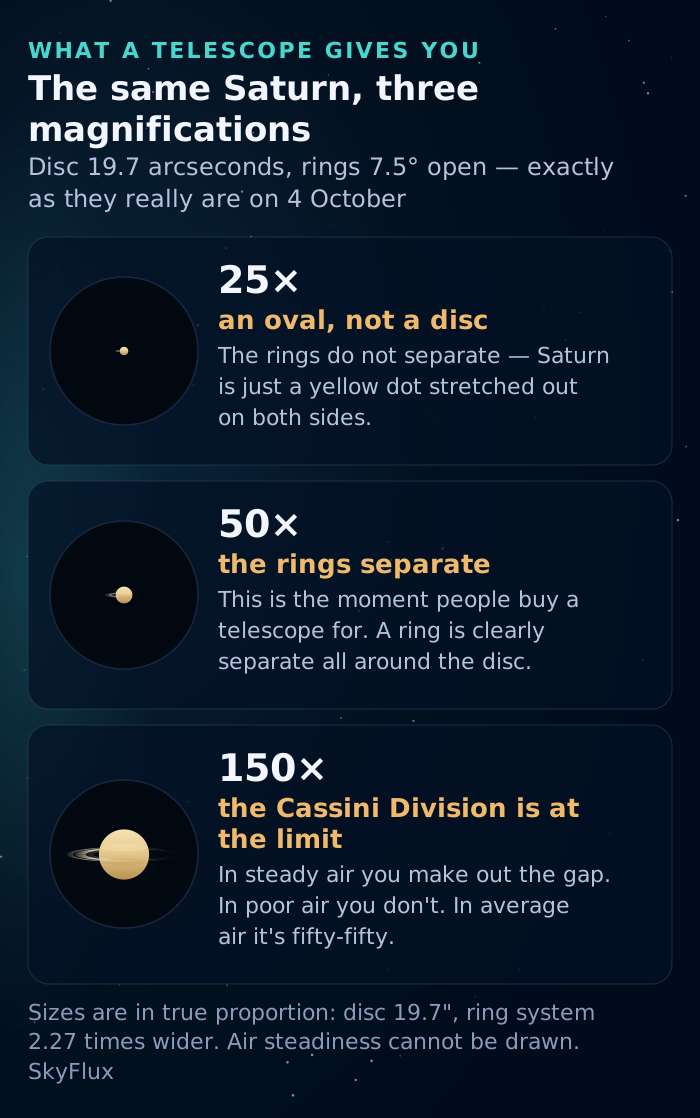
The rings are 7.5 degrees open this year — and that is good news
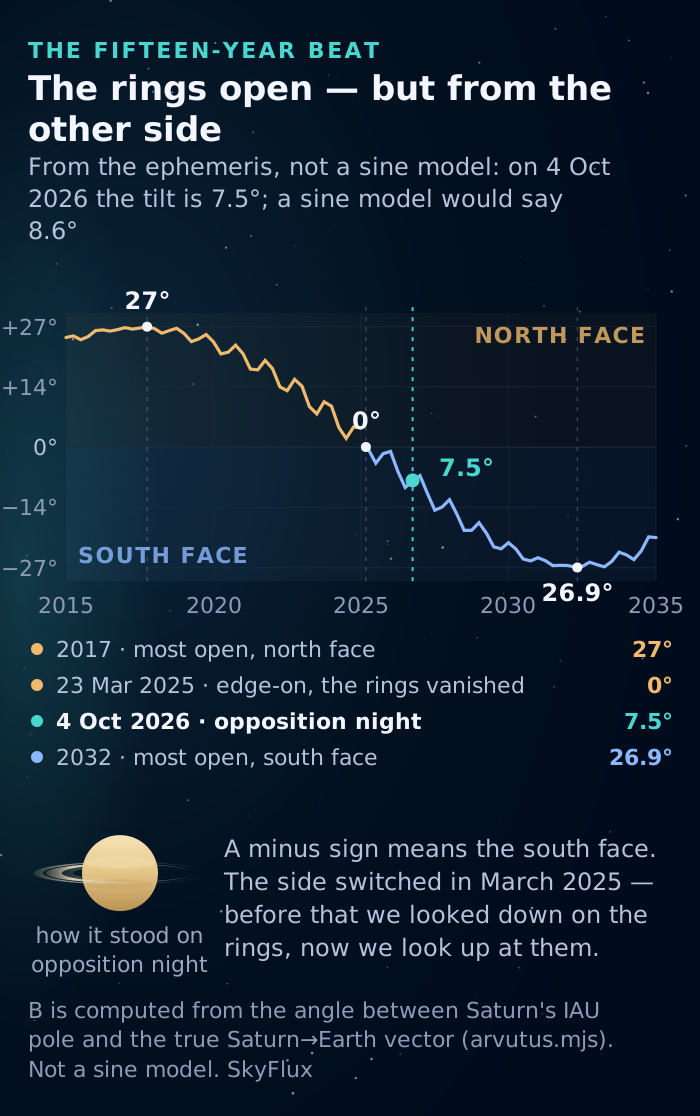
On 23 March 2025, Earth crossed Saturn’s ring plane. The rings are typically ten metres thick, and from 1.58 billion kilometres away they simply disappeared — telescopes were left with a bare yellow disc. Almost nobody watched it happen: that day Saturn stood only ten degrees from the Sun, lost in its glare — everywhere on Earth it rose and set that day at almost the same time as the Sun. This happens roughly every fifteen years.
After that crossing the rings narrowed once more through September, October and November 2025, to about 0.4 degrees around 24 November, but without turning edge-on again. Since then they have been opening, with a dip of a few months around each opposition — and we now see them from the other side: until 2025 we were looking at the northern face of the rings; now we are looking at the southern face, and that is how it stays until the next ring-plane-crossing season in 2038. They reached about 9 degrees at the end of July 2026 and are narrowing again until early December, to about 6 degrees: on 4 October 2026 the angle is 7.5 degrees. A year earlier, at the 2025 opposition, it was 1.8 degrees — essentially a line. A year later, in October 2027, it will be 12.9 degrees. They open widest in May 2032, at 27 degrees. The planet’s own magazine has a longer piece on the rings, the moons and why Saturn is less dense than water: read more about Saturn.
Did you know?Saturn is 0.25 magnitudes brighter this year than at last year’s opposition — and 0.20 magnitudes of that comes from the rings alone. Distance accounts for only about 0.05 of a magnitude. The rings are not decoration: they are an icy mirror wider than the planet itself, and when they open, the whole planet’s brightness changes. What you see with the naked eye is that geometry, directly.
The Moon stays out of the way when it matters
On the evening of 4 October the Moon is a 35 per cent waning crescent, and more to the point it does not rise until late in the evening or around midnight, depending on where you are — roughly when Saturn nears its highest. The first half of the night is free of it. And even once it is up, it is still low, and 107 degrees away from Saturn — in another part of the sky altogether. It will not spoil your view of the rings at all; the only reason to go out earlier is if you also want faint nebulae the same night.
4 October is not the only night — and 10–11 October is actually the best one
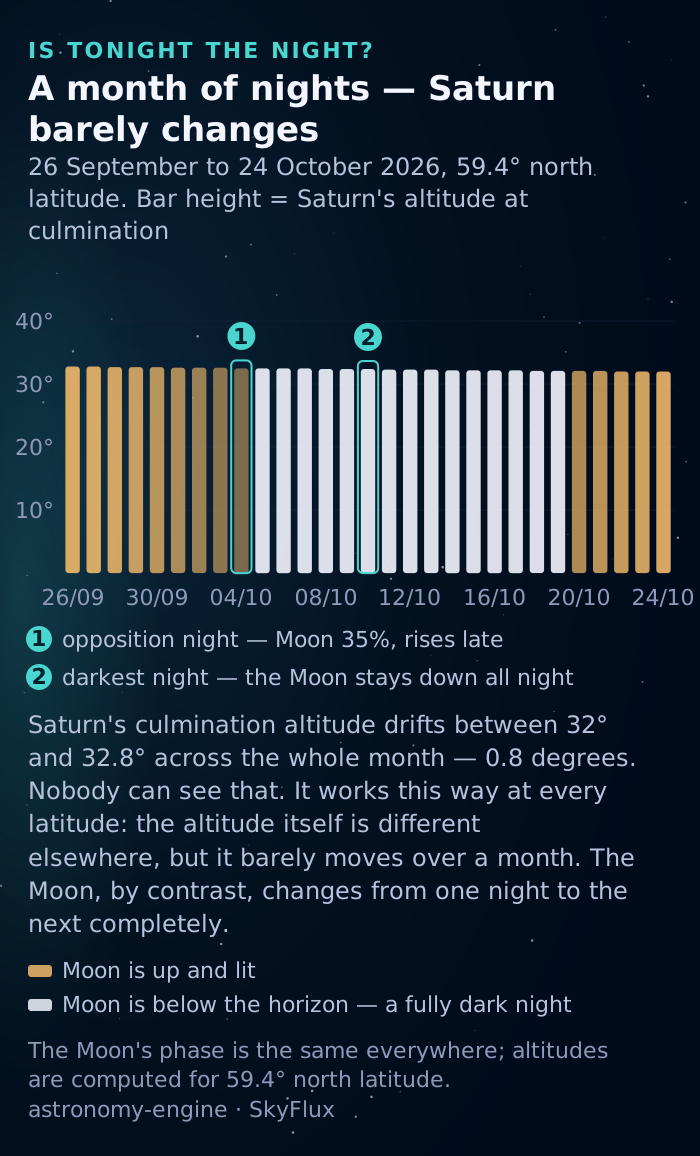
No “look tonight!” headline will tell you this. Opposition is not your only chance. We computed Saturn’s brightness, altitude and the Moon’s interference for every night from 26 September to 24 October, and the result is reassuring:
- Across that whole window Saturn’s magnitude stays between +0.33 and +0.43, and it is brightest on opposition day itself: +0.33. The number does not slide steadily from one end to the other: it falls to its lowest on opposition day, early in the window, and then climbs back. On the magnitude scale a smaller number means a brighter object, so that low point is Saturn at its brightest. The whole swing is one tenth of a magnitude — too small to notice from one night to the next.
- The altitude at its highest point changes by less than one degree over that whole month — and it changes by almost the same amount at most latitudes, because what moves is Saturn’s declination, not you.
- Which means: Saturn itself changes very little across that month, but moonlight makes some clear nights much better than others.
And if you want the single best one, it is not 4 October. New Moon falls on 10 October, at 15:50 UTC — the small hours of the 11th in Tokyo and Sydney. On 4 October the Moon stays down only until the middle of the night and then rises in the east, far off to one side of Saturn; on the night of 10–11 October it never rises at all. The whole night is dark, not just the first half of it. Saturn’s magnitude is 0.36 and its altitude is practically identical to 4 October’s. The night of 10–11 October is the same planet under a darker sky.
So: go out on 4 October, because the date means something and it is easier to tell a friend about. But if the weather ruins it, do not be disappointed — the best night arrives six days later. And if the town sky is too bright, see how far out of town it is worth driving: dark-sky places.
How SkyFlux gets you out of the door
The ten clock times above are a demonstration, not an instruction — each one is true in its own city and in no other, because the clock time of Saturn’s highest point depends on location. In your app they are all there, yours, not as text but computed from your coordinates:
- “Tonight’s altitude curve” on Saturn’s page draws this same night for you: altitude hour by hour, the twilight boundaries, the best window highlighted. Drag a finger along it and you get the height and the bearing for every moment.
- “Set a reminder” alerts you shortly before the best moment. “Add to calendar” puts that same moment in your calendar.
- “Find” takes you to the sky map in one tap, with the target ring on Saturn. From there, raise the phone and follow the bearing.
- 3D Solar System shows you why the night is like this: drag time and watch Earth pass Saturn. Opposition stops being a word and becomes a position.
- In the Events calendar, “Saturn at opposition” is already there — nobody typed it in; it is recomputed from the orbital tables every time.
- Saturn’s magazine on the planet page tells the ring story at length, and the tilt diagram in it is set to your own clock.
Bottom line
On 4 October 2026 Saturn reaches opposition, and about an hour and forty minutes later it is as close to Earth as it gets this year. That night it rises at sunset, stands at the top of its arc in the middle of the night — due south from most of the northern hemisphere, due north from most of the southern, and almost overhead near the equator — and sets at dawn. At magnitude +0.33 it is the brightest object in that part of the sky; the rings are 7.5 degrees open — narrowing a little until early December, then opening again towards their widest in 2032. The Moon, just past last quarter, does not rise until late in the evening, so the first half of the night is dark. And the night of 10–11 October is better still, whatever the weather does on the 4th: the Moon is new and stays down all night, and Saturn is hardly fainter.
Take binoculars if you have them. If you do not, just go outside — one steady yellow point in the sky that barely twinkles is worth seeing in itself. It is 1.26 billion kilometres away, and its light has been travelling for seventy minutes.
Sources and licences
- Hero photograph — ESA/Hubble heic2612a · CC BY 4.0 · esahubble.org/images/heic2612a/
- Ephemeris — astronomy-engine (JPL DE405/DE441) · SkyFlux
- Stars and boundaries — HYG database (CC BY-SA 4.0) · IAU 1930 constellation boundaries (Delporte)