SkyFlux
PLANETS
Venus at greatest brilliancy: why the morning star is brightest as a crescent
Published · Updated
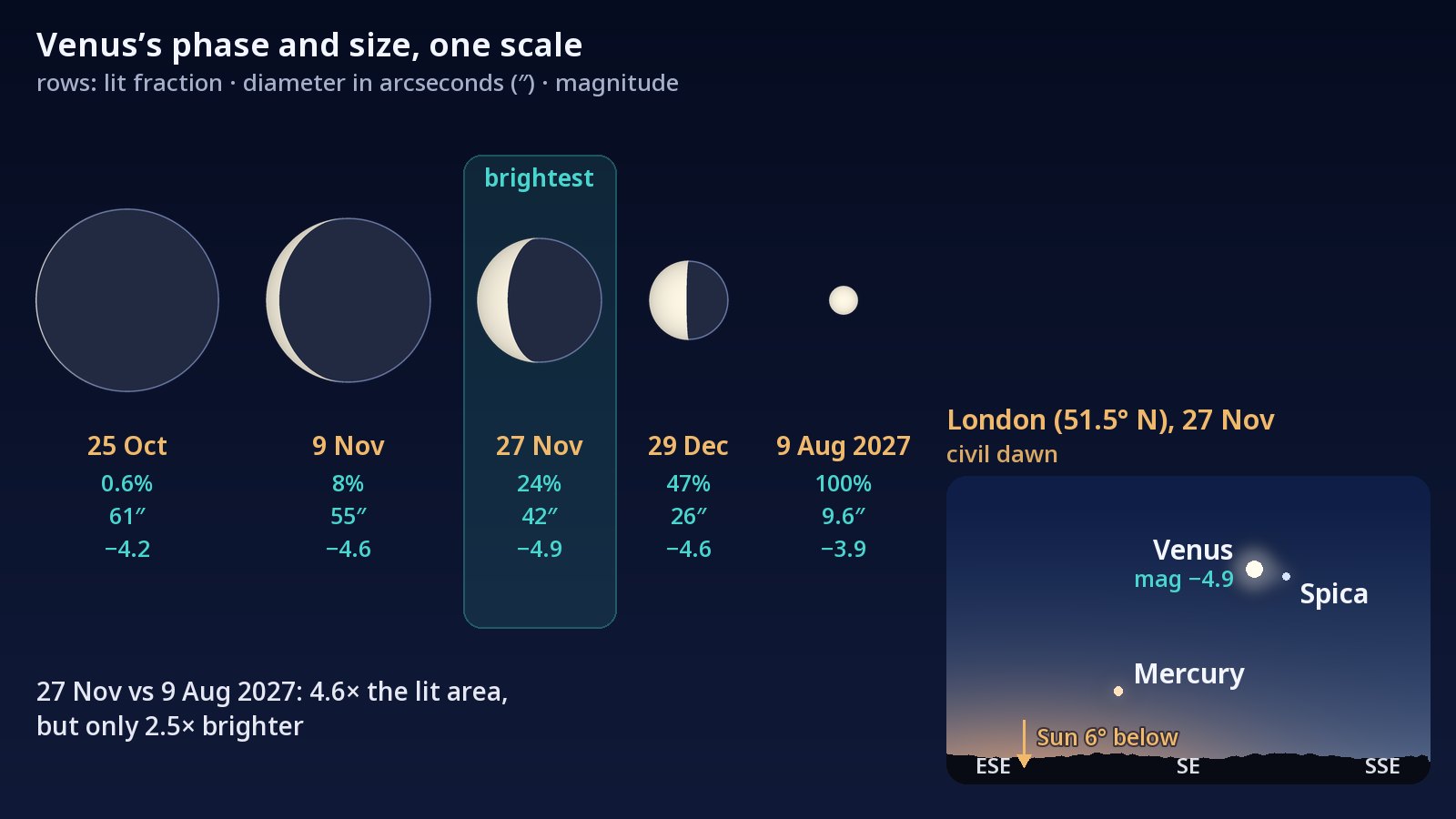
In late November Venus reaches its greatest brilliancy as the morning star, at magnitude −4.9 (on this scale, the lower the number, the brighter the object). Only a quarter of its disc is lit, yet Venus is brighter then than it ever is when fully lit. Binoculars held steady can show the crescent.
Why Venus is brightest as a crescent
Venus's orbit lies inside Earth's, so its phase and its distance from us change together. On the far side of the Sun its disc is fully lit, but the planet is then about 259 million km away and only 9.6 arcseconds across (an arcsecond is 1/3600 of a degree). In late October Venus passes between Earth and the Sun: it is then 41 million km away and 61 arcseconds across, but it turns its night side towards us, with less than 1% of the disc lit.
In between, brightness depends both on how much of the disc is lit and on how close the planet is. On 27 November Venus is 60 million km away, 41.7 arcseconds across and 24% lit. The lit crescent then has about 4.6 times the apparent area of the full disc seen beyond the Sun. It shines only about 2.5 times as brightly, though (magnitude −4.9 compared with −3.9), because when Venus is a crescent, sunlight strikes its visible clouds at a slant, so each patch of cloud looks dimmer. The larger lit area outweighs that dimming.
The peak is very flat. JPL Horizons places it between 24 and 26 November; the Astronomy Engine library behind the SkyFlux calendar puts it, with a different brightness formula, at 01:47 UTC on 27 November. From 22 to 30 November the brightness changes by less than 0.02 magnitude in either model, too little for the eye to notice.
Where to look
Look east to southeast in the hour before sunrise. On 27 November at civil dawn, when the Sun is 6° below the horizon, Venus stands:
- 59.4° N (Tallinn, Stockholm): 18° high, in the south-southeast; civil dawn is 57 minutes before sunrise.
- 51.5° N (London): 22° high, in the southeast; civil dawn is 43 minutes before sunrise.
- 40° N (Madrid, New York): 27° high, in the southeast; civil dawn is 33 minutes before sunrise.
Venus is also well placed in the southern hemisphere: from Sydney (33.9° S) it stands 17° high, due east.
On 27 November, from northern latitudes, Spica (Virgo's brightest star) lies about 3.5° to the right of Venus and a little lower; Mercury is about 20° to Venus's lower left, close to the horizon. From Sydney, Spica appears above Venus, and Mercury lies to Venus's lower right. Our story “Mercury in the morning sky: use Venus to find it before sunrise” explains how to catch Mercury.
To see where Venus appears in your own sky, open the SkyFlux sky map.
Seeing the crescent through binoculars
At 41.7 arcseconds, the crescent is too small for most eyes to make out unaided. 8× or 10× binoculars make it look about a fifth as wide as the Moon appears to the naked eye. In February 2025, Sky & Telescope's Bob King wrote that Venus, 32% lit and 35.8 arcseconds across, was big enough to make out its shape easily through 8×42 binoculars. This November's crescent is bigger, though thinner.
- Brace the binoculars against a wall or post: a shaky image smears the shape.
- Try observing in twilight rather than full darkness: a brightening sky tones down the glare.
- The lit side faces the Sun, which is still below the horizon: from northern latitudes the crescent bulges towards the lower left, from the southern hemisphere towards the lower right.
Put the binoculars away before sunrise. The Sun rises in the same part of the sky, and even a brief glimpse of it through binoculars can permanently damage your eyes.
According to the California Academy of Sciences, Venus is bright enough for experienced observers to spot in the daytime sky, if they know exactly where to look. To try safely, stand where a building will hide the rising Sun, and keep following Venus with the naked eye as dawn turns into day.
Sources and licences
- JPL Horizons (NASA/JPL) — Magnitudes, illuminated fraction, apparent diameter, distance, elongation, and topocentric altitude and azimuth of Venus, Mercury and the Sun, computed 17 October 2026. https://ssd.jpl.nasa.gov/horizons/
- Astronomy Engine 2.1.19 (Don Cross) — Time and magnitude of Venus's peak brightness as used in the SkyFlux calendar (SearchPeakMagnitude). https://github.com/cosinekitty/astronomy
- SIMBAD (CDS, Strasbourg) — Coordinates of Spica (alf Vir). https://simbad.cds.unistra.fr/simbad/
- Sky & Telescope, Bob King, 12 February 2025 — Crescent of Venus (32% lit, 35.8″) seen in 8×42 binoculars; a blue sky sharpens the view. https://skyandtelescope.org/astronomy-news/give-your-beau-venus-on-valentines-day/
- California Academy of Sciences, Bing Quock, 8 February 2017 — Venus is bright enough for experienced observers to spot in the daytime sky. https://www.calacademy.org/explore-science/can-you-see-venus-in-the-daytime
- NASA NSSDC Moon Fact Sheet — Mean apparent diameter of the Moon, 1896 arcseconds. https://nssdc.gsfc.nasa.gov/planetary/factsheet/moonfact.html