SkyFlux
PLANETS
Uranus at opposition: how to find the blue-green planet in Taurus
Published · Updated
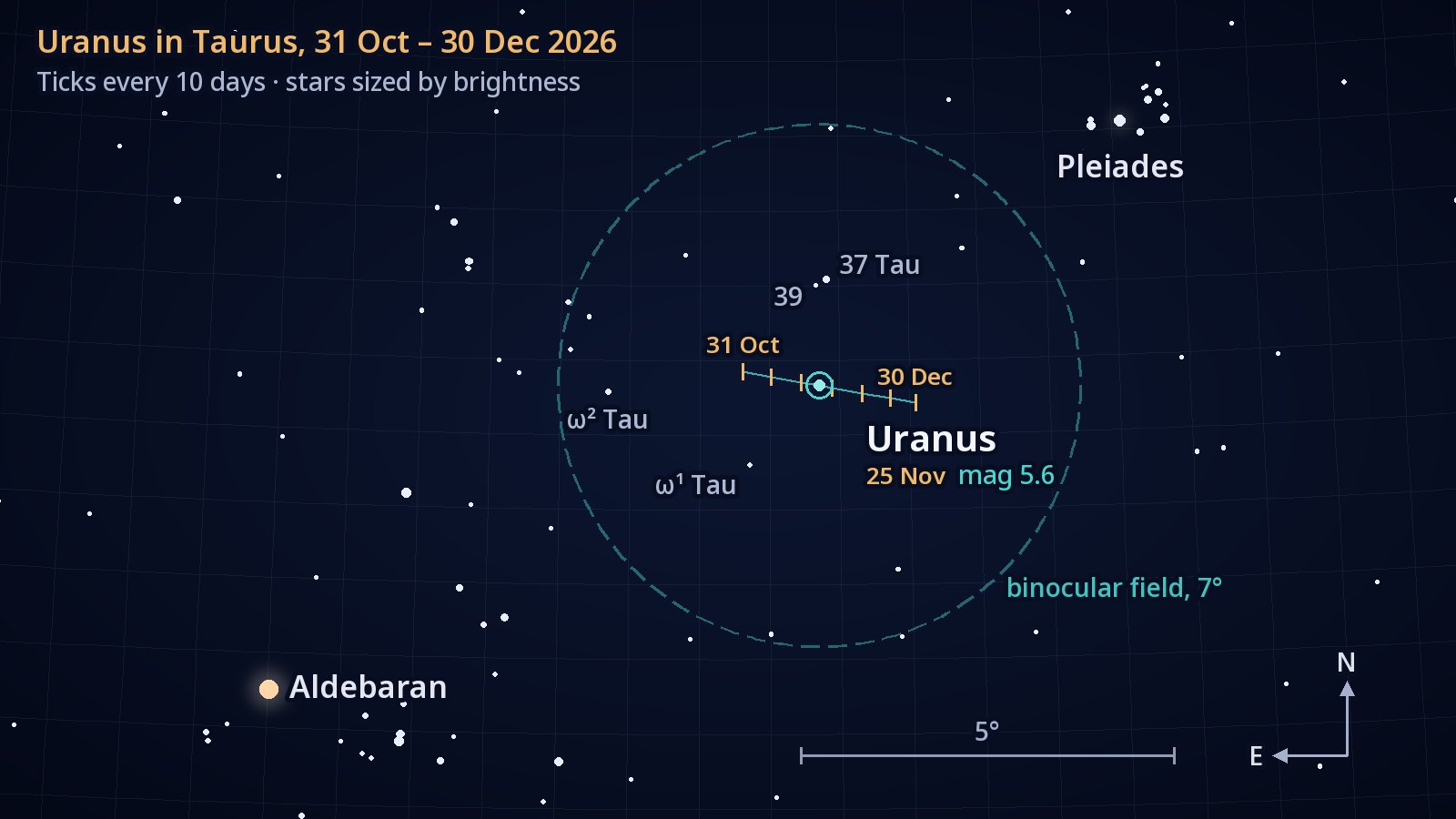
Late on 25 November (UTC), Uranus is opposite the Sun. It is up all night, as close to Earth as it gets this year, and sits in Taurus between the Pleiades and Aldebaran. The catch is the Moon: it is full the day before and passes only about 5° from the planet.
Why opposition matters
At opposition, Earth passes between the Sun and Uranus, so the planet lies on the opposite side of our sky from the Sun. That is why it rises around sunset, sets around sunrise and stands highest in the middle of the night (due south from latitudes north of about 21° N), when the sky is darkest.
It is also when Uranus is closest to us: about 2.76 billion km, or 18.44 times the Earth–Sun distance. Because Uranus is about 19 times farther from the Sun than Earth is, Earth's orbit changes our distance to Uranus by only about 10% over the year, so its brightness barely changes: magnitude 5.6 at opposition and 5.8 when it is behind the Sun next May (on this scale, a smaller number means a brighter object). What opposition really gives you is a long night with the planet high; this year moonless dark hours return from about 29 November.
Where to look
Uranus is in Taurus, about 5° south-east of the Pleiades star cluster and about 8° north-west of Aldebaran, the bright orange star of Taurus. Both are easy naked-eye guides to the right patch of sky.
Closer to Uranus, three stars form a small signpost. 37 Tauri, magnitude 4.4, lies about 1.4° north of Uranus and slightly to the west, with fainter 39 Tauri right beside it. About 1.4° to the south-east lies omega-1 Tauri, magnitude 5.5. Uranus drifts westward against these stars, about 0.4° every ten days, and at the end of November it passes almost exactly due south of 37 Tauri.
Its highest altitude above the southern horizon:
- Latitude 59.4° N (Tallinn, Stockholm): 51° above the horizon
- Latitude 51.5° N (London): 59° above the horizon
From the southern hemisphere it stays lower, because it lies north of the celestial equator: from latitude 35° S it climbs to about 34° above the northern horizon.
To see where Uranus is from your own location, open the SkyFlux sky map.
The full Moon gets in the way
The Moon is full on 24 November and passes about 5° north of Uranus that day. Until the early hours of the 26th it is more than 95% lit and within about 24° of the planet, sharing its part of the sky all night. Moonlight washes out the faintest stars, and to the naked eye Uranus is lost with them. In binoculars it can still be found, with much less contrast.
You do not have to observe on the night of opposition itself: Uranus stays near opposition brightness for weeks. From about 29 November the Moon rises late enough to leave a dark evening sky around Uranus, and in the first week of December there are several moonless hours with the planet high, at both northern latitudes above.
What you will see
With the naked eye, Uranus is near the limit of what you can see. It is fainter than 37 Tauri and about as bright as omega-1 Tauri. You need a dark site, no Moon and an exact idea of where to look. Faint as it is, it was not recognised as a planet until after 1781. That year William Herschel spotted it with a telescope and at first took it for a comet; it became the first planet discovered with a telescope.
With binoculars it is easy: all three signpost stars and Uranus fit in one field of view. It looks like another star, so compare the view with a star chart, or check again a week later: by then Uranus has shifted westward by nearly twice the gap between 37 and 39 Tauri.
With a telescope it stops being a point. Uranus is 3.8 arcseconds across, so at 100× magnification it looks about a fifth as wide as the full Moon does to the naked eye: small, but clearly a disc. That disc and its pale blue-green colour, which comes from methane in its atmosphere absorbing red light, set it apart from a star.
Sources and licences
- JPL Horizons (NASA/JPL) — Opposition time, positions, magnitude, distance, apparent diameter and constellation of Uranus; Moon phase and positions; altitudes for 59.4° N and 51.5° N, computed 17 October 2026; the 35° S altitude is derived from Uranus's declination. https://ssd.jpl.nasa.gov/horizons/
- Yale Bright Star Catalogue (VizieR V/50) and SIMBAD (CDS, Strasbourg) — Positions and V magnitudes of 37, 39 and omega-1 Tauri, Alcyone (Pleiades) and Aldebaran. https://vizier.cds.unistra.fr/viz-bin/VizieR?-source=V/50 and https://simbad.cds.unistra.fr/simbad/
- NASA Science: Uranus facts — Methane as the cause of the blue-green colour; discovery by William Herschel in 1781. https://science.nasa.gov/uranus/facts/