SkyFlux
PLANETS
Mercury in the morning sky: use Venus to find it before sunrise
Published · Updated
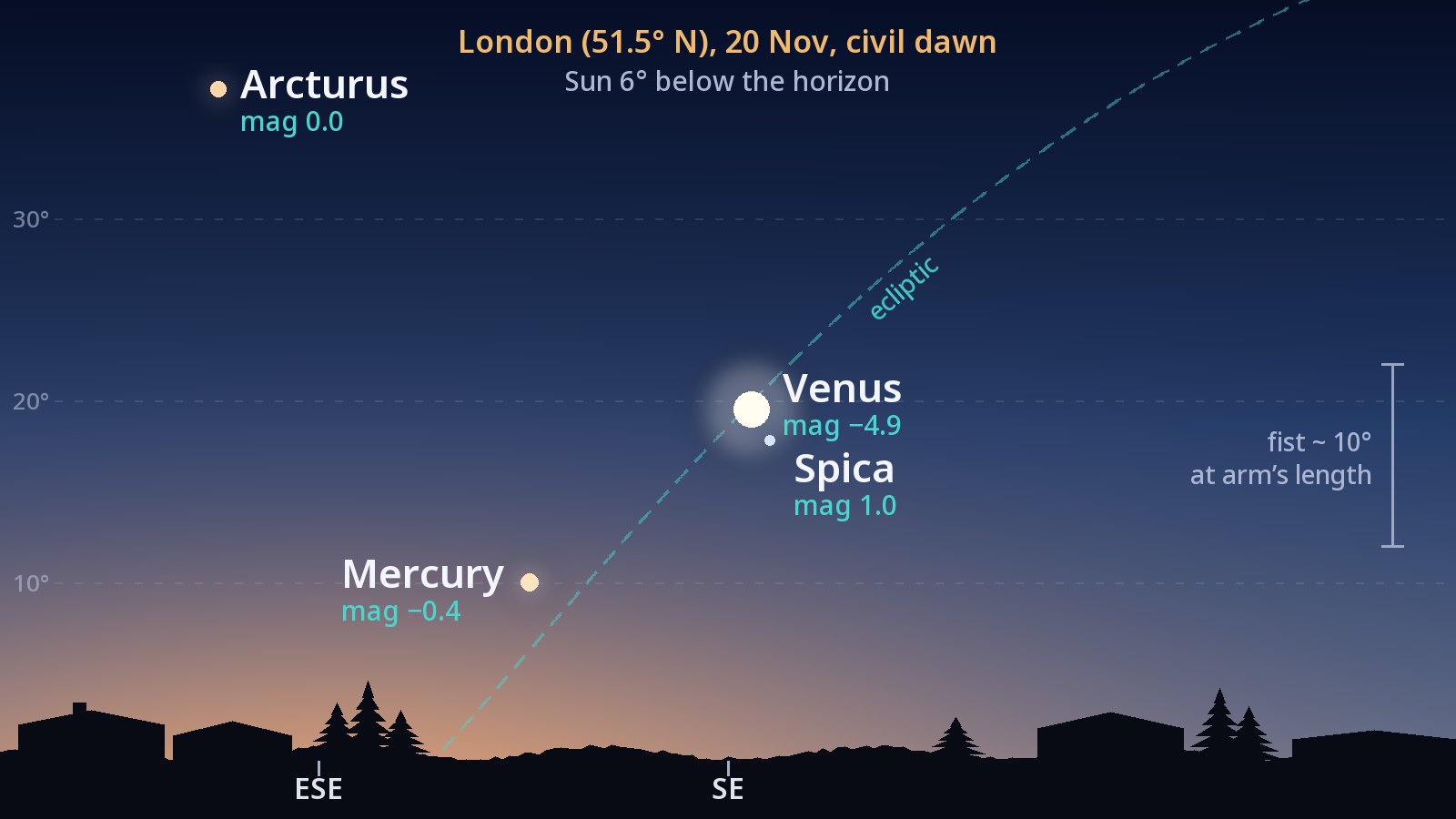
Late on 20 November (UTC), Mercury reaches its greatest angular distance west of the Sun, 19.6° (its greatest western elongation). For northern-hemisphere observers the mornings around that date are a good chance to catch the most elusive of the naked-eye planets, and brilliant Venus, higher and to its right, shows where to look.
Why late November is a good time for northern-hemisphere observers
Mercury's orbit lies inside Earth's, so from here the planet seems to swing from one side of the Sun to the other. West of the Sun, it rises before sunrise and appears in the dawn twilight; late on 20 November (UTC) it reaches its greatest angular distance on that side.
That separation is modest. What helps is the ecliptic, the Sun's yearly path across the sky, which the planets stay close to. Before sunrise in a northern autumn it rises steeply from the eastern horizon: at civil dawn on 20 November it meets the horizon at about 51° as seen from London, compared with only 16° at dawn around the March equinox. A steep path puts Mercury above the Sun rather than beside it, so more of its angular distance from the Sun turns into height above the horizon.
Partly because the ecliptic west of the Sun runs northward at this time of year, and partly because Mercury lies about 2° north of the ecliptic itself, the planet sits well north of the Sun in the sky. Declination is the sky's equivalent of latitude: Mercury's is −12.2°, the Sun's −19.8°. At northern latitudes this makes Mercury rise well ahead of the Sun; in London, nearly two hours before sunrise.
Where to look
Look low in the southeast (east-southeast for observers farther south), starting about an hour before sunrise. By then Mercury is already 7–8° high at latitudes from 40° to 59° N; earlier it is lower and deeper in the horizon haze. Find Venus first. It passed between Earth and the Sun in late October (inferior conjunction) and is now the brightest object in that part of the sky, at magnitude −4.9 (on this scale, the lower the number, the brighter the object). Mercury is lower and to the left, about 15° from Venus on 20 November, or one and a half fists at arm's length. The gap grows from 13° on the 14th to 20° on the 26th, because Venus pulls away from the Sun faster than Mercury, which turns back after the 20th.
Heights on 20 November at civil dawn, when the Sun is 6° below the horizon:
- 59° N (Stockholm, Oslo): Mercury 8°, Venus 16°; civil dawn is 54 minutes before sunrise.
- 51.5° N (London): Mercury 10°, Venus 19°; civil dawn 42 minutes before sunrise.
- 40° N (Madrid, New York): Mercury 12°, Venus 24°; civil dawn 33 minutes before sunrise.
Mercury stays near these heights from about 17 to 23 November. About 2° directly below Venus is Spica, Virgo's brightest star. Don't mistake it for Mercury, which is brighter and lies much lower and farther to the left.
To see where Mercury is in the sky from your own location, open the SkyFlux sky map.
What you will see
To the naked eye Mercury is just a point of light in the brightening sky, and it gets brighter day by day because we see more of its sunlit half: magnitude +0.3 on 14 November, −0.2 on the 17th, −0.4 on the 20th and −0.6 on the 23rd. Near the horizon, though, haze dims it, so it can look fainter than these numbers suggest.
Binoculars help: sweep slowly down and to the left of Venus, and once you have found Mercury, lower the binoculars and find it with the naked eye. Put the binoculars away before sunrise. The Sun comes up close to where you have been looking, and even a brief view of it through binoculars can permanently damage your eyes.
The Moon stays out of the way: until 23 November it has set by dawn, and from full Moon on the 24th it hangs low in the west at dawn, opposite Mercury.
Why Mercury is hard to see
Mercury's orbit is so small that, seen from Earth, the planet never gets more than about 28° from the Sun. From mid-northern latitudes it is therefore seen low and in twilight, rarely if ever in a fully dark sky. This time the maximum is only 19.6°, because Mercury is about 50 million km from the Sun, near its minimum of 46 million km and well below its maximum of 70 million km; when Mercury is closer to the Sun, its greatest apparent separation from the Sun is smaller.
Sources and licences
- JPL Horizons (NASA/JPL) — Positions, elongation, magnitudes, phase, declinations and topocentric altitude and azimuth of Mercury, Venus, the Sun and the Moon, computed 17 October 2026. https://ssd.jpl.nasa.gov/horizons/
- SIMBAD (CDS, Strasbourg) — Coordinates and V magnitude of Spica (alf Vir) and Arcturus (alf Boo). https://simbad.cds.unistra.fr/simbad/
- NASA NSSDC Mercury Fact Sheet — Mercury's perihelion (46.0 million km) and aphelion (69.8 million km) distances. https://nssdc.gsfc.nasa.gov/planetary/factsheet/mercuryfact.html