SkyFlux
Pa 30, Remnant of SN 1181: Gemini North Finds Knots in Its Firework-like Filaments
Published · Updated
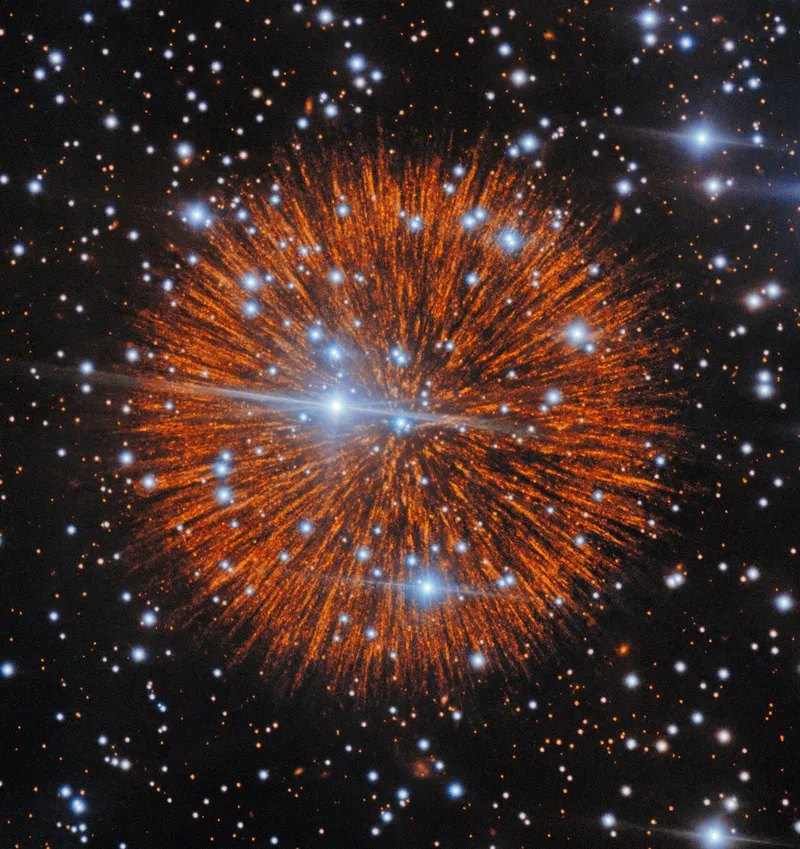
In August 1181, astronomers in China, Japan and the Arab world recorded a new star in Cassiopeia. New images from the Gemini North telescope show that the filaments of Pa 30, the firework-shaped cloud most likely left by that explosion, are chains of tiny knots, a feature that hints at how the debris got its shape.
A new star in Cassiopeia
Between 4 and 6 August 1181, observers noticed a star in Cassiopeia where none had shone before. It stayed visible for 185 days, and eight separate texts record it; because these independent accounts agree, we know reliably when and roughly where it appeared.
SN 1181 is one of only five well-recorded supernovae in our Galaxy from before the invention of the telescope. An explosion on that scale should leave an expanding cloud of debris behind, so astronomers searched for one. The remnant 3C 58 was long the favourite, but its estimated age casts strong doubt on the match. That left SN 1181 as the only historical supernova of the last thousand years without a confirmed remnant.
The star that survived its own explosion
Pa 30 was not discovered until 2013, and not by a professional. The American amateur astronomer Dana Patchick spotted it while searching infrared data from the WISE satellite for planetary nebulae; it was the 30th nebula he found, hence the number in its name.
In 2021, a team led by Andreas Ritter linked it to SN 1181. Pa 30's gas moves at about 1,100 km/s, and at that speed the cloud would have needed roughly a thousand years to reach its present size. Its position also agrees, to within 3.5 degrees, with the location given in the Chinese and Japanese reports.
What makes Pa 30 unique is the star at its centre, IRAS 00500+6713. Its surface temperature is about 200,000 kelvin, and it drives a stellar wind at around 16,000 km/s. Both the star and its cloud appear to lack hydrogen and helium. That composition is consistent with a merger of two white dwarfs, the dense cores that sun-like stars leave behind. Such a merger can set off a Type Iax supernova: an ordinary Type Ia explosion destroys the exploding white dwarf completely, whereas a Type Iax explosion is weaker and incomplete, so a star survives it. Pa 30 is the only known Type Iax remnant in the Milky Way.
Fireworks made of knots
Earlier images in the light of ionised sulphur showed a cloud about 170 arcseconds across (just under three arcminutes, a tenth of the full Moon's width), threaded by dozens of straight filaments that all point back towards the central star. That pattern is why Pa 30 is compared to fireworks.
The new images, analysed by a team led by Timothy Cunningham and Ilaria Caiazzo, come from the GMOS spectrograph on Gemini North. They reveal about ten times as many filaments as earlier studies found, and show that the filaments are not smooth streaks but strings of small knots, like beads on a thread. A typical knot is estimated to be about 100 billion kilometres across, several hundred times the distance from Earth to the Sun. The images also show for the first time that the faint oxygen glow comes from the same filaments that emit the sulphur light.
Knots matter because a perfectly even outflow would stay smooth. A chain of knots suggests that the gas around the star varied in temperature or density, and that these variations broke the debris apart as it streamed outward. How the filaments formed in the first place is still debated; any model now has to reproduce the knots.
The team also found that the geometric centre of the nebula coincides with the star. A lopsided explosion would have kicked the surviving star off-centre; since it still sits in the middle, any sideways kick gave it less than about 100 km/s, which points to a fairly symmetrical blast.
Where Pa 30 is and why it is an imaging target
Pa 30 lies in Cassiopeia at right ascension 0h 53m 11s, declination +67° 30′. At that declination it never sets anywhere north of about 22.5° N, so from Europe and most of North America it is always above the horizon, and it stands highest around midnight in early October, in the evening in November and December, and around nightfall in January. South of about 22.5° S it never rises at all. It lies about 7,500 light-years (2.3 kiloparsecs) away.
No visual magnitude for the nebula seems to have been published, and the detailed images of its filaments come from professional telescopes fitted with narrowband filters, most recently Gemini North. It is a target for long-exposure narrowband imaging, not for visual observation through an eyepiece.
Sources and licences
- NOIRLab press release noirlab2624 (6 October 2026) — Dates and records of SN 1181 (4–6 August 1181, eight texts, Chinese, Japanese and Arabic observers, 185 days, Cassiopeia), one of five pre-telescope Galactic supernovae, discovery of Pa 30 by Dana Patchick in WISE data (2013, 30th nebula), Kitt Peak follow-up, central star IRAS 00500+6713, Type Iax explanation, the new Gemini North/GMOS results (about ten times more filaments, chains of knots, circumstellar medium variations, star centred). https://noirlab.edu/public/news/noirlab2624/
- NOIRLab image noirlab2624a — Hero image, credit line, coordinates (RA 0h 53m 11.24s, Dec +67° 30′ 4.34″), field of view 4.36 × 4.58 arcminutes, filters [O III] 499 nm and [S II] 672 nm and their colour channels. Licence: CC BY 4.0 per https://noirlab.edu/public/copyright/ . https://noirlab.edu/public/images/noirlab2624a/
- Cunningham, Caiazzo, Raymond & Kenyon, The Astrophysical Journal 1010 (2026), Detection of Knots in the Type Iax Supernova Remnant Pa 30 — Knots and clumps in the filaments, about an order of magnitude more filaments, [O III] emission from the same filaments, kick upper limit about 100 km/s, knot diameter about 10¹⁶ cm. https://doi.org/10.3847/1538-4357/ae9cb2
- Ritter et al., The Astrophysical Journal Letters (2021), The remnant and origin of the historical supernova 1181 AD — Identification of Pa 30 with SN 1181, 3C 58 in doubt, gas at about 1,100 km/s, expansion age about 1,000 years, position within 3.5 degrees of the historical reports. https://arxiv.org/abs/2105.12384 (DOI 10.3847/2041-8213/ac2253)
- Gvaramadze et al., Nature (2019), A massive white-dwarf merger product before final collapse — Central star about 200,000 kelvin, wind about 16,000 km/s, star and nebula free of hydrogen and helium, white-dwarf merger. https://arxiv.org/abs/1904.00012 (DOI 10.1038/s41586-019-1216-1)
- Fesen, Schaefer & Patchick, The Astrophysical Journal Letters 945 (2023) — Nebula 170 arcseconds across in [S II], dozens of radial filaments 5–20 arcseconds long converging near the central star, distance estimate 2.3 kpc. https://doi.org/10.3847/2041-8213/acbb67
- Coughlin, Salvesen & Pasham, The Astrophysical Journal Letters 996 (2025), A Wind-driven Origin for the Firework Morphology of the Supernova Remnant Pa 30 — One of the competing models for how the filaments formed (wind–surrounding gas interface). https://doi.org/10.3847/2041-8213/ae267d
- Green & Stephenson (2003), The Historical Supernovae — SN 1181 among the five well-recorded Galactic supernovae of the last two thousand years (1006, 1054, 1181, 1572, 1604); AD 185 less certain. https://arxiv.org/abs/astro-ph/0301603