SkyFlux
Webb Finds the Host Galaxy of the Most Distant Fast Radio Burst
Published · Updated
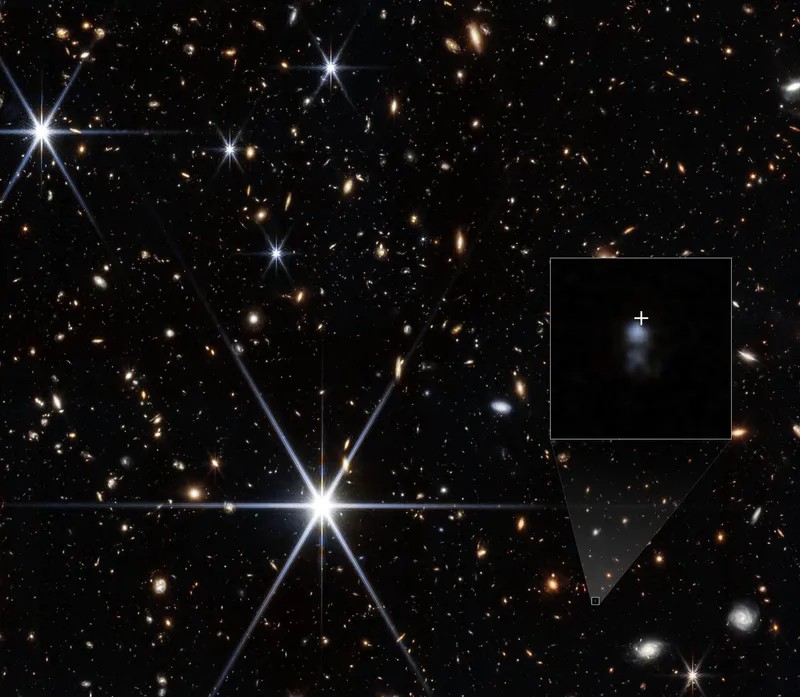
On 4 March 2024 the MeerKAT radio telescope in South Africa recorded a radio flash lasting milliseconds, catalogued as FRB 20240304B after that date. Only the James Webb Space Telescope could find the galaxy it came from: a young dwarf galaxy seen as it was 3 billion years after the Big Bang, the most distant fast-radio-burst host identified so far.
A flash that lasts milliseconds
Fast radio bursts (FRBs) are pulses of radio waves lasting milliseconds that reach us from other galaxies. The first was found in 2007 in archived pulsar-survey data. Most are seen only once; a minority repeat.
On its way to us each pulse crosses thin, electrically charged gas, which delays lower radio frequencies more than higher ones. From that delay astronomers calculate the dispersion measure, a tally of the free electrons along the whole path. For FRB 20240304B it was unusually large, hinting at a very distant source, but dense gas near the source or in galaxy clusters along the way can also inflate it. Only the host galaxy's redshift can settle the distance.
From a radio position to a redshift
MeerKAT is an array of 64 radio dishes spread over 8 km. The burst was caught at 00:50 UTC by MeerTRAP, a system that searches for brief signals. The detection triggered MeerTRAP to save 300 milliseconds of raw data from the 62 antennas then in use, enough to fix the flash's position to within about half an arcsecond, less than a three-thousandth of the full Moon's width.
Deep ground-based images from Keck and MMT showed nothing there. Webb's NIRCam instrument then found a faint galaxy about 0.3 arcseconds from the burst's position, which the team calculates has a 97.5% probability of being the host. Webb's NIRSpec spectrograph measured light from its hydrogen and oxygen, giving a redshift of 2.148: visible light from the galaxy arrives stretched to about three times its original wavelength, into the infrared.
Why the distance matters: weighing the gas between galaxies
More than three-quarters of the ordinary matter in the Universe is diffuse gas between and around galaxies, too thin to see. Comparing a burst's dispersion measure with its distance weighs that gas. In 2020 Jean-Pierre Macquart's team did this with a handful of bursts, and the amount of ordinary matter they found matched what measurements of the early Universe predict. FRB 20240304B extends the method along a path covering about 80% of cosmic history.
The signal passed through more free electrons than a typical path of that length. The team traced about half of the excess to two structures along the line of sight: the Virgo Cluster of galaxies, about 54 million light-years away, and a previously unknown group of galaxies at redshift 0.31. The pulse also arrived heavily smeared out in time, probably largely by gas in its own galaxy, and the team concludes that current surveys miss a whole population of bursts smeared like this one.
What produces the bursts is still an open question
Two kinds of source are the leading candidates. Pairs of neutron stars are expected to take billions of years to spiral together and merge, so mergers should favour old galaxies. A magnetar, a young neutron star with an extremely strong magnetic field, can form within a few million years of a burst of star formation, so it would favour galaxies still making stars. Most known FRB hosts are large star-forming galaxies; this one has about a thousandth of the expected mass and makes stars so fast that, at its current rate, it could have formed all of them in about 50 million years: its stars are young. So the team considers a merger very unlikely here. In 2020 a magnetar in our own Galaxy, SGR 1935+2154, produced a similar radio burst, about 40 times weaker than the faintest extragalactic one.
Yet in 2022 a repeating FRB was traced to a globular cluster belonging to the galaxy M81: a dense ball of very old stars, where young magnetars should not form. Whether one-off and repeating bursts share a cause is still unknown.
None of this can be seen with amateur equipment: the flash lasted milliseconds and the host galaxy is far too faint. It lies in the constellation Virgo, about 12 degrees north of the celestial equator, a region visible from both hemispheres except the far south.
Sources and licences
- ESA/Webb science release weic2621 (8 October 2026) — MeerTRAP/MeerKAT detection on 4 March 2024, failed ground-based searches, NIRCam and NIRSpec, redshift 2.148, 3 billion years after the Big Bang, host 1,000 times less massive than expected, merger vs magnetar argument, Virgo Cluster at 54 million light-years and a cluster/group at redshift 0.3. Text credited to ESA/Webb. https://esawebb.org/news/weic2621/
- ESA/Webb image weic2621a — Hero image and credit line. Licence: CC BY 4.0 per https://esawebb.org/copyright/ . https://esawebb.org/images/weic2621a/
- Caleb, Nanayakkara, Stappers et al., Science (8 October 2026), A fast radio burst at redshift 2, three billion years after the Big Bang — Redshift 2.148, low-mass star-forming host, about 80% of cosmic history probed, heavy scattering implying undetected bursts. https://doi.org/10.1126/science.adz2675 . Details (MeerKAT array, 300 ms buffer from 62 antennas, localisation 0.28 × 0.48 arcsec, Keck and MMT non-detections, 0.3 arcsec offset, 97.5% association, Virgo Cluster and z = 0.31 group, about 100 host redshifts, mostly below 0.5) from the preprint: https://arxiv.org/abs/2508.01648 The published Science text is behind a paywall and was not read in full; values taken from the preprint may differ slightly in the final version.
- Lorimer et al., Science 318 (2007), A Bright Millisecond Radio Burst of Extragalactic Origin — First fast radio burst, found in archival pulsar-survey data. https://doi.org/10.1126/science.1147532
- Macquart et al., Nature 581 (2020), A census of baryons in the Universe from localized fast radio bursts — More than three quarters of baryons in diffuse gas; baryon density from FRB dispersion consistent with early-Universe values. https://arxiv.org/abs/2005.13161
- Bochenek et al., Nature 587 (2020), A fast radio burst associated with a Galactic magnetar — Radio burst from SGR 1935+2154 on 28 April 2020. https://arxiv.org/abs/2005.10828
- Kirsten et al., Nature 602 (2022), A repeating fast radio burst source in a globular cluster — FRB 20200120E in a globular cluster of the M81 system, challenging young-magnetar models. https://arxiv.org/abs/2105.11445