SkyFlux
Second-Generation Planet Candidate Found Around a White Dwarf
Published · Updated
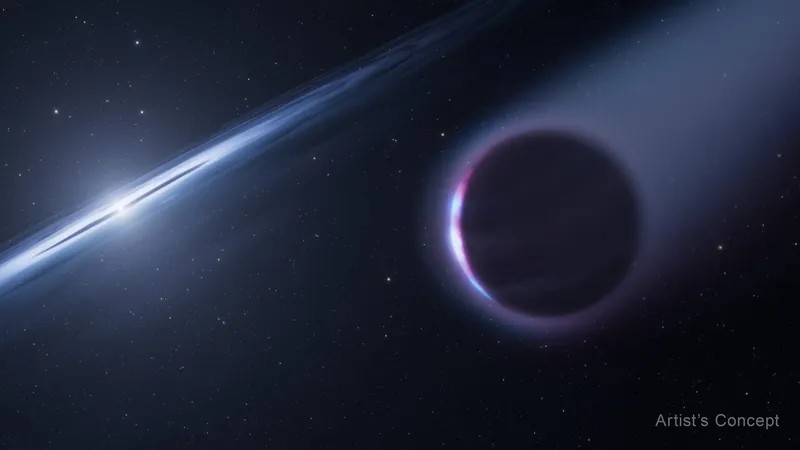
Unidentified lines in a 1999 Hubble spectrum turn out to be largely copper and niobium. A new study argues that the white dwarf HS 0209+0832 is swallowing gas from a giant planet built from material the star itself shed as it died. If confirmed, it will be the first second-generation planet found around a white dwarf.
A Hubble cold case
HS 0209+0832 is a white dwarf about 270 light-years away: the exposed core of a sun-like star that has used up its fuel and shed its outer layers. It is young: still about 35,800 kelvin at the surface after only some 5 million years of cooling. Its gravity pulls helium and heavier elements below the surface within months, so the helium and metals seen there must still be arriving from outside.
A 2000 study of an ultraviolet spectrum taken by Hubble on 10 January 1999 identified seven elements, but about 100 lines could not be matched to any known element, leaving the pollution's source a mystery. Jamie Williams of the University of Warwick and colleagues reanalysed the data with newer atomic line lists and traced most of them to copper and niobium. Spectra taken in 2002 by FUSE, a now-retired NASA ultraviolet satellite, show the same niobium lines.
What a second-generation planet is
Earth is a first-generation planet: it grew from the disc of gas and dust left over when the Sun formed. A second-generation planet forms late in its star's life, from material the star itself has thrown off.
In its final giant stage (the asymptotic giant branch, AGB), a sun-like star blows its outer layers away. Inside such stars, atomic nuclei capture neutrons one at a time, slowly building elements heavier than iron; astronomers call this the s-process (s for slow). Niobium is one of its products, so a planet built from AGB ejecta should show a niobium excess that no known process gives a planet born around a young star.
A lone star shedding mass evenly is unlikely to leave a planet-forming disc, so the authors suggest a close companion: engulfed by the swelling giant, it would have helped eject the giant's envelope, part of which could have settled into a disc.
The evidence
- Too much niobium. The ratio of niobium to calcium is more than a thousand times the Sun's, and FUSE spectra of 33 other debris-polluted white dwarfs show no niobium.
- Not rock. Polluting debris is usually rich in silicon and iron. Here silicon appears only in traces and iron is not detected, so nickel is at least twice as abundant as iron; in Earth as a whole, iron is about twenty times as abundant as nickel. With the incoming helium, this points to a giant planet's atmosphere.
- A 4.4-day rhythm. NASA's TESS saw the star brighten and fade by 0.12% every 4.4 days. White dwarfs typically rotate once in about 30 hours, so the team attributes the slower signal to a body orbiting 6.6 million kilometres out, a ninth of Mercury's distance from the Sun.
What is still uncertain, and where to look
The planet has not been seen and its mass is unknown, so the paper calls it a candidate. TESS never saw it pass in front of the star, and the 4.4-day signal is weak: analysed separately, only two of the four observing periods show it clearly. Starlight reflected or re-emitted by an ordinary planet's dayside could cause a 0.12% swing only if the planet were four to eight times wider than Jupiter. The authors propose either a young planet whose hot nightside outshines its hazy dayside, or a comet-like tail of escaping gas crossing our line of sight where the planet itself does not.
The chemistry does not fit perfectly either: models predict that AGB stars make strontium along with niobium, yet no strontium was detected.
HS 0209+0832 lies in Cetus at right ascension 2h 12m, declination +8° 47′. It is visible from both hemispheres and stands highest in the middle of the night in late October, 47° high from London and Cape Town alike. At about magnitude 13.8 it can be found only with a telescope and a detailed chart, and even then it is a faint point like any other star. No telescope, Hubble included, has seen the planet itself: everything here was read from the star's light.
Sources and licences
- ESA/Hubble science release heic2613 (5 October 2026), Suspected second-generation planet solves Hubble cold case — The cold-case framing, 1999 Hubble observation with about 100 unidentified features, Jamie Williams (University of Warwick), FUSE confirmation, TESS brightness variations, planet losing atmosphere, https://esahubble.org/news/heic2613/
- ESA/Hubble image heic2613a, HS 0209+0832 System (Artist's Concept) — Hero image (type: artwork), image description and credit line NASA, ESA, L. Hustak (STScI). Licence: CC BY 4.0 per https://esahubble.org/copyright/ . https://esahubble.org/images/heic2613a/
- Williams, Gänsicke, Stone et al., Nature Astronomy (2026), Discovery of a second-generation planet candidate accreting onto a white dwarf — White dwarf parameters (35,800 K, cooling age 5.1 million years, distance 82.6 pc), STIS observation of 10 January 1999, the 2000 study, FUSE spectrum of 2002, niobium and nickel-to-iron abundances, comparison with 33 white dwarfs, AGB s-process origin, common-envelope disc scenario, TESS period (4.399 days), amplitude and per-sector results, orbit of 0.044 au, interpretations of the signal, missing strontium. https://doi.org/10.1038/s41550-026-02983-7 (arXiv: https://arxiv.org/abs/2610.07161)
- SIMBAD astronomical database (CDS, Strasbourg), entry HS 0209+0832 — Coordinates (RA 02h 12m 04.9s, Dec +08° 46′ 51″, J2000), alternative name Feige 20, V magnitude 13.84. https://simbad.cds.unistra.fr/simbad/sim-id?Ident=HS%200209%2B0832