SkyFlux
NGC 7129 Stellar Nursery: Webb Image Shows Young Stars' Jets and Outflows
Published · Updated
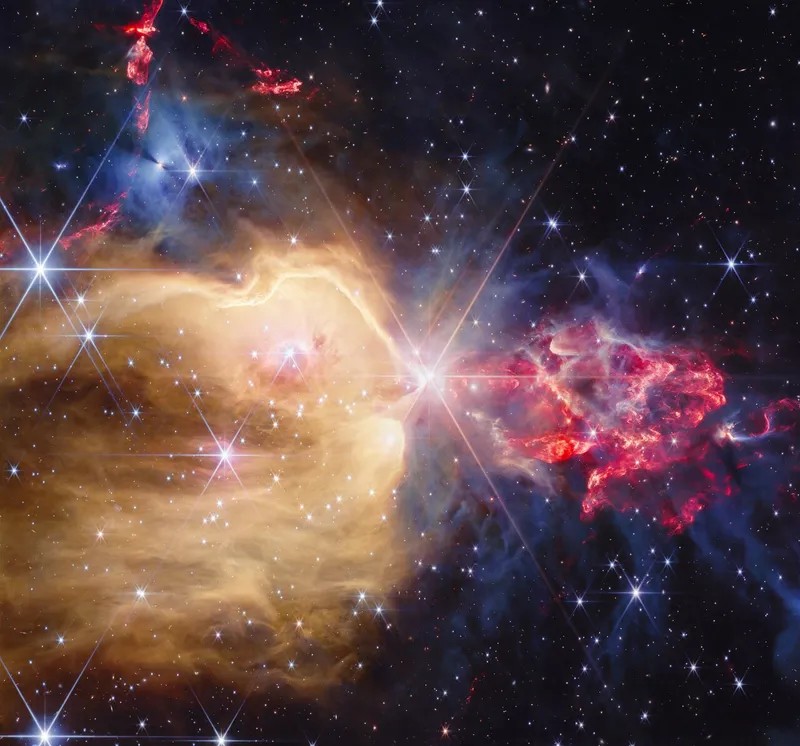
The James Webb Space Telescope has imaged NGC 7129, a stellar nursery in Cepheus about 3,300 light-years away, where young stars at different stages of formation sit side by side with the ragged red outflows of the youngest.
Young stars at different stages in one frame
The bright star at the centre is LkHα 234, a young star of roughly five to eight solar masses. It has mostly finished gathering mass and is shrinking under its own gravity, heating up as it does, until it can fuse hydrogen like the Sun. More massive stars develop faster, so LkHα 234, the most massive star in this young cluster, is also the most mature.
To its left, a golden cavity about 3.5 light-years across was carved out of the molecular cloud by outflows from an earlier stage of the star's development. Where gas heated by the stars presses against the colder cloud, a sharp ridge forms along the cavity's top. Along this boundary, called a photodissociation region, starlight breaks hydrogen molecules into atoms, wearing the cloud away over millions of years.
To the right, clumpy gas lit red by outflows hides protostars: stars at an earlier stage, still collecting mass. At the centre of a blue nebula at the upper left sits another protostar, whose doughnut-shaped disc casts a shadow across the surrounding gas.
Jets, shocks and Herbig–Haro objects
Young stars not only take in material; they also eject some of it in narrow jets and broader outflows. When that fast gas hits the slower cloud, shock waves make the gas glow; such glowing regions around newborn stars are called Herbig–Haro objects. In Webb's image, the red, textured patches are outflows from several protostars, superimposed along our line of sight.
A 2008 review of star formation in Cepheus lists more than two dozen Herbig–Haro objects in and near NGC 7129, many attributed to the LkHα 234 region. An optical jet found there in 1990 points southwest into the cavity. Later observations found several buried young objects within a few arcseconds of LkHα 234; one of them, a clump seen only at millimetre wavelengths, is the likely source of the region's molecular-hydrogen jet, and the review finds no evidence of a two-sided outflow from the bright star itself. The ESA/Webb release does not label individual Herbig–Haro objects in the image.
Why Webb looks in infrared
Stars form inside cold, dense clouds whose dust scatters and absorbs visible light, hiding the youngest objects from optical telescopes. Infrared light passes through much of that dust, and the shock-heated gas in outflows also glows in the infrared, for example through warm molecular hydrogen.
The image combines six NIRCam filters between 1.15 and 4.7 micrometres, each given a colour: the shorter wavelengths blue and cyan; a 3.35-micrometre filter sensitive to carbon-rich molecules called polycyclic aromatic hydrocarbons (PAHs) yellow; and the two longest red, one centred on a molecular hydrogen line. The colours label filters, not elements: ESA/Webb describes the gas filling the golden cavity as hot atomic hydrogen, the red regions as cooler molecular gas heated by outflows, and the grey areas as the coldest, densest gas, where no stars have formed yet.
Where NGC 7129 is, and what a telescope shows
NGC 7129 lies in Cepheus at right ascension 21h 43m, declination +66° 07′. It never sets north of about 24° N; from the latitude of London it climbs to about 75° above the northern horizon. It stands opposite the Sun in mid-August, so it is highest in the middle of the night then, and in the evening in October and November. From the equator it rises no more than about 24°, and south of about 24° S never: it is a northern-hemisphere object.
A large amateur telescope can show the reflection nebula, dust lit by the cluster's stars. Catalogues give about magnitude 11.5 and a size of about 7 arcminutes. With a 44 cm telescope, the visual observer Steve Gottlieb saw a glow of fairly high surface brightness, about 3 by 2 arcminutes, around three stars of magnitudes 9.5 to 10.5. Gottlieb also observed it with a 33 cm telescope; the sources we read describe no views through smaller instruments. An optical photograph by Robert Gendler, reproduced in the 2008 review, shows the cluster, the nebula and several Herbig–Haro objects. Webb recorded infrared light in assigned colours, so no eyepiece view or ordinary photograph will look like this image.
Sources and licences
- ESA/Webb photo release weic2620 (6 October 2026), Webb captures commotion from nebula's stellar jets — Distance about 3,300 light-years, LkHα 234 as central pre-main-sequence star of 5–8 solar masses, golden cavity about 3.5 light-years across carved by earlier outflows, bow shocks, photodissociation ridge, protostars and red outflows to the right, blue nebula with protostar and disc shadow, why infrared. https://esawebb.org/news/weic2620/
- ESA/Webb image weic2620a, NGC 7129 (NIRCam image) — Hero image, credit line, caption (hot atomic hydrogen, cooler molecular hydrogen, grey coldest gas), coordinates (RA 21h 43m 04.9s, Dec +66° 06′ 45″), field of view 6.26 × 5.84 arcminutes, orientation, constellation, NIRCam filters 1.15, 1.87 (Paschen-alpha), 2.0, 3.35 (PAH), 4.44 and 4.7 µm (molecular hydrogen) and their colours. Licence: CC BY 4.0 per https://esawebb.org/copyright/ . https://esawebb.org/images/weic2620a/
- ESA, Webb snaps supersonic outflow of young star (HH 211, 2023) — What Herbig–Haro objects are (shocks where jets and winds from newborn stars hit nearby gas and dust) and why infrared reveals embedded outflows. https://esa.int/ESA_Multimedia/Images/2023/09/Webb_snaps_supersonic_outflow_of_young_star
- Kun, Kiss & Balog (2008), Star Forming Regions in Cepheus, Handbook of Star Forming Regions Vol. I — NGC 7129 as a reflection nebula around a young cluster at about 1 kpc, table of Herbig–Haro objects in NGC 7129, optical jet of Ray et al. (1990) pointing southwest into the cavity, embedded sources near LkHα 234 and the likely jet driver, at least four nearly parallel outflows, optical photograph by Robert Gendler showing several HH objects. https://arxiv.org/abs/0809.4761
- CzSky deep-sky catalogue entry NGC 7129, with visual notes by Steve Gottlieb — Catalogue magnitude 11.5 and size 7′; Gottlieb's observations with 13-inch and 17.5-inch telescopes (nebulosity about 3′ × 2′ around three stars of magnitude 9.5–10.5). https://www.czsky.eu/deepskyobject/NGC7129/info
- JPL Horizons — Apparent right ascension of the Sun, August 2026 to January 2027, used to work out when NGC 7129 is highest in the sky. https://ssd.jpl.nasa.gov/horizons/