SkyFlux
NGC 1827: Hubble Image of an Edge-On Spiral Galaxy in Columba
Published · Updated
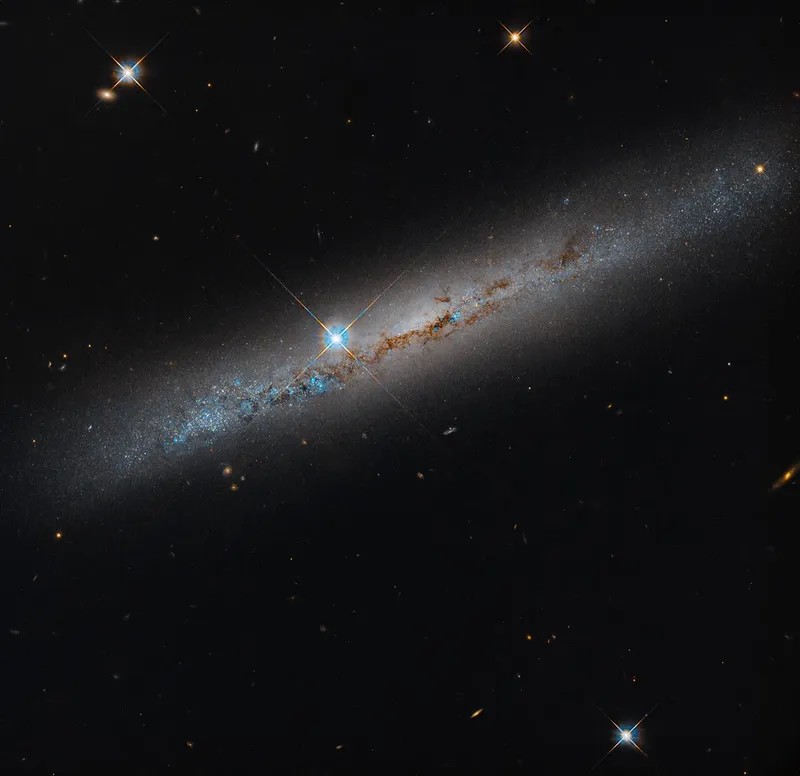
A new Hubble image shows NGC 1827, a spiral galaxy seen almost exactly edge-on, in the southern constellation Columba, the Dove. From this angle the arms are hidden, but the view shows what a face-on image cannot: how thick the disk is and where its dust lies.
A spiral seen from the side
NGC 1827 lies roughly 37 million light-years away. Catalogues class it as a barred late-type spiral (type Sc), with a small bulge and loosely wound arms. Its disk is tilted about 85 degrees from face-on, so it looks about five times as long as it is wide. It spans just over three arcminutes, roughly 35,000 light-years across at that distance.
Edge-on, the disk shows its profile: a pale band of starlight around a brighter central bulge, with a ragged line of reddish-brown dust and blue clumps along the middle. NASA identifies the blue clumps as places where new stars are likely forming; young, hot stars shine blue, while dust absorbs and reddens light from behind.
Did you know?The four spikes around the bright foreground star are an optical effect: starlight bends around the supports of Hubble's secondary mirror, giving every bright star in Hubble images the same cross.
Why astronomers study galaxies edge-on
A face-on view shows the spiral pattern; an edge-on view shows the third dimension: how far the stars reach above and below the midplane. A study of 34 edge-on galaxies found that their light is best explained by two components, a thin disk and a thick disk about twice as thick. In galaxies rotating more slowly than about 120 km/s, the thick disk supplies nearly half the light and most of the stellar mass, suggesting most of their stars are old even when these galaxies look blue.
Dust is also easiest to see edge-on, in silhouette against the starlight behind it. A survey of edge-on disks found that sharp, narrow dust lanes are common in galaxies rotating faster than about 120 km/s and largely absent in slower ones, where the cold gas and dust form a thicker, more turbulent layer. The gas in NGC 1827 rotates at about 77 km/s, and its dust here is patchy and broken rather than a single knife-edge lane, consistent with that trend.
In an edge-on disk, gas on one side moves almost straight towards us and on the other side away, so measured rotation speeds need little correction for tilt: for NGC 1827 the correction raises the speed from 76.9 km/s to only 77.2 km/s.
Part of a census of small galaxies
The image comes from Hubble program 18061, the Hubble Census of Nearby Satellites, led by Michael Jones (Caltech). It aims to count every satellite galaxy brighter than a set limit around 22 Milky Way-like host galaxies within about 32 million light-years, 260 satellites in all. Of these, 111 already had Hubble images; the other 149 get one Hubble orbit each. NGC 1827 is on the program's target list. Catalogues place it in the NGC 1808 group; its distance estimates, 36 to 37 million light-years, put it just beyond the survey's nominal edge.
Small galaxies test models of how matter clumps, which often struggle on small scales; until recently the only complete sample was the satellites of our own Galaxy and its neighbours. NGC 1827 was photographed with Hubble's Wide Field Camera 3 through two filters, F606W (a broad visible band centred near 589 nm) and F814W (near-infrared, centred near 804 nm). Hubble resolves individual stars, and two colours locate the tip of the red giant branch, the nearly fixed peak luminosity of red giants in an old population, which gives the distance.
Can you see NGC 1827?
NGC 1827 lies in Columba, at right ascension 5h 10m and declination −37°. Observers north of about 53° N never see it rise; from London (51.5° N) it reaches only about 1.5° above the southern horizon, too low to observe. From the Southern Hemisphere it is well placed: it stands highest in the middle of the night in December, and in the evening sky in January and February.
Catalogues give it a total magnitude of about 13, spread along a streak about three arcminutes long, so even in a telescope under dark skies it is a faint glow. The dust and the blue star-forming clumps show up only in long-exposure photographs.
Sources and licences
- NASA Science, NASA's Hubble Spies Spiral's Edge (16 October 2026) — Image and credit line, distance about 37 million light-years, Columba, intermediate edge-on spiral, survey of 260 satellites around 22 Milky Way-like hosts within about 32 million light-years (111 observed, 149 orbits), blue star-forming regions, foreground star and diffraction spikes from the secondary-mirror supports, purpose of low-mass galaxy studies; names the Advanced Camera for Surveys, whereas the program's observing plan and the MAST archive list only Wide Field Camera 3 for NGC 1827 (see below). https://science.nasa.gov/missions/hubble/nasas-hubble-spies-spirals-edge/
- NASA Images and Media Usage Guidelines — NASA content is generally not subject to copyright in the United States; NASA should be acknowledged as the source; no implied endorsement. https://www.nasa.gov/nasa-brand-center/images-and-media/
- STScI, HST program 18061 Phase II file (version 27, 8 October 2026) — Title Hubble Census of Nearby Satellites, PI Michael Gordon Jones (Caltech), Cycle 33; abstract (260 satellites, 22 hosts, 10 Mpc, 149 orbits, 111 existing targets, small-scale tension with cosmological models); NGC 1827 imaged with WFC3/UVIS in F606W and F814W; distances from the tip of the red giant branch; other targets observed with ACS/WFC. https://www.stsci.edu/hst/phase2-public/18061.pro
- MAST archive, HST observations at NGC 1827 — WFC3/UVIS F606W (794 s) and F814W (1262 s), program 18061, observation start MJD 61166.21 = 6 May 2026 UTC; no ACS data within 0.25° of the galaxy. https://mast.stsci.edu/
- WFC3 Instrument Handbook, UVIS spectral elements — Pivot wavelengths F606W 588.9 nm (wide V) and F814W 803.9 nm (wide I). https://hst-docs.stsci.edu/wfc3ihb/chapter-6-uvis-imaging-with-wfc3/6-5-uvis-spectral-elements
- HyperLEDA, NGC 1827 (PGC 16849) — Type Sc, barred, inclination 84.7°, diameter log d25 = 1.51 (3.2 arcminutes), axis ratio log r25 = 0.69 (about 4.9), total B magnitude 13.24, distance modulus 30.20 (about 36 million light-years), gas rotation 76.9 km/s apparent and 77.2 km/s corrected for inclination. http://atlas.obs-hp.fr/hyperleda/ledacat.cgi?o=NGC1827
- HyperLEDA designation [BFK2006]GEMS-N1808-06 — NGC 1827 catalogued as a member of the NGC 1808 group (GEMS group survey designation). http://atlas.obs-hp.fr/hyperleda/ledacat.cgi?o=NGC1827
- Dalcanton, Yoachim & Bernstein, The Astrophysical Journal 608 (2004), The Formation of Dust Lanes: Implications for Galaxy Evolution — Narrow dust lanes only in disks with rotation above 120 km/s; thicker, more turbulent cold gas layer in slower galaxies. https://arxiv.org/abs/astro-ph/0402472
- Yoachim & Dalcanton, The Astronomical Journal 131 (2006), Structural Parameters of Thin and Thick Disks in Edge-On Disk Galaxies — 34 edge-on galaxies, thin plus thick disk, thick disk scale height about twice as large, thick disk nearly half the light below 120 km/s. https://arxiv.org/abs/astro-ph/0508460