SkyFlux
PLANETS
MMX Mission to the Moons of Mars: What NASA Adds to Japan's Phobos Sample Return
Published · Updated
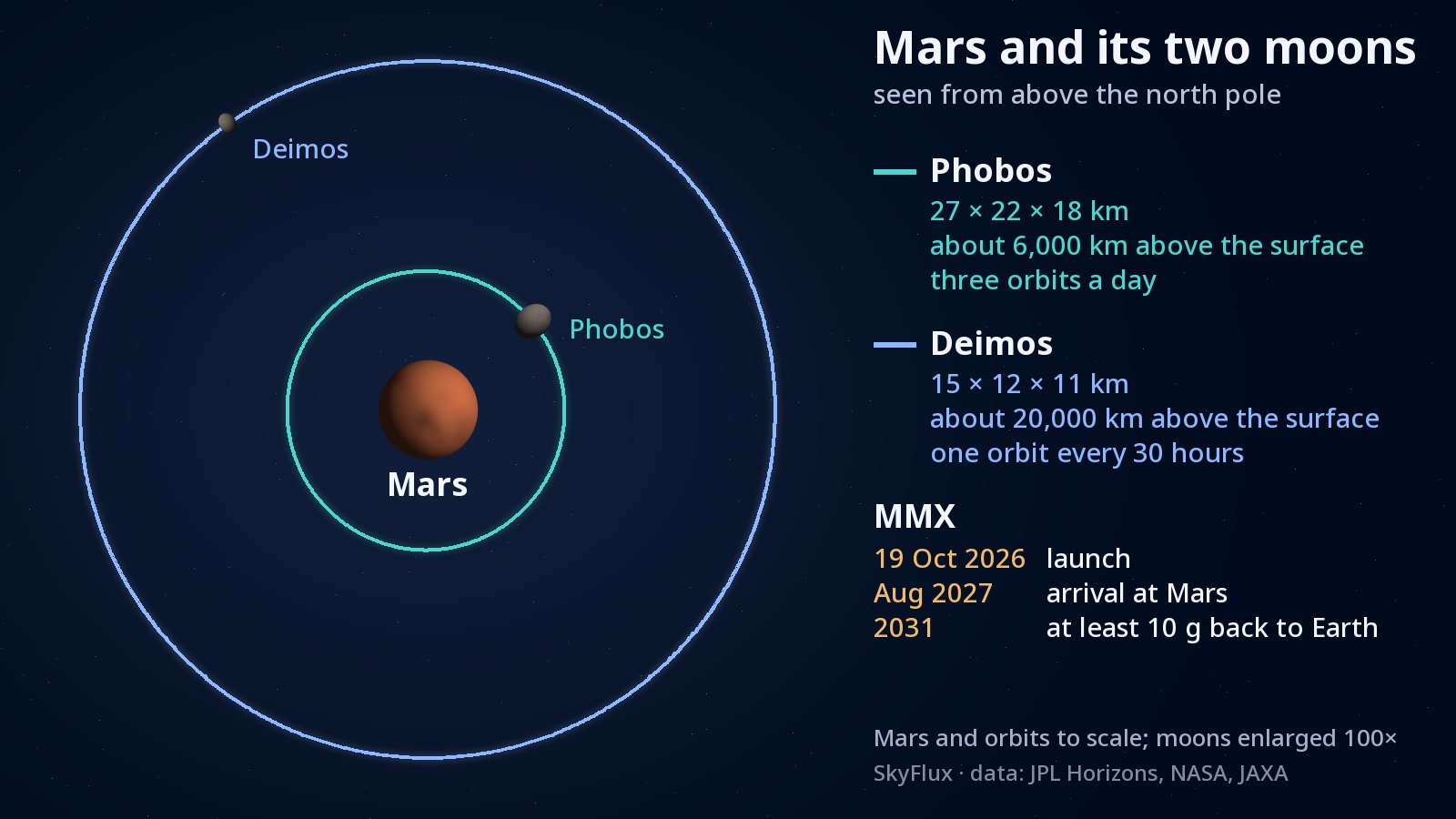
Japan's MMX (Martian Moons eXploration) spacecraft aims to bring at least 10 grams of material from the Martian moon Phobos back to Earth in 2031. Its launch from Tanegashima was set for 19:41 UTC on 19 October 2026, with backup dates until 7 November (Japan date). NASA contributes an instrument, a sampler and Deep Space Network tracking.
What NASA is contributing
MMX is led by the Japan Aerospace Exploration Agency (JAXA), with NASA as a partner. NASA's main contribution on board is MEGANE, a gamma-ray and neutron spectrometer. Cosmic rays constantly strike Phobos, and the surface answers with gamma rays and neutrons whose energies depend on which elements are present, so measuring them from orbit reveals the surface's make-up.
NASA also supplied the P-Sampler, a technology demonstrator mounted on one of the landing legs; it uses bursts of high-pressure nitrogen to blow surface material into a container. JAXA's own C-Sampler collects cores from several centimetres below the surface. The Deep Space Network will help with communications and navigation, and about 15% of the returned sample will be curated at NASA's Johnson Space Center in Houston.
Captured asteroids or debris from an impact?
Phobos measures about 27 × 22 × 18 km and orbits about 6,000 km above the Martian surface, circling the planet three times a day. Deimos, about 15 × 12 × 11 km, circles Mars every 30 hours. Both are dark, and the way they reflect light resembles that of carbonaceous asteroids. That resemblance supports the idea that Mars captured them, although NASA notes that some evidence contradicts it.
The rival idea is a giant impact: a large body struck Mars and threw material into orbit, where it coalesced into the moons. JAXA describes the two as competing theories. A third proposal, published in 2024 by researchers at NASA and Durham University, is that Mars's gravity tore apart a passing asteroid, whose fragments collided and ground one another down into a disc from which the moons formed.
Carbonaceous asteroids can carry water and the substances that build atmospheres, so captured moons would be samples of the kind of material that may have delivered water to the inner planets, Earth among them. Moons made from impact debris would instead preserve a piece of early Mars.
What ten grams of Phobos can reveal
MEGANE's map of elements across Phobos will help choose where to land. A laboratory can analyse the chemistry and mineralogy of individual grains. Composition is the key test between a captured asteroid and a moon born in an impact.
Because Phobos orbits so close to Mars, JAXA estimates that it has collected more than a hundred times as much material blasted off the Martian surface as Deimos has. The sample may therefore also contain small pieces of Mars, delivered long after the moon formed, whichever way it formed.
Mission timeline, and how to see the moons yourself
- 19 October 2026, 19:41 UTC (planned): launch on H3 flight No. 10; backup launch dates run until 7 November, Japan date.
- August 2027: arrival at Mars, then a close orbit around Phobos to map it and choose landing sites.
- No earlier than December 2028: sample collection. A small rover lands first, then the main spacecraft.
- 2030: after a flyby to observe Deimos, departure from Mars for a journey of about a year.
- 2031: a capsule carrying the sample will enter Earth's atmosphere and be recovered in Australia.
At the next opposition, in the second half of February 2027, Mars will shine in Leo at magnitude −1.3, Phobos at magnitude 12.1 and Deimos at 13.2. Then Phobos never strays more than about 19 arcseconds from the planet's centre, and Deimos no more than about 48 arcseconds. Without a telescope you will see only Mars: at magnitudes 12 to 13, the moons are far beyond the naked eye and binoculars. Faintness matters less than the glare of a planet more than 13 magnitudes brighter: seeing them takes high magnification, steady air and ideally a way to block it. Mars, about 15° north of the celestial equator, will be well placed for observers in both hemispheres.
Sources and licences
- NASA Science, NASA to Help Unlock Mysteries of Mars' Moons in Upcoming Mission (15 October 2026) — Launch time (19:41 UTC on 19 October), NASA contributions (MEGANE, P-Sampler, Deep Space Network, US science team), about 15% of the sample at Johnson Space Center, C-Sampler depth, impact vs capture quote, water and organics, arrival August 2027, sample no earlier than December 2028, return 2031, MEGANE built by Johns Hopkins APL. https://science.nasa.gov/directorates/smd/planetary-science-division/nasa-to-help-unlock-mysteries-of-mars-moons-in-upcoming-mission/
- JAXA press release, launch schedule of MMX aboard H3 F10 (20 August 2026) — Launch time 19:41:03 UTC on 19 October 2026 (given by JAXA in Japan time), reserved period 21 October – 7 November 2026 (Japan dates), Yoshinobu Launch Complex, Tanegashima. https://global.jaxa.jp/press/2026/08/20260820-1_e.html
- JAXA MMX project site (home, Mission and Science pages) — At least 10 g from Phobos, two landings (rover first), quasi-satellite orbit, Deimos flyby, departure 2030, return 2031 with recovery in Australia, Phobos about 6,000 km above Mars, carbonaceous-asteroid-like reflectance, giant impact and capture as two competing theories, MEGANE's gamma rays and neutrons generated by cosmic rays and natural radioactivity, more than 100 times as much Martian material as Deimos. https://www.mmx.jaxa.jp/en/ · https://www.mmx.jaxa.jp/en/mission/ · https://www.mmx.jaxa.jp/en/science/
- NASA Science, Phobos, Deimos and MMX mission pages — Sizes of Phobos (27 × 22 × 18 km) and Deimos (15 × 12 × 11 km), three orbits a day, 30-hour orbit of Deimos, C-type composition, some evidence contradicting capture, MEGANE measuring method. https://science.nasa.gov/mars/moons/phobos/ · https://science.nasa.gov/mars/moons/deimos/ · https://science.nasa.gov/mission/mmx/
- Durham University news, Supercomputer simulations offer new explanation for the formation of Mars' moons (20 November 2024) — Disrupted-asteroid proposal by researchers at NASA Ames and Durham, published in Icarus; composition as the test between asteroid and impact origins. https://dur.ac.uk/news-events/latest-news/2024/11/supercomputer-simulations-offer-new-explanation-for-the-formation-of-mars-moons-/
- JPL Horizons (queried 17 October 2026) — Magnitudes of Mars, Phobos and Deimos and Mars's position near the February 2027 opposition; orbital sizes of Phobos and Deimos, used to compute their greatest distances from Mars on the sky. https://ssd.jpl.nasa.gov/horizons/