 SkyFlux
Voyager 1 Is Now One Light-Day From Earth: What It Found on the Way
Published · Updated
This story was written before the event: its times and expectations are a forecast, not a result.

At 5:16 a.m. EST on Nov. 18 (2:16 a.m. PST; 10:16 UTC), Voyager 1 became the first human-made object to be one light-day from Earth: 16.09 billion miles (25.9 billion km), the distance light covers in exactly 24 hours. NASA announced the date in advance; we worked out the minute from the spacecraft's trajectory as computed by NASA's Jet Propulsion Laboratory (JPL), and it matched the countdown clock NASA ran on its Voyager 1 page. Because a radio signal now needs a day to make the trip, two more times belong to the same milestone: a command sent from Earth after 1:24 p.m. EST on Nov. 17 takes more than a day to reach the spacecraft, and every signal from it that arrives after 9:17 p.m. EST on Nov. 18 has spent more than a day on the way.
What one light-day means
Light, and the radio waves Voyager 1 uses to talk to Earth, travels 186,282 miles (299,792.458 km) every second. A day has 86,400 seconds, so one light-day is 16,094,799,105 miles (25,902,068,371 km), about 173 times the average distance between Earth and the Sun.
The chart at the top puts that in proportion. Sunlight reaches us in 8 minutes, and light from Neptune, the outermost planet, in 4 hours 4 minutes, so the Sun and all eight planets fit into the first fifth of the scale. Voyager 1's twin, Voyager 2, is 20 hours 6 minutes away.
The delay is what makes the milestone matter. A command now takes about a full day to arrive and the reply another day to come back, so engineers wait two days to learn whether an instruction worked. When the team sent commands on April 17 to switch off an instrument to save power, NASA noted the commands would take "23 or so hours" to arrive.
What Voyager 1 found on the way
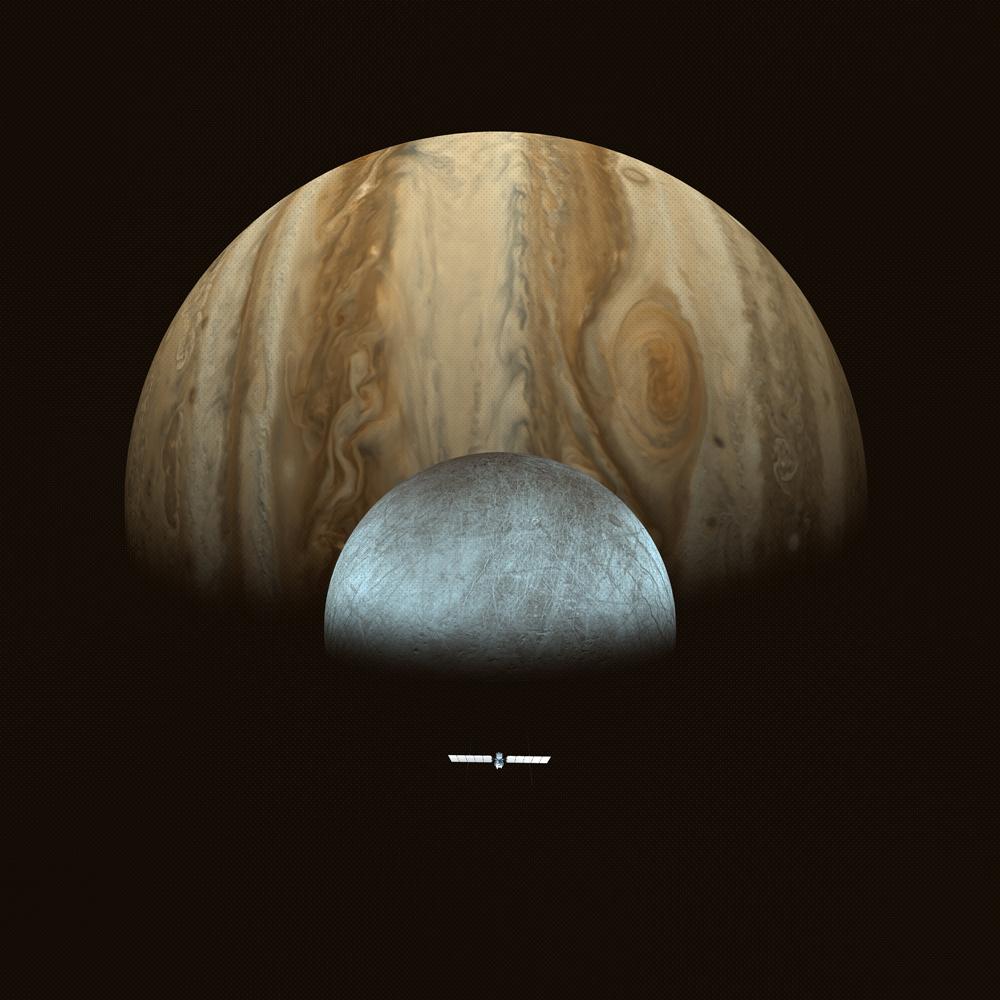
Voyager 1 left Earth on Sept. 5, 1977, and has been flying for 49 years. On March 5, 1979, it passed within 174,000 miles (280,000 km) of Jupiter and found a faint ring around the planet and two previously unknown moons, Thebe and Metis. Days later Linda Morabito, a member of the Voyager team at JPL, noticed a plume rising above the edge of the moon Io in one of the spacecraft's pictures. It was an eruption: the first active volcano seen anywhere beyond Earth.
On Nov. 12, 1980, Voyager 1 flew within 78,000 miles (126,000 km) of Saturn. It found five new moons and a new ring, and it showed what the atmosphere of Saturn's largest moon, Titan, is made of: about 90% nitrogen, the gas that also makes up most of Earth's air.
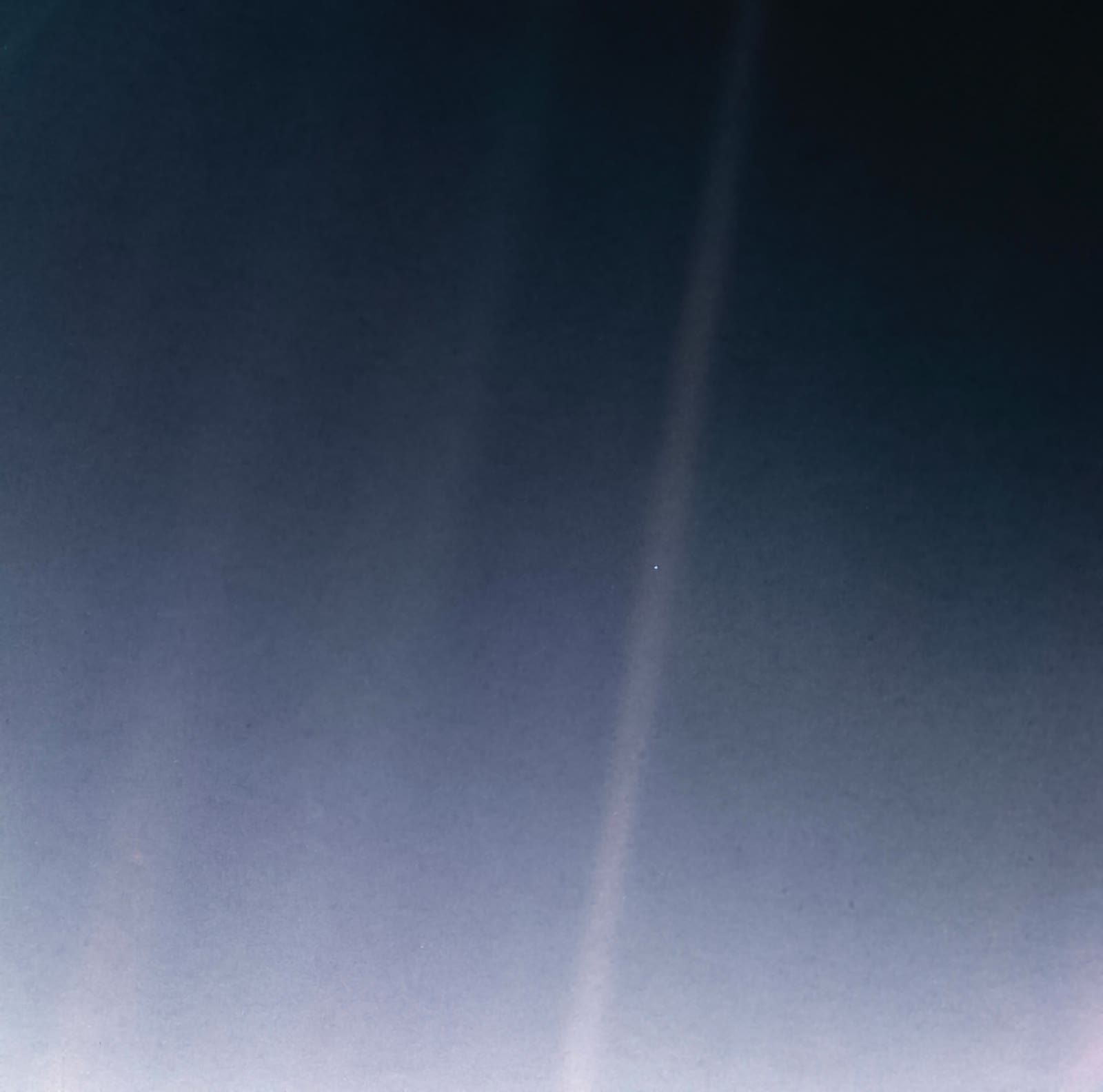
On Feb. 14, 1990, when it was 3.7 billion miles (6 billion km) from the Sun, Voyager 1 turned its cameras back toward home, an idea the astronomer Carl Sagan had proposed in 1981. It took 60 pictures and caught six planets. In one of them Earth is a point of light about one pixel across; the picture became known as the Pale Blue Dot. Thirty-four minutes after the pictures of Earth, the cameras were switched off for good.
On Aug. 25, 2012, Voyager 1 became the first spacecraft to leave the heliosphere, the bubble of particles and magnetic fields that the Sun blows around itself and its planets, and to enter the space between the stars. What gave the crossing away was the thin gas around the spacecraft: outside the bubble it is more than 40 times denser than in the bubble's outer layer. Only one other spacecraft has followed: its twin, Voyager 2, in 2018.
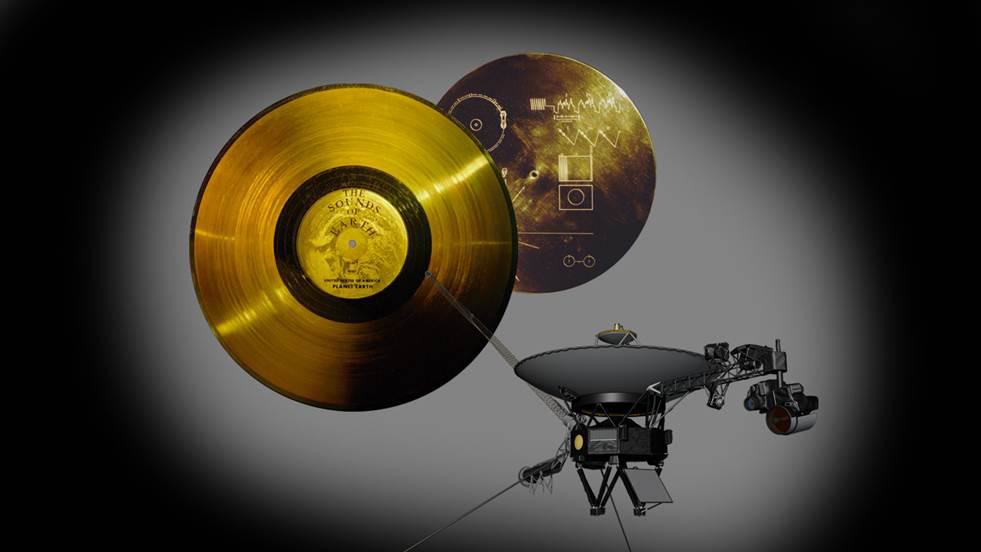
Voyager 1 also carries a message in case anyone ever finds it. That message is the Golden Record, a gold-plated copper disc 12 inches (30 cm) across, with greetings in 55 languages, 35 sounds of life on Earth, 90 minutes of music and 115 pictures.
The month before: two days of silence
A month before the milestone, Voyager 1 went silent. On Oct. 18 and 19, the dishes of NASA's Deep Space Network listened for it at two scheduled times, 24 hours apart, and heard nothing. The signal came back on Oct. 20, about 48 hours after it was lost. The team found that one group of thrusters had gone offline and that the spacecraft had switched to its backup thrusters on its own, as it is built to do when its computers detect a fault. What caused the loss of contact was still under investigation when NASA reported the episode on Oct. 29. At this point in the mission, said Kareem Badaruddin, the Voyager mission manager at JPL, "we have to expect the unexpected."
The other worry is power, because Voyager 1's generator delivers less of it every year. In early September, engineers switched off three of the devices that keep the spacecraft warm and turned on three lower-power ones in their place, all at the same moment so that the heat stayed evenly spread. Without that swap, NASA says, one more of the science instruments still running would have had to be shut down as early as summer 2027.
NASA had also invited people around the world to mark the eve of the milestone: after sunset on Nov. 17, they were to go outside and flash V-G-R, Voyager's call sign, in Morse code with the light of a phone or tablet.
Why the exact moment depends on which way the signal travels
The 5:16 a.m. EST time is a snapshot: Voyager 1 and Earth at the same instant, measured from Earth's center. A radio signal, though, needs a day for the trip, and meanwhile the gap keeps growing. Voyager 1 is moving away from Earth at 15.8 miles (25.4 km) per second. About two-thirds of that is its own flight away from the Sun; at this time of year, Earth's motion along its orbit adds the rest. So the milestone has three answers, each right for its own question. In time order:
- Command sent: 1:24 p.m. EST on Nov. 17 (10:24 a.m. PST; 18:24 UTC). A command sent at this moment is the first to need 24 hours to reach the spacecraft, because it must catch up with where Voyager 1 will be a day later. Every command sent after it takes longer.
- Distance equals one light-day: 5:16 a.m. EST on Nov. 18 (2:16 a.m. PST; 10:16 UTC). This is the snapshot, and the time NASA's countdown clock showed.
- First signal to arrive after a 24-hour trip: 9:17 p.m. EST on Nov. 18 (6:17 p.m. PST; 02:17 UTC on Nov. 19). Every signal from Voyager 1 that arrives later has been on the way for more than a day.
All three times come from the same trajectory and are for Earth's center. A dish on the surface can be up to 3,959 miles (6,371 km) nearer to or farther from Voyager 1, depending on where Earth's rotation has carried it. The gap grows by 15.8 miles every second, so it takes about 4 minutes to grow by that much: for a given dish, each moment can come up to about 4 minutes earlier or later.
Why we measure from Earth, and why it happens only once
Measured from the Sun, Voyager 1 does not reach one light-day until Feb. 3, 2027, at about 4:39 p.m. EST. We use the distance from Earth, as NASA does, because this milestone is about communication, and the antennas that talk to Voyager 1 are on Earth.
That distance does not grow steadily. Earth circles the Sun at 18.5 miles (29.78 km) per second, faster than Voyager 1's own outward speed of 10.5 miles (16.9 km) per second, so from late January to late April each year Earth heads toward the spacecraft faster than the spacecraft retreats, and the gap shrinks: in 2027 by 25.3 million miles (40.7 million km).

A dip like that could pull Voyager 1 back inside one light-day for a few weeks, so that it would cross the line, drop back and cross again. It does not. At its lowest point, on April 24, 2027, Voyager 1 is still 89 light-seconds, or 16.5 million miles (26.6 million km), beyond one light-day. Each later spring dip stays higher, so from Nov. 18 on, Voyager 1 is more than a light-day from Earth for good.
How certain is that minute, and can you see Voyager 1?
That minute comes from JPL's computed path for the spacecraft, not from a fresh measurement. According to JPL's notes, the path was recalculated in 2022 from tracking data taken between 1981 and 1992, then projected forward; in JPL's words, "there has been no new tracking data possible since 1992." That does not mean the radio went quiet: the Deep Space Network still sends Voyager 1 commands and receives its data. What ended in April 1992, JPL's notes say, were the two-way tracking measurements used to pin down its path; the lack of new ones, the notes add, is "a different issue from on-board telemetry." Read 5:16 a.m. EST as the moment the best available model gives.
No telescope can show you Voyager 1. It lies in Ophiuchus, about 40° from the Sun in the evening sky, and the only contact is by radio through the large dishes of NASA's Deep Space Network. The spacecraft is losing about 4 watts of power a year; since April it has two science instruments left, one listening to plasma waves and one measuring magnetic fields.
Sources and licences
- JPL Horizons (NASA/JPL) — Distance of Voyager 1 (ID -31) from Earth's center and from the Sun, geometric and light-time corrected; the times it reaches one light-day; its speed; distances of the Sun, planets, Pluto, New Horizons and Voyager 2 from Earth; its position in the sky; trajectory notes (2022 refit of 1981–1992 tracking data; final two-way tracking measurements April 24, 1992; telemetry continued after that). Computed Oct. 25, 2026. https://ssd.jpl.nasa.gov/horizons/
- NASA, "NASA JPL Looks to Next 90 Years of Innovation, Exploration" (Oct. 21, 2026) — Voyager 1 reaches a full light-day from Earth on Nov. 18. https://www.nasa.gov/centers-and-facilities/jpl/nasa-jpl-looks-to-next-90-years-of-innovation-exploration/
- NASA Science: Voyager 1 — Countdown to one light-day, 5:16 a.m. EST on Nov. 18, 2026 (read Oct. 25, 2026; no longer on the page after the milestone); launch on Sept. 5, 1977; the farthest object made by humans; the Jupiter and Saturn flybys (dates, distances, the ring, the moons, Titan's nitrogen); leaving the heliosphere on Aug. 25, 2012; the Golden Record. https://science.nasa.gov/mission/voyager/voyager-1/
- NASA Voyager blog, "NASA Shuts Off Instrument on Voyager 1 to Keep Spacecraft Operating" (April 17, 2026) — Commands take 23 or so hours to arrive; power loss of about 4 watts a year; the two instruments still operating. https://science.nasa.gov/blogs/voyager/2026/04/17/nasa-shuts-off-instrument-on-voyager-1-to-keep-spacecraft-operating/
- NASA Voyager blog, "NASA's Voyager 1 Conserves Power, Resolves Brief Communications Pause" (Oct. 29, 2026) — No signal on Oct. 18 and 19, contact again on Oct. 20; the thrusters switched to their backups, cause under investigation; three warming devices swapped for lower-power ones in early September; without the swap an instrument would be turned off as early as summer 2027; the quotation. https://science.nasa.gov/blogs/voyager/2026/10/29/nasas-voyager-1-conserves-power-resolves-brief-communications-pause/
- NASA, "NASA Invites Media, Public to Join Voyager 1 One-Light Day Activities" (Nov. 10, 2026) — The Nov. 17 invitation to flash V-G-R in Morse code after sunset; Voyager 2 entered interstellar space in 2018. https://www.nasa.gov/news-release/nasa-invites-media-public-to-join-voyager-1-one-light-day-activities/
- NASA Science: Voyager 1's Pale Blue Dot — Pictures of Earth taken on Feb. 14, 1990, 3.7 billion miles (6 billion km) from the Sun; 60 images, six planets; Earth about a pixel in size; Carl Sagan's idea from 1981; cameras powered off 34 minutes later; the 2020 version of the picture. https://science.nasa.gov/mission/voyager/voyager-1s-pale-blue-dot/
- NASA JPL, "NASA Spacecraft Embarks on Historic Journey Into Interstellar Space" (Sept. 12, 2013) — The gas outside the heliosphere is more than 40 times denser than in its outer layer. https://www.jpl.nasa.gov/news/nasa-spacecraft-embarks-on-historic-journey-into-interstellar-space/
- NASA History, "Voyager: The Grand Tour of Big Science" (SP-4219, chapter 11) — Linda Morabito of the JPL Voyager team found the first of nine active volcanoes on Io in 1979; reported in Science as "Discovery of Currently Active Extraterrestrial Volcanism" (June 1, 1979). https://www.nasa.gov/history/SP-4219/Chapter11.html
- NASA NSSDC Earth fact sheet — Earth's mean orbital velocity (29.78 km/s) and mean radius (6,371 km); nitrogen is 78.08% of Earth's air. https://nssdc.gsfc.nasa.gov/planetary/factsheet/earthfact.html
- BIPM, SI base unit: the metre — The speed of light in vacuum is exactly 299,792,458 m/s. https://www.bipm.org/en/si-base-units/metre