 SkyFlux
Europa Clipper Earth flyby: gravity assist planned for 3 December
Published · Updated
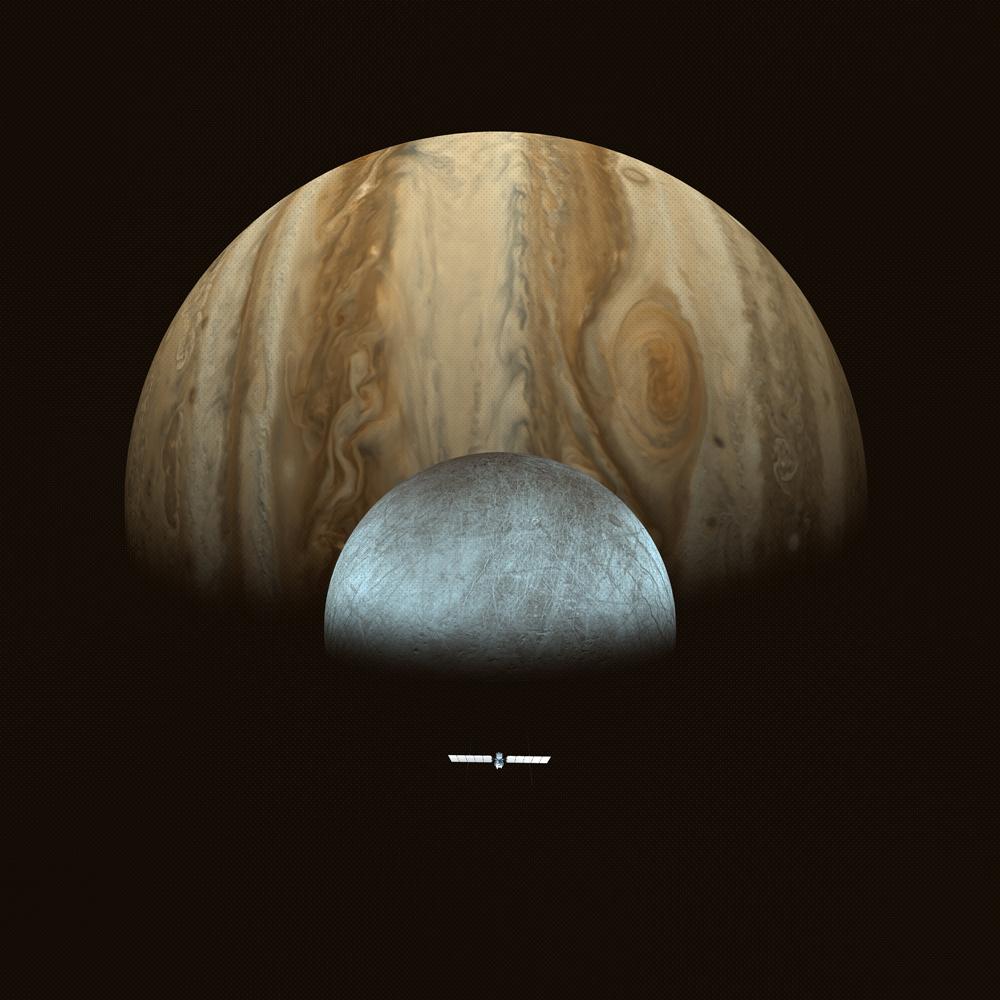
Europa Clipper, NASA's Jupiter-bound spacecraft, is due to swing past Earth on 3 December 2026, about 3,200 km (2,000 miles) from the planet, according to the agency's mission pages. The pass is a gravity assist: it speeds the spacecraft up relative to the Sun on its way to Jupiter and its moon Europa, with arrival at Jupiter planned for April 2030.
What is planned for 3 December
Europa Clipper launched on 14 October 2024 and is travelling about 2.9 billion km (1.8 billion miles) to the Jupiter system. The mission timeline describes the December pass as the spacecraft coming "home (briefly)" for its second gravity assist, about 3,200 km (2,000 miles) from Earth. That is a planned figure, not a measured one.
Both pages were read on 21 October 2026. The mission page names 3 December as the date; the mission timeline page says only "December 2026". The pages we read give no closest-approach time, so none is stated here, and we cannot say which part of Earth the spacecraft will pass over. Spacecraft dates can slip: if the plan changes, trust NASA's current page over this article.
The flyby is also a test opportunity. A JPL article from November 2024 says that the magnetometer, an instrument that measures magnetic fields, will measure Earth's magnetic field during the pass, which calibrates the instrument. A 2026 conference abstract by team scientists calls this the only absolute calibration of that instrument after launch, meaning a check against a known true value. The same abstract says the plasma instrument (PIMS, which measures charged particles around the spacecraft) will be cross-checked against data from other spacecraft near Earth, and that further tests of several instruments and systems working together are under consideration.
Why fly past Earth to reach Jupiter
A NASA article on the Mars flyby explains the detour. Without the assists from Mars in 2025 and from Earth in 2026, it says, the 6,000 kg spacecraft would need extra propellant, which adds weight and cost, or a much longer trip to Jupiter.
The physics is general, not specific to this mission: during a close pass, the spacecraft and the planet pull on each other. Relative to the planet, the spacecraft leaves exactly as fast as it arrived, only in a new direction. Relative to the Sun, however, the planet is moving, so the spacecraft can leave faster or slower than it came. Passing behind the planet, as seen along its path around the Sun, adds speed taken from the planet's orbital motion, and the planet loses a vanishingly small amount; passing ahead of it does the opposite.
The Mars flyby on 1 March 2025, 884 km above the surface, was a slow-down relative to the Sun. NASA said Clipper would use Mars to "pump the brakes" and reshape its orbit around the Sun: relative to the Sun, it was to arrive at about 24.5 km/s (15.2 miles per second) and leave at about 22.5 km/s (14 miles per second). The Mars pass took energy away and bent the path back towards Earth. The Earth pass is the opposite case, a speed-up relative to the Sun: NASA calls it a slingshot that gives a velocity boost, and the title of the team's abstract speaks of borrowing a little speed from Earth.
Where the Earth flyby fits
- 14 October 2024: launch on a Falcon Heavy rocket from Florida.
- 1 March 2025: Mars flyby, 884 km above the surface.
- 3 December 2026: Earth flyby, planned; about 21 months after Mars (our arithmetic).
- April 2030: arrival at Jupiter, when the engines fire for about six hours to brake the craft into orbit around Jupiter.
- Spring 2031: first flyby of Europa. The mission plans 49 close flybys of the moon.
No further planetary flyby is planned on the way: the team's abstract calls the December pass the "second and final" gravity assist. After it, the cruise to Jupiter takes about three years and four months more (our arithmetic from the dates above).
Can you see it?
None of the NASA or JPL pages we read says that the flyby will be visible from the ground, or gives a brightness, and we do not estimate one. We therefore cannot recommend a way to watch for it with the naked eye or a telescope. The mission page instead points to its "Eyes on the Solar System" tool, where the spacecraft's position, including the Earth flyby, can be previewed on a screen.
Sources and licences
- NASA, Europa Clipper mission page — Used for the launch date, the planned April 2030 arrival, the 1.8 billion miles (2.9 billion km) of travel, the 49 planned Europa flybys and the 3 December 2026 Earth flyby date. It also points to the Eyes on the Solar System tool. https://europa.nasa.gov/
- NASA, Europa Clipper mission timeline — Used for the "swinging about 2,000 miles (3,200 kilometers) from Earth" wording, the Mars flyby altitude, the six-hour braking at Jupiter and the first Europa flyby in spring 2031. It says only "December 2026" for the Earth flyby, so the exact day comes from the mission page. https://science.nasa.gov/mission/europa-clipper/mission-timeline/
- NASA, Europa Clipper Uses Mars to Go the Distance — Used for the Mars flyby speeds relative to the Sun, the "pump the brakes" wording, the 6,000 kg mass and the propellant saving. It also describes the Earth flyby as a slingshot that gives a velocity boost. https://www.nasa.gov/missions/europa-clipper/nasas-europa-clipper-uses-mars-to-go-the-distance
- NASA/JPL, Millions of Miles Down, Instruments Deploying — Used for the November 2024 statement that in December the magnetometer will measure Earth's magnetic field to calibrate the instrument. It gives the month only, not the day. https://www.jpl.nasa.gov/news/nasas-europa-clipper-millions-of-miles-down-instruments-deploying/
- Korth, Pappalardo and Buratti, Slingshot Prep (EGU26-7780, 2026) — Used for the 3 December 2026 date, the "second and final" gravity assist, the only post-launch absolute magnetometer calibration and the cross-check of the plasma instrument. Its title is the source of the phrase about borrowing a little speed from Earth. https://meetingorganizer.copernicus.org/EGU26/EGU26-7780.html
- NASA Photojournal PIA26445 — Used for the artist's concept shown above, credited NASA/JPL-Caltech. It is an illustration, not a photograph. https://science.nasa.gov/photojournal/europa-clipper-approaches-its-target-artists-concept/