 SkyFlux
Artemis III: Orion Will Test Moon Landers in Earth Orbit
Published · Updated
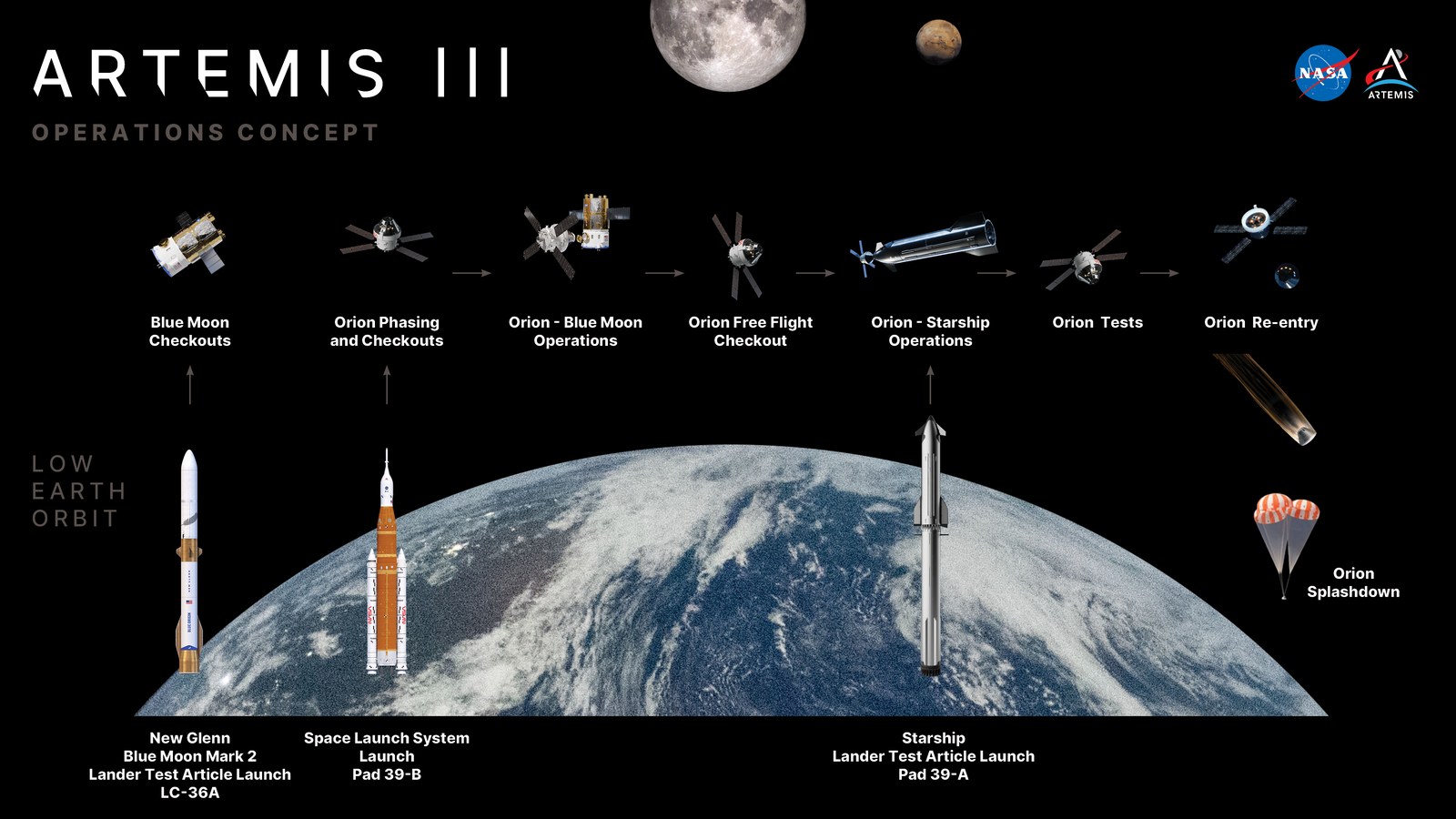
Artemis III will not land on the Moon; NASA moved the landing to 2028 back in February. On Oct. 23, the agency laid out how the crewed flight will instead spend about 14 days in low Earth orbit in 2027, docking Orion with test versions of the two commercial Moon landers before anyone tries to land on one.
From a landing to a rehearsal
Until this year, Artemis III was meant to be the first crewed Moon landing since Apollo 17 in 1972. On Feb. 27, NASA turned it into a test flight in Earth orbit and moved the landing to Artemis IV, planned for 2028. NASA called the new plan a more robust approach to testing. Associate Administrator Amit Kshatriya pointed to Apollo, where each flight built on the last, and said each step should be big enough to make progress but not so big that it takes unnecessary risk.
Neither lander has flown a crew yet. NASA says an Earth-orbit mission allows more launch opportunities for each of the three spacecraft, Orion and both landers, than a lunar mission, which raises the chance of overall success.
The crew, named June 9, is commander Randy Bresnik, pilot Luca Parmitano of the European Space Agency (ESA), and mission specialists Frank Rubio and Andre Douglas, who will focus on the landers. Europe also builds Orion's service module, which provides its propulsion, power, air and water.
Three rockets, two dockings
Blue Origin goes first, launching a test version of its Blue Moon Mark 2 lander into a circular orbit about 273 miles (439 km) up, where it can wait up to 30 days. Days later, once the lander checks out, NASA's SLS rocket lifts Orion from Kennedy Space Center. Orion is first placed on a temporary, lopsided path between 18 and 1,122 miles (29 and 1,806 km) high, whose low point is too deep in the atmosphere to last. Its European service module then reshapes it into a circular orbit about 345 miles (556 km) high before Orion closes in on the lander.

After two days of checks in orbit, Orion docks at a port beside Blue Moon's crew cabin. The astronauts open the hatch and spend about two days inside, testing the controls and life support and making sure the cabin holds pressure.
Then Orion undocks, and SpaceX launches a Starship Version 3 test vehicle from Florida into a lower orbit, about 237 miles (382 km) up. Orion then docks nose-first to a docking system at Starship's tip, in a test expected to last up to two hours. Nobody goes inside: the test is about how the two spacecraft fly while joined, communicate and separate.
What the crew will learn
NASA wants to see how the software, guidance and radios on Orion and a commercial lander work together, and how mission control coordinates three spacecraft from three different teams in one mission. Blue Moon carries many of the avionics, flight controls and life-support systems planned for the real lander, so this is the first time those systems will run together in space.
With the dockings done, Orion has up to five more days for other tests: spacesuits, docking sensors, noise and temperature measurements, a cell biology experiment, and a trial of how astronauts could check their own health without help from Earth. The flight ends with a splashdown in the Pacific off California.
What is decided and what is not
Artemis II is done: four astronauts flew around the Moon and back from April 1 to 10, 2026. Artemis III is set for 2027 but has no launch date yet. NASA says the Artemis IV landing near the Moon's south pole will come in 2028, but has not said which lander it will use.
Much of this is still a plan. The mission depends on two landers that are not finished yet, and the Planetary Society has noted that if either is not ready, Artemis III could slip. NASA has not published any viewing information. Whether the spacecraft could be seen from the ground, as moving points of light after dusk or before dawn like the space station, depends on how steeply their orbits are tilted to the equator, which sets how far north and south of it they pass, and NASA has not announced the tilt either.
Sources and licences
- NASA, NASA's Artemis III Mission to Test Future Moon Lander Operations (Oct. 23, 2026) — Used for the crew and the 14-day plan in low Earth orbit, the 2028 landing near the south pole, the Blue Moon orbit (273 miles, 237 nautical miles; 439 km) and its 30 days on orbit, Orion's first orbit (18 x 1,122 miles) and circular orbit (345 miles, 300 nautical miles), the two days of checks, the docking beside Blue Moon's cabin, about two days inside the lander, Starship Version 3 at 206 nautical miles (our conversion: 237 miles, 382 km) in a docking test of up to two hours with no crew entry, the tests in the last five days and the splashdown off California. https://www.nasa.gov/missions/artemis/nasas-artemis-iii-mission-to-test-future-moon-lander-operations/
- NASA, NASA Adds Mission to Artemis Lunar Program, Updates Architecture (Feb. 27, 2026) — Used for the date of the change, the landing moving to Artemis IV in 2028, and Amit Kshatriya's reasoning. https://www.nasa.gov/news-release/nasa-adds-mission-to-artemis-lunar-program-updates-architecture/
- NASA, NASA Outlines Preliminary Artemis III Mission Plans (updated May 15, 2026) — Used for NASA's statement that the Earth-orbit mission allows more launch opportunities for each vehicle than a lunar mission, increasing overall mission success, and for the hero graphic (credit NASA). https://www.nasa.gov/missions/artemis/artemis-3/nasa-outlines-preliminary-artemis-iii-mission-plans/
- ESA, ESA astronaut Luca Parmitano assigned as Artemis III pilot (June 9, 2026) — Used for the crew roles and the European Service Module's role. https://www.esa.int/Newsroom/Press_Releases/ESA_astronaut_Luca_Parmitano_assigned_as_Artemis_III_pilot
- The Planetary Society, What we know about Artemis III: NASA announces crew (June 9, 2026) — Used for the crew announcement date and the risk that a late lander could delay Artemis III. https://www.planetary.org/articles/what-we-know-about-artemis-iii-nasa-announces-crew
- NASA, Artemis I and Artemis II mission pages — Used for Artemis I (launched Nov. 16, 2022, splashdown Dec. 11, 2022, no crew) and Artemis II (launched April 1, 2026, splashdown April 10). https://www.nasa.gov/mission/artemis-i/ https://www.nasa.gov/mission/artemis-ii/